Table of Contents
Bordeaux is not merely a wine region; it is the global benchmark for viticultural harmony. While other prestigious regions like Burgundy focus on the singular expression of a lone grape, Bordeaux has built its thousand-year reputation on the philosophy of the assemblage.
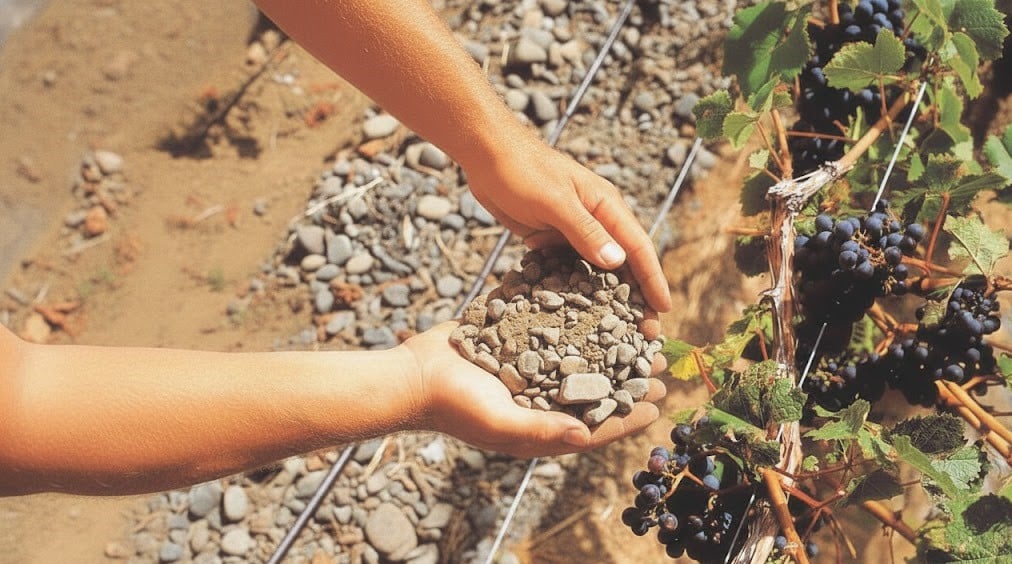
The region’s identity is defined by the tension between its maritime climate and its diverse soils—a combination so unpredictable that relying on a single variety would be a gamble few could afford. Instead, Bordeaux has mastered the art of the blend, a meticulous process where the whole invariably becomes greater than the sum of its parts.
Step Out of the History Books and Into the Cellar
The Philosophy of the Bordeaux Assemblage: Artistry in Balance
In Bordeaux, blending is the winemaker’s most critical tool. It is both a practical necessity and a pursuit of aesthetic perfection. Because the region sits near the Atlantic, it is prone to vintage variability—heavy rains, late frosts, or humid summers. By planting multiple varieties that bud and ripen at different times, a château ensures that even if one grape struggles, another will thrive.
The Architecture of a Blend
To understand the architecture of a Bordeaux blend is to understand the construction of a sensory masterpiece. It is not a random mixing of juices, but a calculated assembly of structural components: skeleton, flesh, and ornament. The “skeleton” is almost always provided by Cabernet Sauvignon. Its thick skins contribute the high tannin and acidity that create the verticality of the wine—the “frame” that allows it to stand upright and endure decades of aging. Without these architectural bones, the wine would collapse under its own weight over time.
The “flesh” is the domain of Merlot. If Cabernet is the bone, Merlot is the muscle and skin. It provides the horizontal dimension of the wine—the mid-palate volume, the succulent fruit, and the velvety texture that fills the gaps in the Cabernet’s rigid structure. It rounds out the “shoulders” of the wine, making it approachable and hedonistic.
Finally, the “ornamentation” comes from the accessory grapes. Cabernet Franc acts as the aromatic bridge, adding a “high-toned” lift of violets and spice that brings elegance to the deeper fruit notes. Petit Verdot is the “architectural seasoning,” used in tiny percentages (often just 1–5%) to deepen the color and provide a structural “snap” to the finish with its vigorous tannins and spicy character.
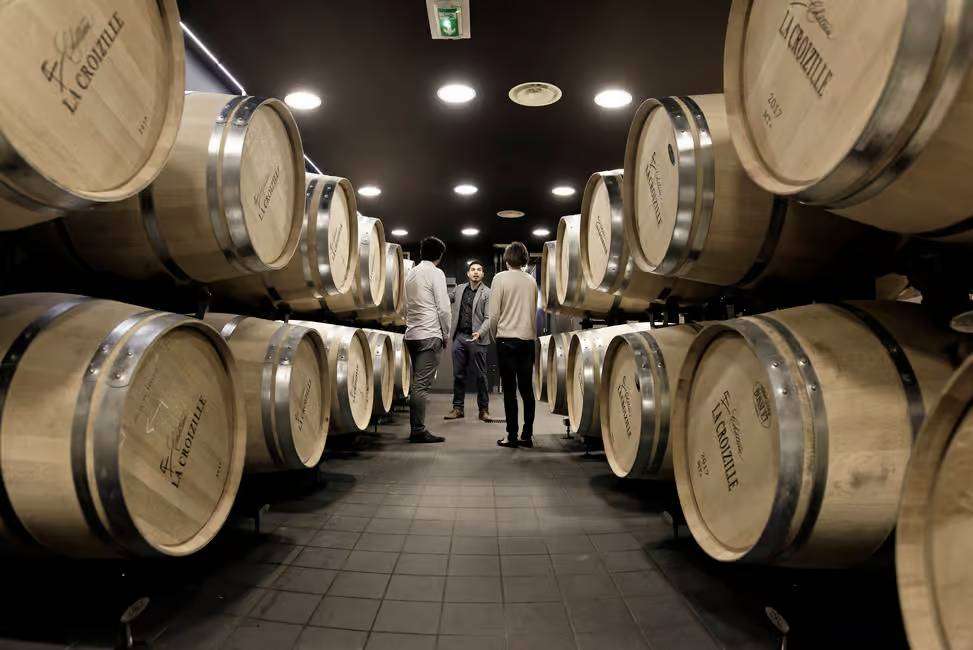
When a winemaker sits down to create a “Grand Vin,” they are balancing these dimensions. The ritual begins in the cellar during the winter months, where winemakers and consultants taste through dozens of individual lots, separated by grape variety, vine age, and specific vineyard plots (terroir). This selection process is what maintains the legendary status of Bordeaux; it is a quest for balance where acidity, tannin, alcohol, and fruit are knit together into a seamless tapestry. Anything that doesn’t meet the rigorous standard for complexity and aging potential is relegated to a “Second Wine,” ensuring that the flagship label remains an uncompromising expression of the estate’s peak potential.
The Red Varieties: The Pillars of Power
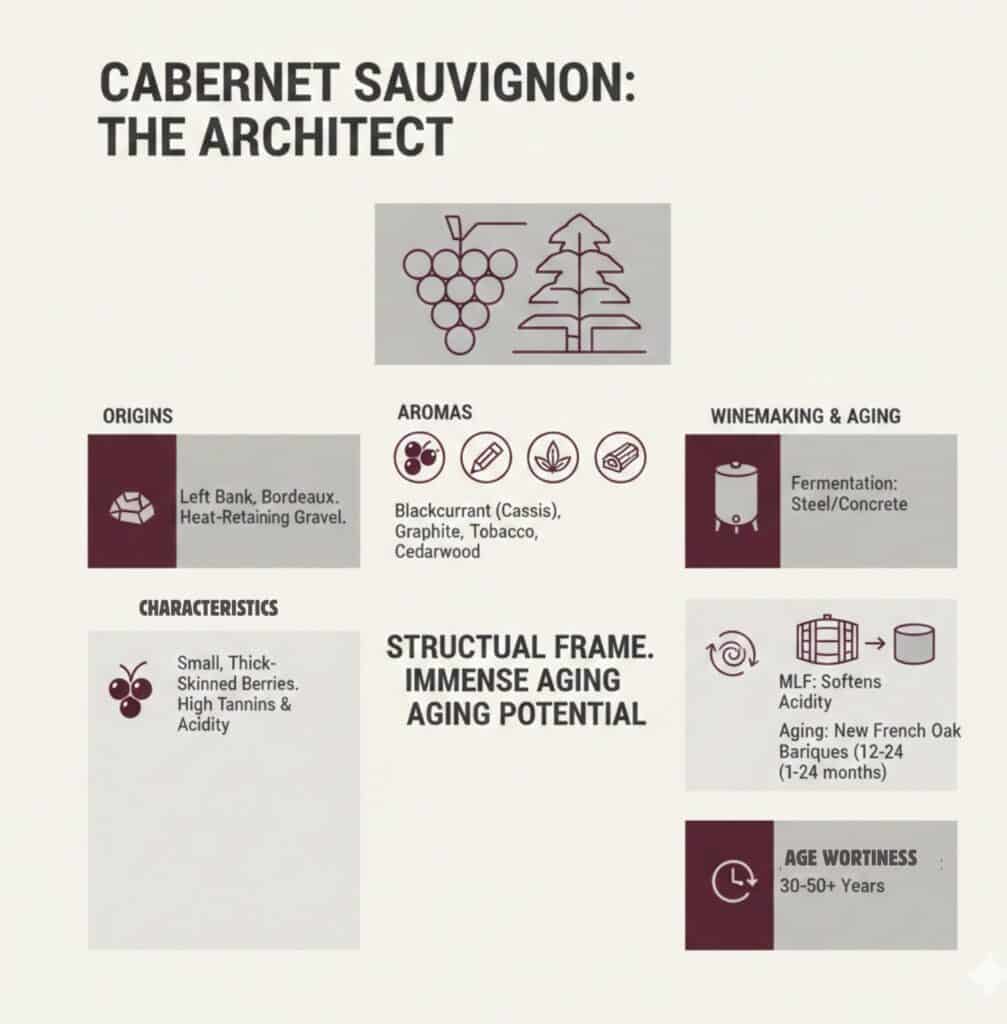
Cabernet Sauvignon: The Architect
Known as the “King of the Left Bank,” this variety thrives in the heat-retaining gravel of the Médoc and Graves.
Characteristics:
Small, thick-skinned berries resulting in high tannins and acidity. Aromas: blackcurrant (cassis), graphite, tobacco, and cedarwood.
The Role: Provides the structural frame and immense aging potential.
Winemaking & Styles:
Fermentation: Usually conducted in temperature-controlled stainless steel or concrete vats to manage extraction.
Malolactic Fermentation: This process is systematically completed for red Bordeaux to soften harsh malic acids into smoother lactic acids, providing microbiological stability.
Aging: Highly receptive to New French Oak. Premium styles spend 12–24 months in small oak barrels (barriques), which integrates tannins and adds spice, toast, and vanilla.
Age-worthiness: Exceptional; top examples can evolve for 30–50 years or more.
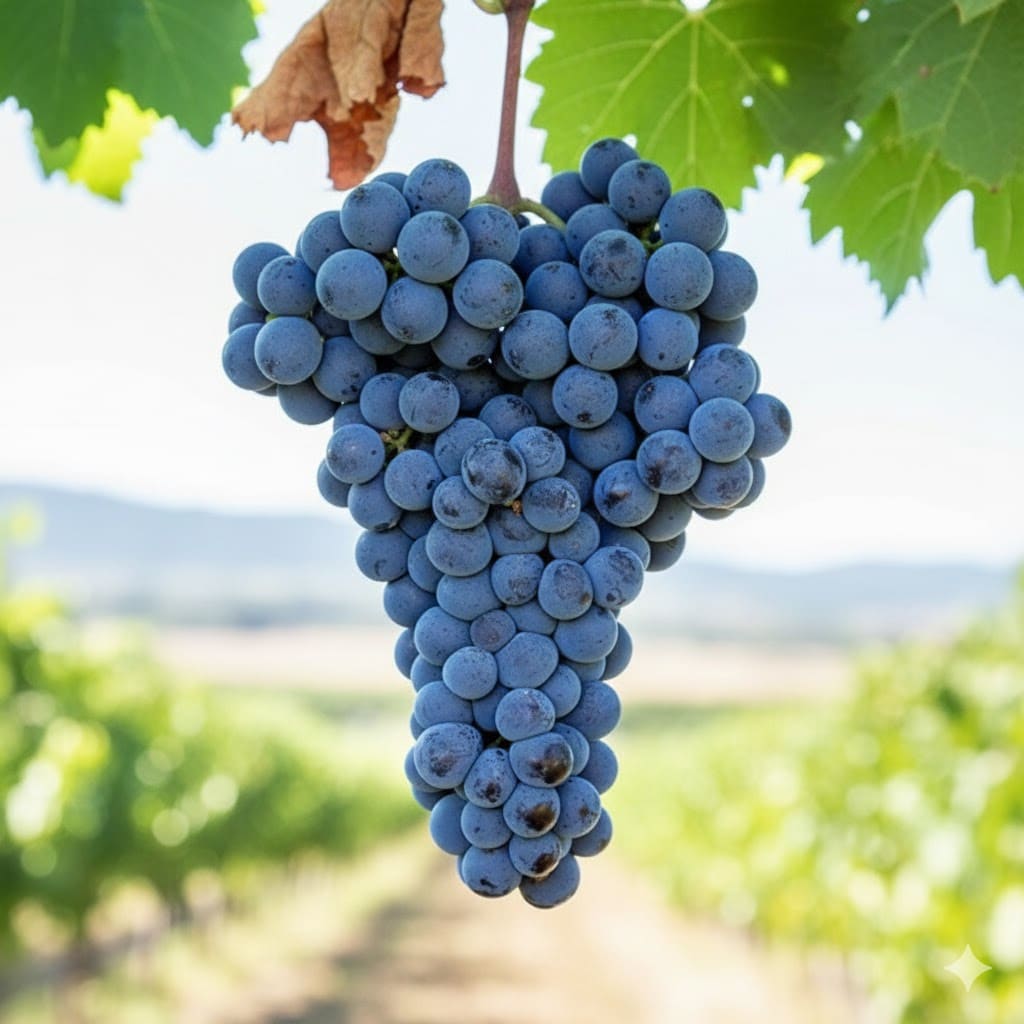
Merlot: The Velvet Heart
The most widely planted grape, dominant on the Right Bank (Saint-Émilion, Pomerol) where clay and limestone prevail.
Characteristics:
Thinner skins than Cabernet; lower tannin and acidity but higher potential alcohol. Aromas: plum, black cherry, chocolate, and truffle.
The Role: Adds mid-palate “flesh,” sweetness, and softness.
Winemaking & Styles:
Fermentation: Often involves shorter maceration times compared to Cabernet to avoid over-extracting bitter tannins from the seeds.
Malolactic Fermentation: Always completed to enhance the round, velvety mouthfeel.
Aging: Frequently aged in oak, though Right Bank producers may use a lower percentage of new oak to preserve the delicate, plush fruit profile.
Age-worthiness: High (10–25 years), though it becomes approachable much earlier than Cabernet-dominant wines.
Cabernet Franc: The Aromatic Lift
A crucial partner on the Right Bank, prized for its elegance and ability to ripen in cooler soils.
Characteristics:
Lighter body and thinner skin than Cabernet Sauvignon. Aromas: violets, red raspberry, and a distinct “stony” or “pencil shavings” minerality.
The Role: Provides freshness, aromatic lift, and floral complexity.
Winemaking & Styles:
Fermentation: Handled gently with lower temperatures to preserve volatile aromatic compounds.
Malolactic Fermentation: Completed to ensure the wine is supple and stable.
Aging: Some estates prefer large wooden vats or used oak to ensure the delicate perfume isn’t overwhelmed by heavy wood influence.
Age-worthiness: Excellent; it provides the “vibrant” spine that allows Right Bank blends to age with grace.
Malbec: The Rustic Depth
Historically a major player in Bordeaux (locally known as Côt or Pressac), Malbec now serves as a prized blending component, particularly in the Côtes de Bourg and Blaye.
Characteristics:
Known for producing deeply pigmented, inky-colored wines. It features moderate tannins and lower acidity than Cabernet, with a flavor profile of brambly blackberry, plum, and hints of violets or tobacco.
The Role: It acts as a “bridge” in the blend, adding juice, rustic fruit intensity, and a dark, vibrant color that enhances the visual appeal and mid-palate of the wine.
Winemaking & Styles:
Fermentation: Often fermented in stainless steel or concrete to preserve its signature “brambly” fruit and spice.
Malolactic Fermentation: Always completed. This is crucial for Malbec to transform its rustic edges into a smoother, more integrated texture.
Aging: Generally aged in used oak or for shorter durations in new oak; this prevents the delicate, spicy fruit from being masked by aggressive wood tannins.
Age-worthiness: Moderate to High (10–15 years). While it ages well, it is often valued for the color and richness it contributes to the wine in its earlier years of development.
Petit Verdot: The Architectural Seasoning
A thick-skinned, late-ripening variety that provides intense color, tannin, and a spicy edge to the finest Bordeaux blends.
Characteristics:
Known for its deep violet hue and powerful tannic structure. Aromatically, it offers concentrated notes of black fruits, violet, leather, and distinctive black pepper spice.
The Role: It acts as the “salt and pepper” of the blend, adding muscle, depth of color, and a structural “snap” that bolsters the finish.
Winemaking & Styles:
Fermentation: Requires high temperatures to fully extract its phenolic richness, usually conducted in stainless steel or oak vats.
Malolactic Fermentation: Always completed to integrate its robust tannins and ensure a stable, harmonious mouthfeel.
- Aging: Highly compatible with New French Oak, which helps to soften its naturally aggressive tannins over a period of 12–18 months
- Age-worthiness: Exceptional; its high tannin and acidity contribute significantly to the long-term structural integrity and evolution of the wine.
Carménère: The Lost Jewel of Bordeaux
Once a dominant variety in the Médoc and Graves, Carménère is often called the “Lost Bordeaux.” After the phylloxera plague of the 19th century, it was largely abandoned in France due to its difficulty to grow, only to be famously rediscovered in Chile a century later. Today, a handful of prestigious estates are bringing it back to its original home.
Characteristics:
It is a late-ripening variety that demands a long, warm season. It produces wines of a deep crimson color (from which its name, carmin, is derived) with a medium body and velvety tannins. Aromatically, it is a powerhouse of dark chocolate, tobacco, and black cherry, with a signature “green” edge of peppercorn or grilled chili if not fully ripe.
The Role: In a blend, Carménère is the “exotic top-note.” Usually added in tiny quantities (1–4%), it provides a savory complexity and a lush, generous mouthfeel that bridges the gap between the spice of Cabernet Sauvignon and the fruit of Merlot.
Winemaking & Styles:
Fermentation: Requires precise temperature control; winemakers often push for full phenolic ripeness to ensure the herbal notes are integrated and “sweet” rather than bitter.
Malolactic Fermentation: Always completed. This is essential to soften its natural bite and enhance its opulent, velvety texture.
Aging: It has a natural affinity for New French Oak, which complements its cocoa and tobacco notes. It is often aged for 14–18 months to allow its firm tannins to polymerize and soften.
Age-worthiness: High (10–20 years). While it provides immediate aromatic intensity, its structural balance allows it to develop beautiful secondary notes of leather and dried earth over time.
The White Varieties: Freshness and Opulence
Sémillon: The Golden Soul
The core of Bordeaux’s greatest dry and sweet white wines.
Characteristics:
Thin-skinned and highly susceptible to Botrytis cinerea (noble rot). Aromas: honey, beeswax, apricot, and toasted nuts.
The Role: Provides weight, texture, viscous mouthfeel, and longevity.
Winemaking & Styles:
Dry Style: Often fermented in oak barrels with “lees stirring” (bâtonnage) to build a creamy, oily texture. Malolactic fermentation is usually blocked to maintain essential acidity and freshness.
Sweet Style (Sauternes): Fermented and aged in new oak. The high sugar content and botrytis character create a lusciously thick consistency.
Age-worthiness: Very high; develops complex secondary notes of ginger, lanolin, and dried fruit after a decade in the bottle.
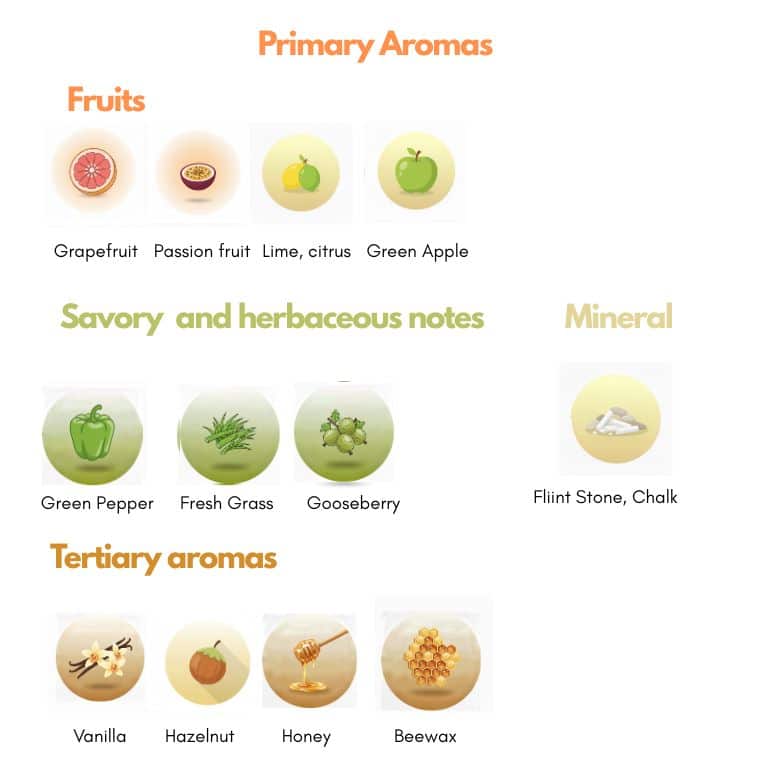
The aomatic spectral of Sauvignon Blanc
Sauvignon Blanc: The Spark of Energy
Provides the essential “nervosity” and acidity to balance Sémillon’s richness.
Characteristics:
Naturally high acidity. Aromas: citrus zest, green apple, white peach, and “gunflint” minerality.
The Role: The “spark” that keeps the blend fresh, energetic, and salivating.
Winemaking & Styles:
Fresh Style: For regional Entre-deux-Mers, it is often fermented in stainless steel tanks at cool temperatures to lock in zesty fruit and “crispness.”
Premium Style: In Pessac-Léognan, it is often barrel-fermented alongside Sémillon for greater complexity.
Malolactic Fermentation: Almost always blocked in white Bordeaux to keep the acidity piercing and bright.
Age-worthiness: Moderate (3–7 years) unless blended with Sémillon, which significantly extends its life.
Muscadelle: The Fragrant Top-Note
Used in small amounts for its floral intensity and grapey sweetness.
Characteristics:
Highly aromatic with a musky, floral profile.
The Role: Adds a subtle perfume and “lift” to the finish of white blends.
Winemaking & Styles:
Technique: Generally treated like Sauvignon Blanc; kept in stainless steel tanks to preserve primary floral notes. Malolactic fermentation is blocked to preserve its delicate aromatics. It is rarely the star, usually acting as an aromatic “seasoning” at 1–5% of the blend.
Sauvignon Gris: The Exotic Cousin
A pink-skinned mutation of Sauvignon Blanc, Sauvignon Gris was nearly extinct in Bordeaux until a recent revival led by top estates seeking more texture and complexity. It is prized for being less “green” and more “opulent” than its more famous relative.
Characteristics:
It produces wines with a richer, more viscous texture and higher sugar potential. Aromatically, it leans toward the exotic—think pink grapefruit, lychee, mango, and white blossoms—with a subtle smokiness and less of the aggressive herbal “grassiness” found in Sauvignon Blanc.
The Role: In a white blend, Sauvignon Gris provides “weight and perfume.” It acts as a bridge between the high-acid Sauvignon Blanc and the round, waxy Sémillon. Even in small percentages, it adds a luxurious, oily mouthfeel and an extra layer of aromatic sophistication.
Winemaking & Styles:
Fermentation: Often undergoes skin contact (maceration) before fermentation to extract its unique aromatic precursors from the pink skins.
Malolactic Fermentation: Almost always blocked in Bordeaux. Like Sauvignon Blanc, it relies on its natural acidity to remain balanced, and preventing this fermentation ensures the exotic fruit notes stay bright.
Aging: It has a fantastic affinity for oak aging and lees stirring. This builds a creamy, smoky profile that complements its natural tropical fruit flavors.
Age-worthiness: Moderate to High (5–12 years). Thanks to its phenolic richness and concentration, it tends to age more gracefully and gain more complexity over time than a standard Sauvignon Blanc.
Colombard: The Energetic Workhorse
Historically the backbone of distillation in nearby Cognac, Colombard holds a steady, traditional presence in Bordeaux, particularly in the northern appellations of Blaye and Bourg. It is valued for its hardiness and its ability to maintain high levels of natural energy even in warmer growing seasons.
Characteristics:
It is a high-yielding variety that produces light-bodied, crisp wines. Its aromatic profile is dominated by piercing citrus (lemon and lime), green apple, and white peach, occasionally leaning toward tropical notes of passionfruit when fully ripe. It is prized for its high natural acidity and lean, refreshing palate.
The Role: In a Bordeaux blend, Colombard acts as a “booster of freshness.” It is used primarily in regional Bordeaux Blanc and Entre-deux-Mers to lift the aromatic profile and provide a zesty, thirst-quenching character. It serves as a cost-effective and reliable partner to Sauvignon Blanc.
Winemaking & Styles:
Fermentation: Almost exclusively fermented in temperature-controlled stainless steel tanks at very cool temperatures. This process is essential to lock in its volatile primary fruit aromas and prevent oxidation.
Malolactic Fermentation: Strictly blocked. Since the primary goal of Colombard is to provide crispness and “crunchy” fruit, winemakers avoid the softening effects of malolactic fermentation.
Aging: Rarely sees any oak. It is typically aged for a short period on its fine lees in tank to add a touch of mid-palate roundness before being bottled early to preserve its “vivid” personality.
Age-worthiness: Low to Moderate (1–3 years). Colombard is designed for immediate enjoyment; it is at its best when its acidity is at its most vibrant and its fruit is at its peak of freshness.
Ugni Blanc: The Acidic Backbone
Widely known as Trebbiano in Italy, Ugni Blanc is a historic workhorse in Southwest France. While its primary fame lies in the production of Cognac and Armagnac, in Bordeaux it serves as a vital structural component for dry white blends, valued for its reliability and its naturally high resistance to vine diseases.
Characteristics:
It is a late-budding and high-yielding variety that produces wines with a pale color and a light body. Its profile is relatively neutral compared to Sauvignon Blanc, offering subtle notes of green apple, lemon peel, and wet stone. Its greatest asset is its sharp, unwavering acidity and low sugar accumulation, which provides a refreshing “lean” profile.
The Role: In a Bordeaux blend, Ugni Blanc acts as the “structural balancer.” It is rarely the star of the show but is used to heighten the total acidity of a blend and provide a clean, neutral canvas that allows the more aromatic grapes like Sauvignon Blanc or Muscadelle to shine. It ensures the wine remains light, bright, and thirst-quenching.
Winemaking & Styles:
Fermentation: Fermented at low temperatures in stainless steel tanks to maintain its delicate, clean fruit profile and prevent any heavy or “baked” flavors.
Malolactic Fermentation: Strictly blocked. Preserving the natural malic acid is essential for Ugni Blanc, as its primary purpose is to provide the “spine” of acidity that keeps the final blend lively.
Aging: Almost never aged in oak. It is kept in tank and bottled quickly to maintain its youthful “snap.” Occasionally, it may spend a short time on fine lees to add a subtle hint of texture to its otherwise linear frame.
Age-worthiness: Low (1–2 years). Like Colombard, it is highly valued for its immediate freshness and is intended to be consumed while its acidic profile is at its most energetic.
Merlot Blanc: The Rare Heritage Variety
Not to be confused with a “White Merlot” (which is a rosé), Merlot Blanc is a distinct genetic crossing between Merlot and Folle Blanche. Once widely planted across the region, it is now a rare find, cherished by traditionalist producers for its unique historical profile and its ability to produce soft, easy-drinking white wines.
Characteristics:
It produces medium-bodied wines with relatively low acidity and moderate alcohol. Its aromatic profile is subtle and delicate, featuring notes of white flowers, wild honey, and ripe pear, often accompanied by a distinct “creamy” or herbaceous undertone. It lacks the sharp, high-key aromatics of Sauvignon Blanc, leaning instead toward a more muted, rounded elegance.
The Role: In a Bordeaux blend, Merlot Blanc acts as a “softener.” Much like its red counterpart, it is used to round out the sharp edges of more acidic varieties. It adds a gentle mid-palate weight and a floral softness to regional Bordeaux Blanc blends, making them more approachable and supple in their youth.
Winemaking & Styles:
Fermentation: Usually fermented in stainless steel tanks at moderate temperatures to preserve its delicate floral esters while building a bit more body.
Malolactic Fermentation: Generally blocked to preserve what little natural acidity the grape possesses, though some producers allow a partial fermentation to enhance its naturally creamy texture.
Aging: Almost exclusively aged in tank for a short duration. It does not typically require oak, as its charm lies in its simple, clean, and floral primary fruit.
Age-worthiness: Low (1–2 years). Merlot Blanc is a “pleasure” grape meant to be consumed fresh. Over time, its delicate floral notes fade, so it is rarely intended for the cellar.
Mauzac: The Rustic Heritage Variety
Though more famously associated with the wines of Limoux, Mauzac (specifically Mauzac Blanc) maintains a tiny, historic foothold in Bordeaux. It is a late-ripening variety that was once a staple in southwestern France, valued for its ability to hold its character in diverse conditions and its distinct, rustic aromatic profile.
Characteristics:
Mauzac is visually distinct for its downy leaves and late harvest window. It produces wines with moderate acidity and a highly idiosyncratic aromatic profile dominated by dried apple skin, honeycomb, and autumnal orchard fruits. Unlike the citrus-heavy Sauvignon Blanc, Mauzac offers a more “earthy” or savory fruit character that becomes increasingly honeyed as the grapes ripen.
The Role: In a Bordeaux blend, Mauzac acts as a “textural anchor.” While it is rarely found in modern mainstream blends, where it does exist, it adds a unique savory depth and a rustic complexity. It provides a different kind of “weight” than Sémillon—one that is less oily and more focused on skinsy, dried-fruit flavors, often used to add character to regional Bordeaux Blanc.
Winemaking & Styles:
Fermentation: Generally fermented in stainless steel or old wooden vats. Winemakers often use slightly warmer fermentation temperatures than they would for Sauvignon Blanc to encourage the development of its signature apple and honey notes.
Malolactic Fermentation: Usually blocked to maintain the grape’s natural structure, though in cooler years, a partial fermentation may be used to integrate its rustic edges.
Aging: Often kept on its fine lees for several months. While it can handle neutral oak, it is most frequently aged in tank to preserve the purity of its “fallen apple” aromatics.
Age-worthiness: Moderate (2–5 years). Mauzac is surprisingly resilient; while it is often enjoyed young for its unique fruit, its firm structure allows it to hold its profile longer than more delicate varieties like Merlot Blanc.
The New “Climate Change” Varieties
In 2021, the INAO (Institut National de l’Origine et de la Qualité or National Institute of Origin and Quality) officially approved six new varieties to help winemakers adapt to rising temperatures. These are currently limited to Bordeaux and Bordeaux Supérieur appellations. They can only make up 5% of a producer’s vineyard area and 10% of the final blend.
New Reds:
Touriga Nacional: The superstar of Portugal (Port). Late-ripening and heat-resistant, it adds incredible structure and floral aromatics.
Marselan: A cross between Cabernet Sauvignon and Grenache. It produces deeply colored, full-bodied wines with supple tannins.
Castets: A “forgotten” local variety that is highly resistant to mildew and creates deeply colored, age-worthy wines.
Arinarnoa: A cross between Cabernet Sauvignon and Tannat. It buds late (avoiding frost) and maintains high acidity and tannins.
New Whites:
Alvarinho (Albariño): Famous in Spain and Portugal. It maintains high acidity even in heat and offers intense aromatic qualities.
Liliorila: A cross between Baroque and Chardonnay. It is highly aromatic and powerful, helping to compensate for flavor loss in hot vintages.
Conclusion: A Legacy of Complexity
Bordeaux is a region where the vineyard is a palette and the winemaker is a painter. By utilizing this diverse cast of grapes—from the structural might of Cabernet Sauvignon to the honeyed richness of Sémillon—Bordeaux creates wines that are not just drinks, but evolving stories in a bottle.