Table of Contents
Mastering the Burgundy Wine Region: Official AOC & Sub-Regional Hierarchy An Authoritative Technical Breakdown of the Côte d’Or, Mâconnais, Chablis and Beaujolais.
The viticultural landscape of Burgundy is a complex mosaic of history, geology, and strict legal frameworks designed to protect the concept of terroir. Unlike many other wine regions that classify by brand or estate, Burgundy classifies the land itself. Governed by the Bourgogne Wine Board (BIVB) and the INAO, this hierarchy ensures that every bottle reflects its precise origin—from the regional “Bourgogne” wines that serve as the foundation to the legendary “Grand Cru” plots that represent the pinnacle of Pinot Noir and Chardonnay. This document serves as the authoritative guide to the region’s five primary sub-regions, its unique northern and southern satellites, and the integration of the granite-based terroirs of Beaujolais, providing a structured overview of the most prestigious AOC system in the world.
Pinnacle of Pinot Noir and Chardonnay
Chablis and the Grand Auxerrois
The Chablis Hierarchy (Major Appellation)
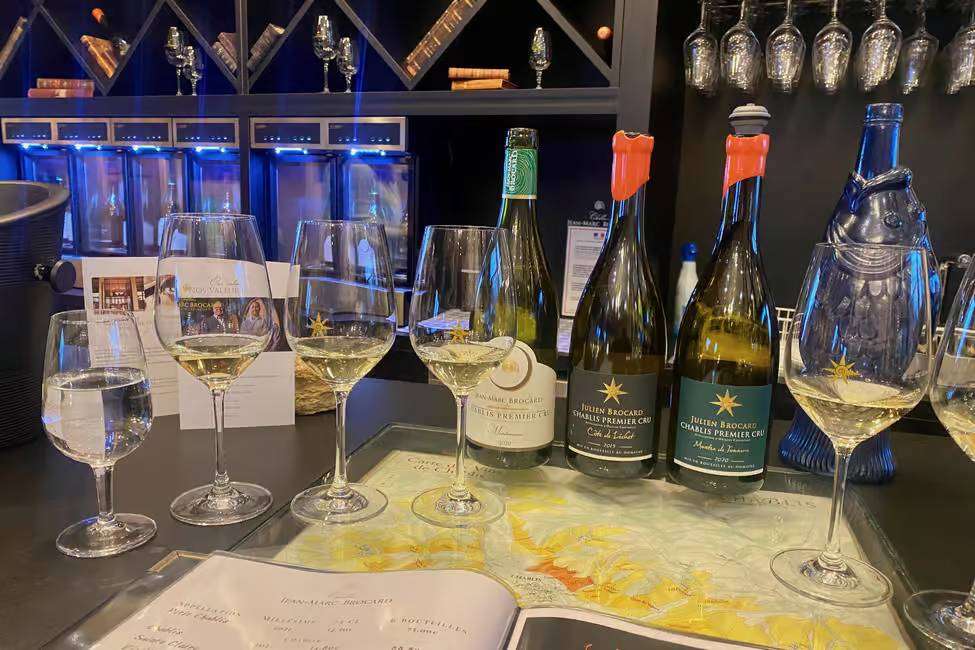
The Chablis district, located in the Yonne department, represents the northernmost vanguard of the Burgundy region. It is defined by a unique geological phenomenon: the Kimmeridgian chain. This ancient seabed, composed of limestone and marl rich in Exogyra virgula (fossilized oysters), provides the uncompromising mineral backbone for which Chablis is world-renowned. T
he authority strictly enforces a four-tier pyramid:
Petit Chablis
(Portlandian soil),
Chablis AOC
(Kimmeridgian slopes),
Chablis Premier Cru
(40 specific climats),
Chablis Grand Cru.
This hierarchy is not merely symbolic; it is a legal mandate reflecting the precise interaction between the Serein River’s microclimate and the slope’s exposure. The authority ensures that the term “Chablis” remains a protected trademark of purity, forbidding any chemical or structural alteration that would mask the “flinty” typicity of the terroir.
The Grand Auxerrois & Surrounds
The Grand Auxerrois encompasses a cluster of historic vineyards surrounding the city of Auxerre. This sub-region serves as a conservatory for Burgundy’s diversity, hosting appellations that challenge the Chardonnay-Pinot Noir duopoly. Irancy AOC, for instance, produces robust reds using the ancient César grape alongside Pinot Noir, while Saint-Bris AOC remains the only Burgundian enclave permitted to cultivate Sauvignon Blanc. These “satellite” appellations are governed by the same rigorous production standards as the central Côte d’Or. The authority recognizes these regions as vital to the genetic and historical heritage of Burgundy, providing a defensive depth to the region’s portfolio and offering varied expressions of cool-climate viticulture that are essential for the region’s overall market resilience.
The Côte d’Or (The Heartland) Côte de Nuits and Côte de Beaune
Côte de Nuits
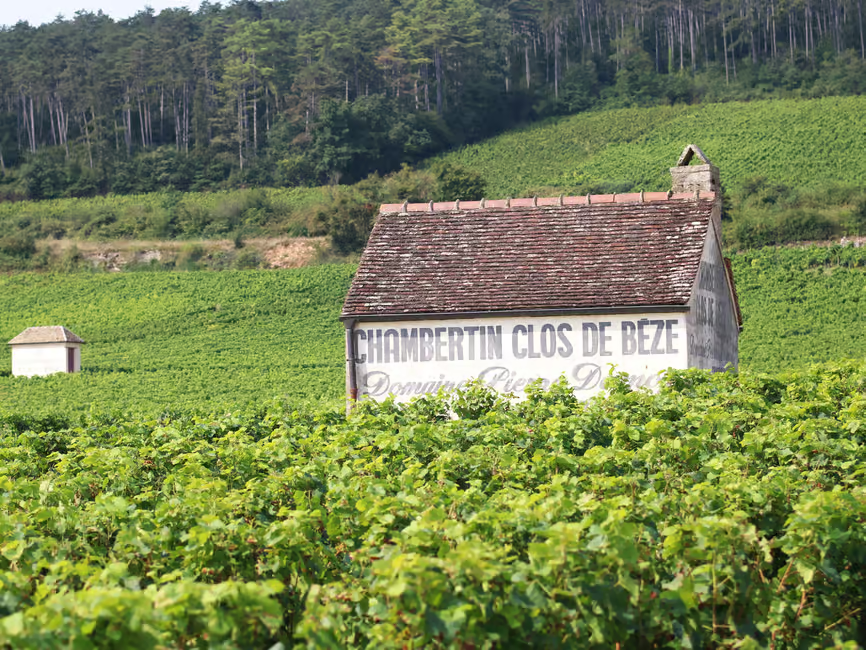
The Côte de Nuits is the spiritual and economic epicenter of Pinot Noir. Stretching from Dijon to Corgoloin, this narrow escarpment contains a concentration of Grand Cru vineyards found nowhere else on Earth. The authority views this region as the ultimate laboratory of “climat”—the concept that a few meters of soil can fundamentally alter the character of a wine. The geological foundation is Middle Jurassic limestone, which yields wines of immense structure, longevity, and aromatic complexity. The authority’s role here is primarily one of preservation: maintaining the ancient boundaries established by Cistercian monks. Every harvest is monitored to ensure that yields do not exceed the threshold that would dilute the concentration of these legendary “terroir” expressions, which represent the highest value-per-hectare agricultural land in the world.
The Communal Powerhouses: Gevrey-Chambertin, Vosne-Romanée, and Nuits-Saint-Georges (Major Appellation) These three communes represent the pinnacle of the Côte de Nuits. Gevrey-Chambertin, the “King of Burgundy,” is defined by power and iron-rich soils; Vosne-Romanée, the “Central Pearl,” is celebrated for its unmatched velvet texture and spice; Nuits-Saint-Georges serves as the sturdy commercial anchor of the south. The authority mandates that for a wine to bear these village names, it must display the specific organoleptic qualities associated with that commune’s geology. The regulations for these AOCs are among the strictest in the world, governing everything from vine density (minimum 10,000 vines per hectare) to the specific method of Guyot pruning. These villages are the benchmark against which all other Pinot Noirs are measured, and the authority treats any breach of protocol in these zones as a threat to the integrity of the entire French AOC system.
The Côte de Beaune
The Côte de Beaune, starting at the hill of Corton and extending south, is the global capital of dry white wine. While it produces world-class reds in Pommard and Volnay, its primary authority stems from the mastery of Chardonnay. The landscape here is more varied than in the north, with rolling hills and diverse limestone compositions that suit white viticulture. The city of Beaune itself acts as the administrative heart of the Burgundy trade. The authority oversees the “Hautes-Côtes de Beaune” as well, ensuring that the higher-altitude vineyards maintain the regional standard for freshness and acidity. This sub-region is a testament to the versatility of the Burgundian slope, where the subtle shift in a hill’s curve can dictate whether a plot is destined for a delicate white or a structural red.
The White Triad: Meursault, Puligny-Montrachet, and Chassagne-Montrachet (Major Appellation)
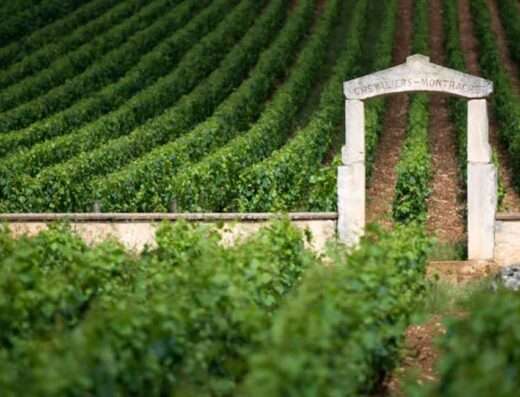
These three villages produce the most sought-after white wines in existence. Meursault is characterized by its richness and buttery depth; Puligny-Montrachet by its laser-like precision and floral elegance; and Chassagne-Montrachet by its power and fleshy fruit. The authority strictly polices the “Montrachet” designation, ensuring that only the specific Grand Cru vineyards shared between Puligny and Chassagne use the name in its purest form. The regulations focus heavily on the preservation of the “white” limestone soils, which are fragile and finite. To maintain the prestige of these AOCs, the authority enforces long aging requirements and restricts the use of irrigation, forcing the vines to delve deep into the bedrock to extract the minerals that define the “Montrachet” style. These appellations are the gold standard for barrel-fermented Chardonnay globally.
The Southern appelations Mâconnais, Côte Chalonnaise and Beaujolais
Côte Chalonnaise
The Côte Chalonnaise represents the continuation of the Burgundy limestone vein, but with a more fragmented, undulating topography. It is home to five village AOCs: Bouzeron, Rully, Mercurey, Givry, and Montagny. The authority recognizes this region for its artisanal integrity and its role in providing high-quality Burgundy that remains accessible. While it lacks Grand Cru sites, its Premier Crus—particularly in Mercurey and Rully—are held to nearly the same analytical standards as those in the Côte d’Or. The authority ensures that these wines maintain their “Burgundian” identity, characterized by vibrant acidity and restrained fruit, acting as a critical bridge between the northern prestige and the warmer southern influence of the Mâconnais.
Mâconnais
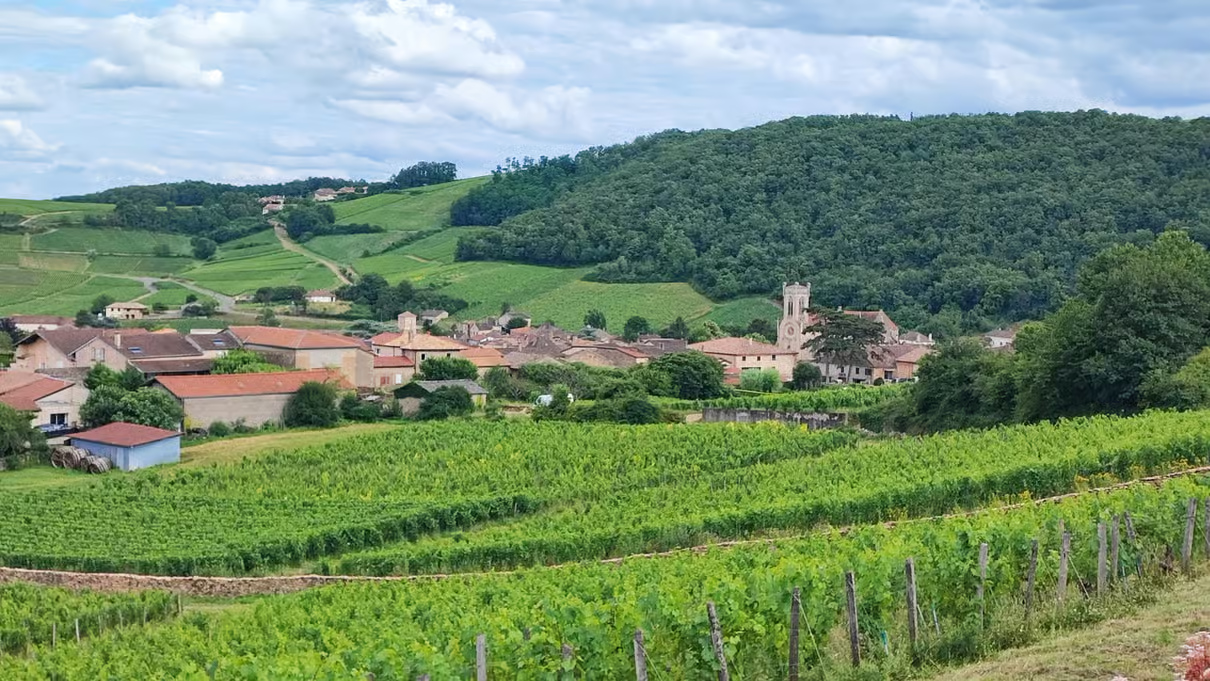
The Mâconnais is the southern gateway of Burgundy, where the climate begins to transition toward a Mediterranean influence. This is a land of rolling hills dominated by the Chardonnay grape. The authority oversees a complex hierarchy here, from the broad Mâcon-Villages AOC to the highly prestigious “Pouilly” group. In a historic move, the authority recently approved the elevation of specific sites in Pouilly-Fuissé to Premier Cru status, reflecting decades of soil analysis and quality consistency. This region is the engine of Burgundian white wine production, and the authority’s mandate here is to balance high volume with the “terroir-driven” philosophy that defines the region, ensuring that even the most affordable Mâcon wine reflects the limestone heritage of the north.
Beaujolais
Beaujolais, while administratively part of the Burgundy region, represents a distinct geological and viticultural departure. Unlike the limestone-dominant north, Beaujolais is defined by its pink granite and schist soils, which are perfectly suited to the Gamay Noir à Jus Blanc grape. The authority manages a three-tier hierarchy: Beaujolais AOC, Beaujolais-Villages, and the 10 “Crus” of Beaujolais. While historically famous for “Nouveau” wines, the authority is currently refocusing global attention on the “Cru” level, where wines of significant depth and aging potential are produced. The management of Beaujolais requires a specific set of regulations regarding “whole-bunch fermentation” and “carbonic maceration,” techniques that are unique to this sub-region within the broader Burgundy framework.
The 10 Crus of Beaujolais: Moulin-à-Vent, Morgon, and Fleurie (Major Appellation)
The 10 Crus represent the elite volcanic and granitic slopes of the northern Beaujolais. Moulin-à-Vent is the “King,” known for its structure and ability to age like a fine Côte de Nuits red; Morgon, particularly from the “Côte du Py,” offers powerful, earthy expressions; Fleurie provides the floral, elegant counterpoint. The authority mandates that these wines be produced from specific, delimited parcels that exclude the flatter, sandy plains of the south. The regulation of these Crus is vital for the region’s “premiumization” strategy. The authority ensures that these wines are distinct from the “Nouveau” image, enforcing traditional vinification methods that honor the unique granite terroir. These ten villages are the guardians of Gamay’s reputation as a noble and serious variety.
Burgundy wine appelations in a nutshell
Official Classification of the Burgundy & Beaujolais Wine Regions
Based on the official classification systems of the INAO (Institut National de l’Origine et de la Qualité), the BIVB (Bourgogne Wine Board), and Inter Beaujolais, here is the structured breakdown of the combined regions following the requested model.
1 Chablis & Grand Auxerrois
1.1 The Chablis Hierarchy
1.1.1 Petit Chablis AOC: Produced from the higher plateau areas with Portlandian soil.
1.1.2 Chablis AOC: The core appellation of the region, characterized by Kimmeridgian limestone.
1.1.3 Chablis Premier Cru AOC: Includes 40 specific climats (e.g., Fourchaume, Montée de Tonnerre).
1.1.4 Chablis Grand Cru AOC: A single AOC with seven official climats (Blanchot, Bougros, Les Clos, Grenouilles, Preuses, Valmur, and Vaudésir).
1.2 The Grand Auxerrois & Surrounds
1.2.1 Irancy AOC: Red wines primarily from Pinot Noir, often blended with the César grape.
1.2.2 Saint-Bris AOC: The only Burgundy AOC permitted for Sauvignon Blanc.
1.2.3 Vézelay AOC: Recently elevated (2017) to village status specifically for white wines.
2 The Côte d’Or (Heart of Burgundy)
2.1 Côte de Nuits (The Land of Red Grands Crus)
2.1.1 Regional/Sub-regional: Bourgogne Hautes-Côtes de Nuits AOC.
2.1.2 Notable Village AOCs: Marsannay, Fixin, Gevrey-Chambertin, Morey-Saint-Denis, Chambolle-Musigny, Vougeot, Vosne-Romanée, and Nuits-Saint-Georges.
2.1.3 Grand Cru AOCs: 24 of Burgundy’s 33 Grands Crus are here, including Romanée-Conti, Clos de Vougeot, and Chambertin.
2.2 Côte de Beaune (The Capital of White Grands Crus)
2.2.1 Regional/Sub-regional: Bourgogne Hautes-Côtes de Beaune AOC.
2.2.2 Notable Village AOCs: Aloxe-Corton, Beaune, Pommard, Volnay, Meursault, Puligny-Montrachet, and Chassagne-Montrachet.
2.2.3 Grand Cru AOCs: Includes Corton (red and white) and the Montrachet family of white wines.
3 The Southern Burgundy Regions
3.1 Côte Chalonnaise
3.1.1 The Five Village AOCs: Bouzeron (Aligoté only), Rully, Mercurey, Givry, and Montagny.
3.1.2 Note on Classification: This region contains numerous Premier Crus but currently has no Grand Cru appellations.
3.2 Mâconnais
3.2.1 Regional: Mâcon AOC and Mâcon-Villages AOC (includes 27 geographical denominations).
3.2.2 The “Pouilly” Village Group: Pouilly-Fuissé (now with Premier Crus), Pouilly-Vinzelles, and Pouilly-Loché.
3.2.3 Other Village AOCs: Saint-Véran and Viré-Clessé.
4 Beaujolais (The Granite Frontier)
4.1 Regional and Villages Appellations
4.1.1 Beaujolais AOC: The basic regional appellation, primarily for Gamay.
4.1.2 Beaujolais-Villages AOC: Sourced from 38 specific villages in the northern part of the region.
4.2 The 10 Crus of Beaujolais (The Elite Sites)
4.2.1 Saint-Amour AOC: Known for romantic marketing and lighter, floral profiles.
4.2.2 Juliénas AOC: Produces ancient, spicy reds with deep fruit character.
4.2.3 Chénas AOC: The smallest and rarest Cru, offering woodsy, floral notes.
4.2.4 Moulin-à-Vent AOC: Often called the “King of Beaujolais” for its power and aging potential.
4.2.5 Fleurie AOC: The “Queen of Beaujolais,” celebrated for its elegance and violet aromas.
4.2.6 Chiroubles AOC: Sourced from the highest altitudes, known for freshness and delicacy.
4.2.7 Morgon AOC: Famous for the “Côte du Py” and its ability to “morgonner” (age into a pinot-like profile).
4.2.8 Régnié AOC: The youngest Cru, recognized for aromatic, supple, and red-fruit-forward wines.
4.2.9 Brouilly AOC: The largest and southernmost Cru, producing vibrant and approachable wines.
4.2.10 Côte de Brouilly AOC: Produced on the volcanic slopes of Mount Brouilly, offering mineral depth.
5 Global Regional Appellations
These apply across the broader territory and form the base of the quality pyramid:
5.1.1 Bourgogne AOC: The general designation for Pinot Noir or Chardonnay.
5.1.2 Bourgogne Aligoté AOC: Specifically for the Aligoté grape variety.
5.1.3 Crémant de Bourgogne AOC: Sparkling wines made using the traditional method.
5.1.4 Coteaux Bourguignons AOC: A modern AOC that allows for blends, including Gamay and Pinot Noir.