Table of Contents
The name Greece immediately conjures the scent of salt-crusted Assyrtiko vines in the volcanic caldera of Santorini, the deep, spicy aromas of Xinomavro in the mist-heavy highlands of Naoussa, and the ancient, earthy resonance of wine aged in clay. To speak of Greek wine is to speak of the very foundation of European viticulture—a 6,500-year odyssey where every bottle is a liquid map of human civilization, soil, and spirit. From the prehistoric wine presses of Crete to the high-tech Oenopoiia of the modern era, the Hellenic vine has survived empires, plagues, and prohibitions to emerge as one of the most exciting frontiers in the global wine market today.


The Dawn of the Symposium: Minoan Foundations and the Golden Age (4500 BC – 146 BC)
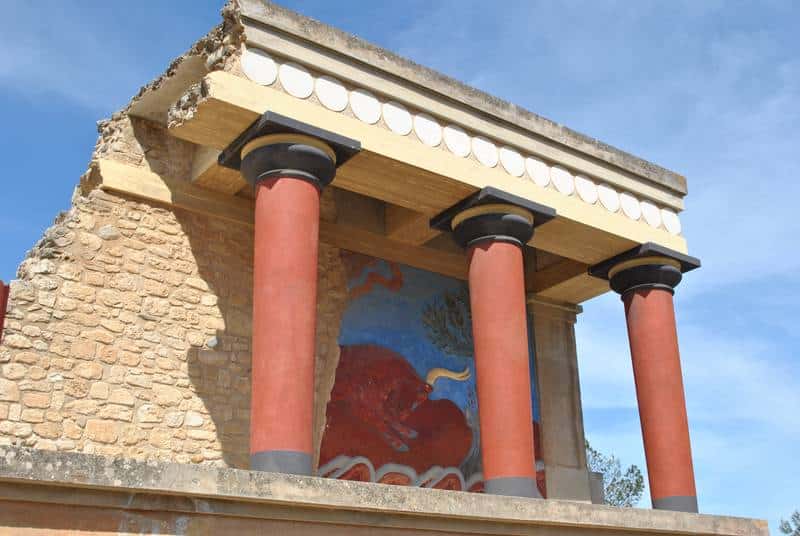
The narrative of the Hellenic vine begins in the Neolithic era, with carbonized grape pips found in Dikili Tash dating back to the 5th millennium BC. However, it was the Minoan and Mycenaean civilizations that first elevated viticulture to a cornerstone of economic and spiritual life. Excavations at the Palace of Knossos and Zakros revealed dedicated wine presses and vast storage magazines, where wine was treated as a sacred currency recorded on Linear B tablets. This was the era of the “Palatial Economy,” where the Ambelonas (vineyard) was a primary source of wealth and power, used for trade with the Pharaohs of Egypt and the kingdoms of the Levant.
By the Classical Period, the Greeks had transformed winemaking into a highly sophisticated trade that defined the Mediterranean power structure. This era birthed the Symposium—not merely a party, but a ritualized “gathering of drinkers” where philosophy, politics, and poetry were debated under the watchful eye of the Symposiarch. The Greeks were the first to identify that different soils produced different characters, leading to the creation of the world’s first Appellation system. City-states like Chios, Thasos, and Rhodes branded their pointed clay amphorae with official seals, guaranteeing the provenance and quality of the vintage. These ancient mariners were the primary “wine colonizers,” planting vineyards from Sicily to the shores of Southern France (Marseille), effectively seeding the future of Western viticulture.
The Krasis Philosophy: The Art of the Mixture
A critical element of this culture was the Krasis Philosophy. In Ancient Greece, the word for wine wasn’t Oenos (the liquid) but Krasi (the mixture). To drink undiluted wine (akratos oenos) was considered “barbaric,” a trait associated with the Scythians or those lacking self-control. Instead, wine was meticulously mixed with water in a large, ornate Kratiras (mixing bowl). The ratio—often three parts water to one part wine—was decided by the host based on the gravity of the discussion. This allowed for prolonged intellectual endurance, ensuring that the participants remained sharp enough for debate while the spirit of Dionysus loosened their tongues. This linguistic heritage remains today; modern Greeks still refer to wine as Krasi, a 2,500-year-old testament to the art of social moderation.
The "Koulara" of Santorini: A 3,000-Year Architectural Feat
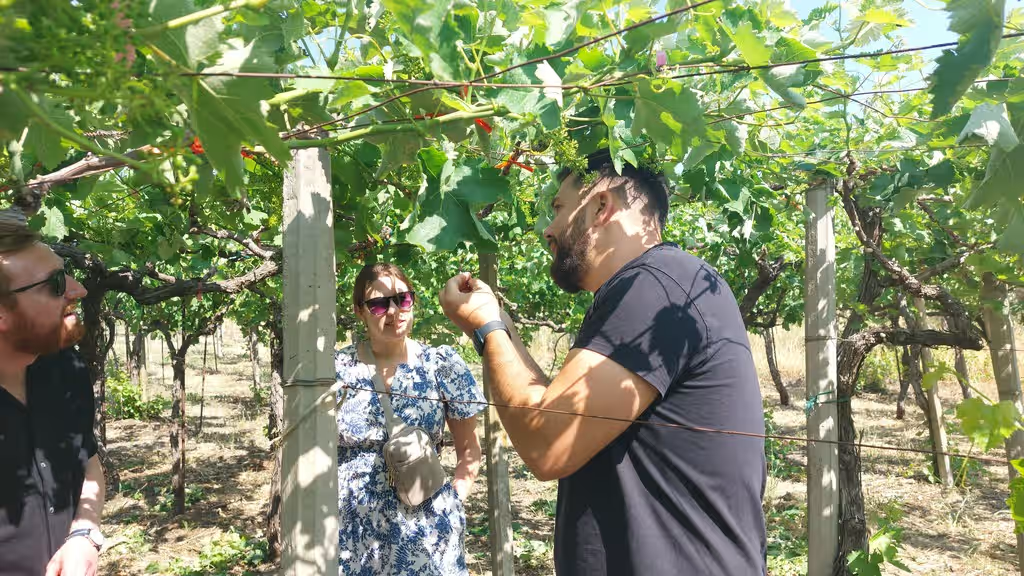
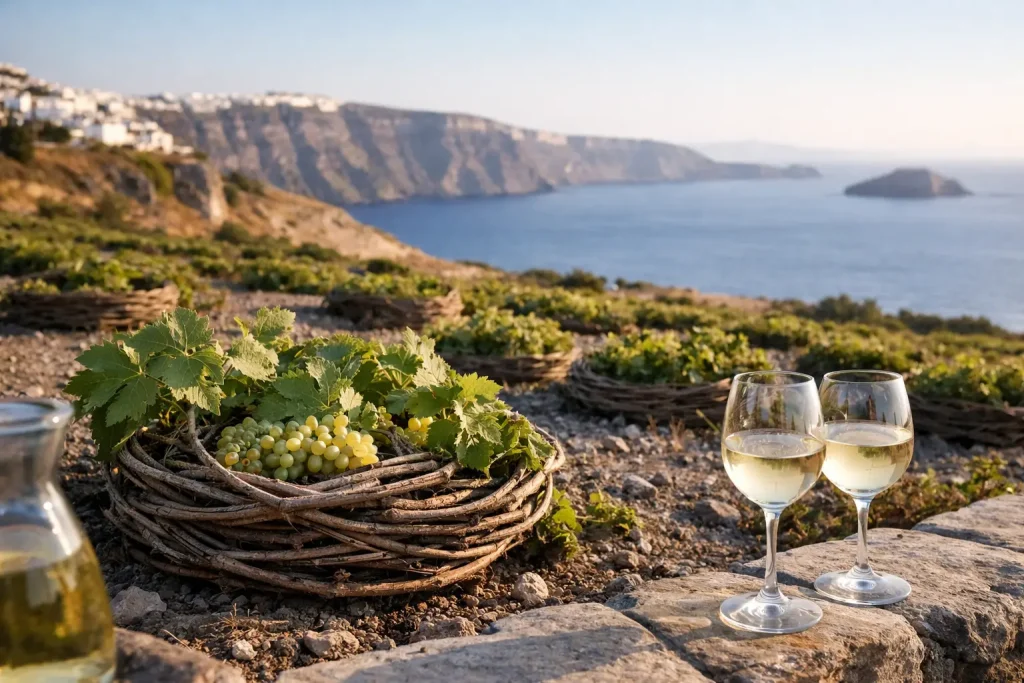
As Greek viticulture expanded across the Aegean, the island of Thera (Santorini) developed a technique that remains one of the world’s most striking examples of agricultural adaptation: the Koulara. While the rest of the world trellises vines upward toward the sun, the winemakers of this volcanic caldera evolved a low-to-the-ground basket weave. This was born of absolute necessity in one of the most hostile viticultural environments on Earth.
The Ambelonas of Santorini is a living museum and arguably the most unique vineyard on the planet. Because the island’s volcanic soil (composed of aspa—a mix of ash, lava, and pumice) lacks the clay content required for the parasite’s survival, it is naturally resistant to Phylloxera. Consequently, these vines are some of the only “own-rooted” vineyards in Europe. While the leafy canopy may be replaced every few decades, the massive root systems are often 200 to 400 years old, delving deep into the volcanic bedrock for moisture.
To protect the delicate grapes from the fierce Meltemi winds and the abrasive, sandblasting effect of volcanic ash, farmers painstakingly weave the canes into a protective circle. The grapes grow on the inside of this “basket,” shielded by a canopy of leaves. This structure also performs a vital function: it traps the heavy morning sea mist, providing the only source of hydration in a desert-like climate with almost no rainfall. This architectural feat is what gives Assyrtiko its bracing acidity, high alcohol, and the distinct saline, mineral tension that mimics the surrounding sea.
Under the Roman Eagle and Byzantine Cross: Preservation of the Oenos (146 BC – 1453 AD)
When Rome conquered Greece, they institutionalized the vineyards rather than dismantling them. Greek wines remained the “Grand Crus” of the Roman world, frequently cited by Pliny the Elder as the pinnacle of luxury. During this period, the Greeks refined the art of sun-drying grapes to concentrate sugars, a technique that would eventually lead to the creation of the legendary Vinsanto. Roman elites would pay exorbitant prices for wines from Crete and Monemvasia, viewing them as essential status symbols for any respectable banquet.
As the empire’s center of gravity shifted to Constantinople, the Byzantine Era ushered in a new epoch of Monastic Influence. The Orthodox Church took up the mantle of viticultural stewardship, viewing wine as the essential blood of the Eucharist. Orthodox monasteries, particularly those on the “Holy Mountain” of Mount Athos, became the world’s most advanced research centers for viticulture. Monks documented vine mutations, soil drainage, and harvest timings with scientific precision, preserving ancient knowledge that was being lost in the West during the Dark Ages.
During this time, the port of Monemvasia in the Peloponnese became the namesake for Malvasia wine. This sweet, sun-dried wine became a global phenomenon, shipped by Venetian merchants to the royal courts of Europe, from London to Moscow. It was the first truly international “icon wine” of the Middle Ages, proving that the Greek terroir could produce luxury goods of unparalleled longevity that could survive years of travel across tumultuous seas.
The Ottoman Veiling and the Legend of Retsina (1453 – 1821)
The fall of Constantinople in 1453 marked the beginning of nearly four centuries of Ottoman rule, a period often characterized in Western history as a “dark age” for the vine. However, a deeper oenological analysis reveals a much more complex reality of survival, adaptation, and silent persistence. While the Islamic faith of the Ottoman Porte strictly prohibited alcohol consumption for the Muslim population, the sultans were astute administrators who recognized the immense economic value of the Greek Ambelonas. Rather than uprooting the vineyards, they transformed wine into a primary engine of the Imperial treasury through the imposition of heavy taxation, notably the haraç (capitation tax) and specific levies on wine production and transport.
During this era, Greek winemaking underwent a process of “internalization.” The grand, flamboyant maritime trade routes of the Byzantine era collapsed, and the industry retreated from the global stage into the shadows of small, domestic Kavas (stone cellars) and remote, high-altitude mountain villages. This geographical retreat was a strategic move to escape the direct oversight of Ottoman tax collectors and local governors (pashas). In these secluded pockets—from the rugged mountains of Crete to the hidden valleys of Epirus—the Greeks maintained their ancient relationship with the vine. Viticulture became an act of cultural and religious preservation; wine remained a non-negotiable element of the Orthodox liturgy and the Greek domestic table, serving as a liquid symbol of Hellenic identity that the “veiling” of Ottoman rule could not extinguish.
Furthermore, the Ottoman period inadvertently served as a massive “genetic reservoir” for Greece’s indigenous grapes. Because the empire did not participate in the industrialization of wine seen in 18th-century France or Italy, the Greek vineyards remained untouched by the drive for standardization. Farmers focused on polyculture, growing a diverse array of the 300+ indigenous varieties alongside currants and raisins (which were highly prized in Ottoman cuisine). This lack of commercial “progress” meant that ancient clones—varieties that might have been replaced by more “marketable” European grapes elsewhere—were preserved in situ, waiting for the modern renaissance to rediscover their unique profiles.
Retsina: The Ancient Sealant and Cultural Anchor
It was within this context of isolation and preservation that the tradition of Retsina became deeply etched into the national character. While its origins date back over 4,000 years to the Bronze Age, Retsina became a definitive staple during the Ottoman centuries. The technique originated from the practical necessity of using Aleppo Pine Resin to seal the porous clay amphorae and later the wooden barrels, creating an airtight barrier that prevented oxygen from spoiling the wine in the sweltering Mediterranean heat.
By the 17th and 18th centuries, the resinous tang of Retsina was no longer just a technical byproduct; it had become a preferred flavor profile for the residents of Attica and Central Greece. The resin acted as a natural preservative in an era before sulfur dioxide was standard, allowing wine to be transported from rural vineyards to the urban tavernas of Athens without turning to vinegar. While often misunderstood today as a “rustic” wine, Retsina represents a direct sensory link to the ancient world’s preservation methods. Modern “New Wave” Retsinas, produced by infusing premium Assyrtiko or Roditis with high-quality resin, are now reclaiming their place as sophisticated, gastronomic wines that honor this 400-year era of silent, resin-scented survival.
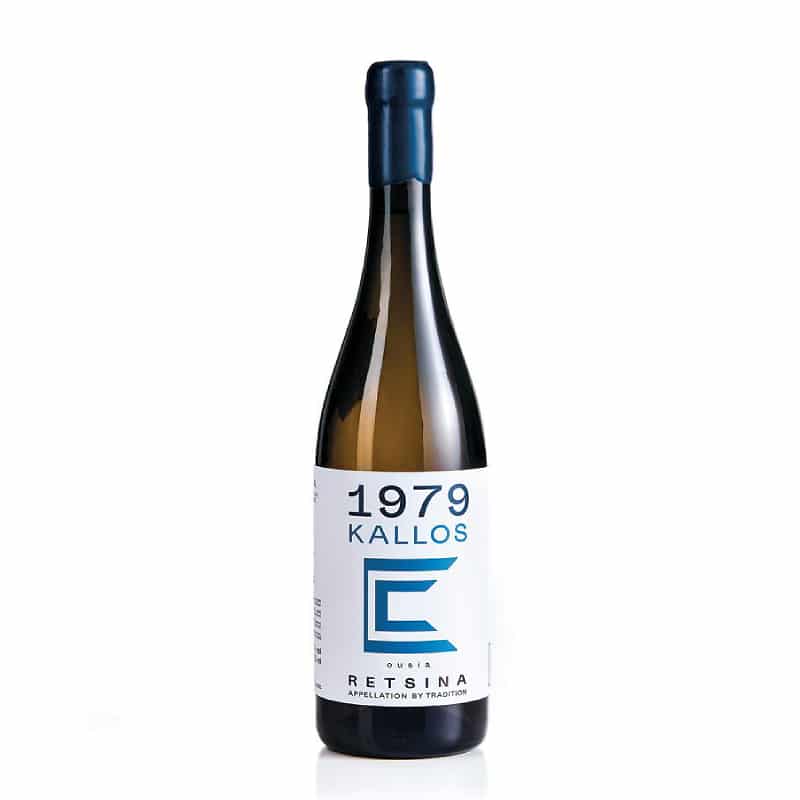
The 1979 Retsian Kallos that reintroduced premium Retisna in greek wine scene
The Rebirth of the Hellenic Vine: Modern Law and the Malagousia Miracle (1821 – 1990)

Greek independance wars, 1821
Following the War of Independence in 1821, Greece inherited a fragmented agricultural landscape struggling to find its identity. The early 20th century brought further devastation through the global phylloxera plague (which decimated the mainland) and successive world wars that saw vineyards abandoned. However, the true technical revolution arrived in the late 1960s as Greece prepared to join the European Economic Community. This era was defined by the Legal Codification of the Ambelonas, a massive effort to map the nation’s diverse microclimates and protect its heritage.
In 1971, the Appellation of Origin system was officially established, creating the POP (Prostasia Onomasias Proelefsis) categories. This legally protected the unique characters of regions like the limestone-rich plateau of Mantinia, the sun-drenched hills of Nemea, and the mist-shrouded slopes of Naoussa. This provided a blueprint for excellence, allowing small estates to invest in modern technology and compete on the global stage.
The Malagousia Miracle: Rescuing a Ghost
The soul of this modern renaissance was saved by a single grape: Malagousia. By the early 1970s, this aromatic white variety was thought to be extinct, existing only as a “ghost grape” in the minds of elderly farmers. The turning point came when professor Vangelis Gerovassiliou, then an oenologist at the Porto Carras estate, discovered a few neglected vines in a remote, mountainous village in Aitoloakarnania.
Under the scholarly guidance of Stavroula Kourakou-Dragona—the “Grand Dame” of Greek wine responsible for the modern appellation system—Gerovassiliou began the painstaking process of clonal selection. He first planted these rescued cuttings at Porto Carras and later brought them to his family estate, Ktima Gerovassiliou. This “miracle” sparked a national movement. Winemakers realized that Greece’s future lay in championing its own 300+ unique genetic heritages rather than imitating French Cabernet. This shift from quantity to indigenous quality is the foundation of the modern Greek wine renaissance.
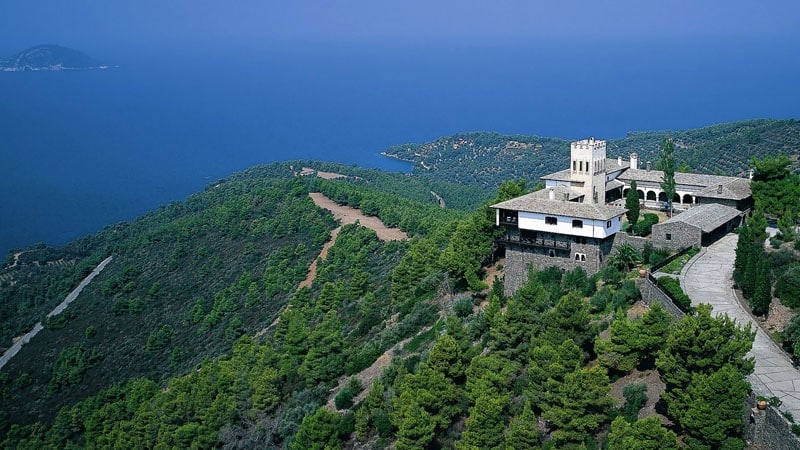
Porto Carras domain
The Modern Renaissance: Sustainability and the Global Icon (1990 – Present)
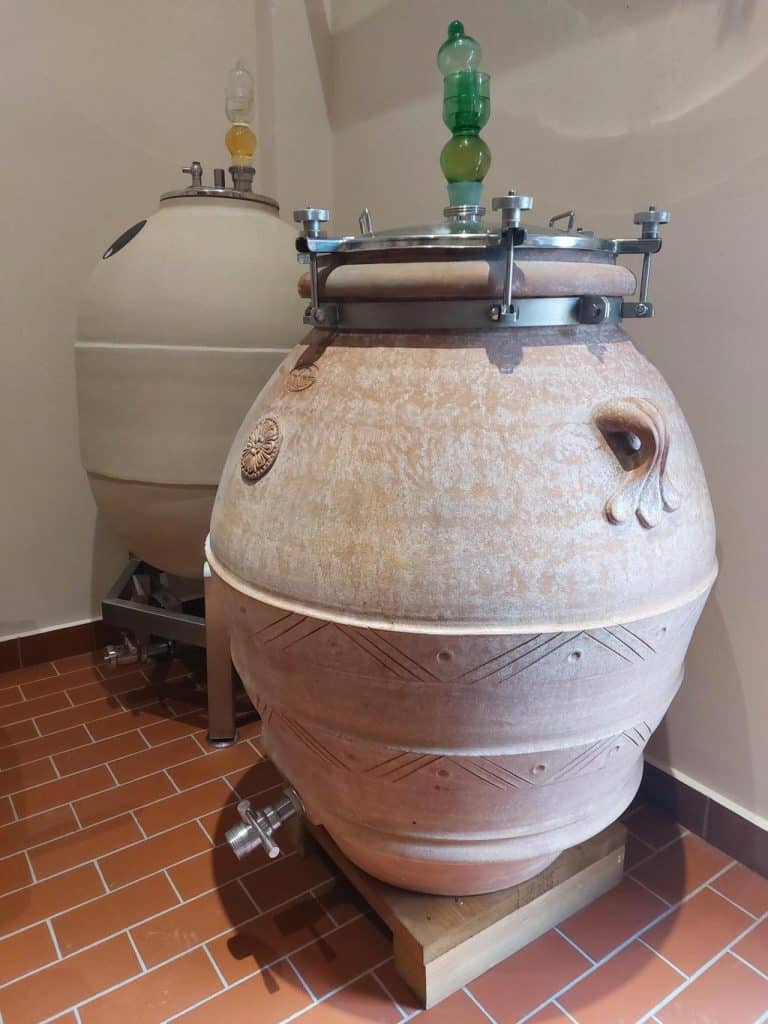
Micri vinification in different techniues, like ceramic pots in Crete
The turn of the 21st century marked the definitive transition of Greek wine from a regional curiosity to a global powerhouse of artisanal excellence. This era, often called the Hellenic Renaissance, was catalyzed by a “brain gain”: a generation of young, ambitious oenologists who, after studying in the prestigious halls of Bordeaux, Montpellier, and Adelaide, returned to their family Ktimas with a radical vision. They sought to marry world-class technical precision with the raw, untamed potential of Greece’s 300+ indigenous cultivars.
This modern epoch is defined by the absolute rejection of “internationalization.” While the 1980s saw a trend toward planting Cabernet Sauvignon and Merlot to appease global palates, today’s elite producers have pivoted back to the “Holy Trinity” of Greek grapes: Assyrtiko, Xinomavro, and Agiorgitiko. We are witnessing a meticulous refinement of terroir expression; winemakers are no longer just making “Greek wine,” they are making “Single-Vineyard Naoussa” or “High-Altitude Amyndeon.” This granular focus has led to the rise of Micro-vinifications, where specific parcels of land are fermented separately to showcase the profound impact of limestone, schist, or volcanic ash on the final bouquet.
Sustainability, Biodynamics, and the Return to the Pithos
In the vineyard, the movement toward Sustainable and Organic viticulture has become the gold standard rather than the exception. In the rugged mountains of Epirus and the wind-beaten terraces of the Aegean, producers are embracing Biodynamics, viewing the vineyard as a closed ecological loop. There is a profound respect for the “old vines”—some own-rooted and centuries old—that require minimal intervention to produce fruit of extraordinary concentration.
In the Oenopoiia (winery), this “minimal intervention” philosophy has sparked a return to ancestral vessels. The modern cellar is now a blend of stainless steel and the ancient Pithos (clay amphora). By fermenting and aging wines in clay, modern masters like those in Crete and Central Greece are allowing the wines to breathe without the flavoring influence of oak, resulting in a purer, more “naked” expression of the fruit. This has also fueled the “Natural Wine” movement in Greece, producing orange wines and unfiltered gems that have captured the attention of sommeliers from New York to Tokyo.
The Global Icon: From Tavernas to Michelin Stars
The result of this 30-year evolution is a total shift in market perception. Greek wine has successfully shed its “vacation novelty” skin. Today, Assyrtiko from Santorini is discussed in the same breath as Grand Cru Chablis for its searing acidity and saline finish. Xinomavro has earned the moniker “the Nebbiolo of the East” for its complex structure and haunting aromas of sun-dried tomato and olive tapenade.
Greece has moved into the “Icon” phase of its history. Elite estates are now fetching record prices at international auctions, and the world’s most prestigious wine lists now feature dedicated Greek sections. This renaissance is not merely about technical improvement; it is a cultural reclamation. The modern Greek winemaker is both a scientist and a guardian of a 6,500-year-old flame, ensuring that every bottle produced today is a sophisticated, world-class continuation of the ancient Symposium spirit.