Table of Contents
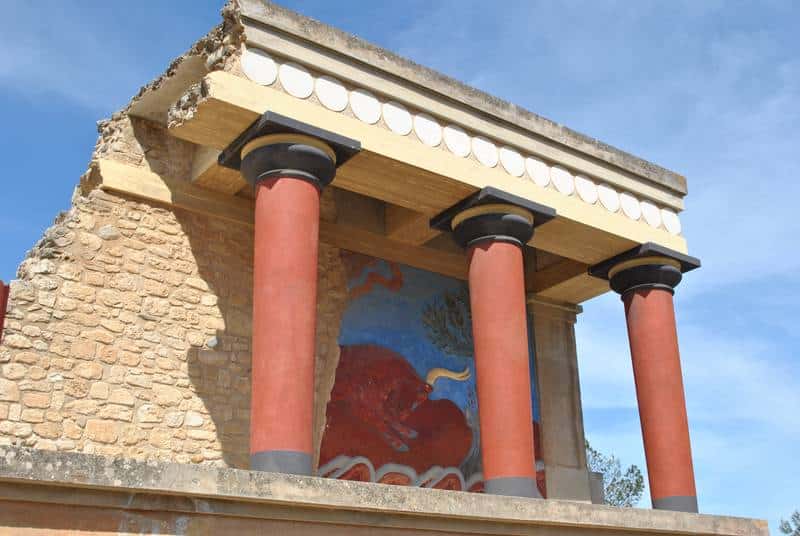
Crete represents one of the most compelling viticultural enigmas in the Mediterranean basin. As the cradle of European wine culture, with a history stretching back over four thousand years to the Minoan civilization, the island serves as a living museum of oenological heritage. To understand the terroir of Crete is to engage with a landscape that is both ancient and radically modern, a place where indigenous varieties that have survived since antiquity are being reinterpreted through the lens of contemporary viticultural science. The island is not merely a production zone but a rugged, mountainous continent in miniature, defined by a dramatic central spine that dictates every aspect of the vine’s existence. The “soul” of the Cretan landscape is found in its verticality, where the transition from sea level to high-altitude plateaus occurs with startling speed, creating a patchwork of micro-climates that are unique in the global wine landscape.
The prestige of Crete lies in its ability to maintain a distinct identity in an era of stylistic homogenization. This is a region where the concept of terroir is an ancestral birthright, deeply embedded in the cultural fabric of the rural communities. From the limestone-rich slopes of Archanes to the wind-swept plateaus of Ziros, the land speaks of survival and adaptation. For the sophisticated traveler and serious collector, Crete offers a narrative of authenticity. The sheer diversity of the terrain, ranging from the sun-drenched coastal plains to the cool, ethereal heights of the Psiloritis foothills, creates a sensory journey that is unparalleled. This guide serves as the technical foundation for understanding how geology, climate, and human persistence converge to produce wines of profound structural integrity and aromatic complexity, solidifying the island’s status as a premier destination for those seeking the true essence of Mediterranean viticulture.



Macro-Climate and Viticultural Foundations
The overarching climate of Crete is Mediterranean, yet this broad classification fails to capture the intricate interplay of forces that define its viticulture. The island’s climate is governed by its geographic position between the Aegean and Libyan Seas and its formidable topography. The central mountain ranges, including the Lefka Ori, Idi, and Dikti, act as a massive thermal regulator and a barrier to weather patterns. These peaks, reaching over 2,400 meters, create a significant rain-shadow effect, ensuring that the northern part of the island receives substantially more rainfall than the semi-arid south. This moisture is vital for the survival of the vines during the long, hot summers, with the mountains acting as a reservoir that slowly releases water through the subsoil.
The Influence of Wind
The most critical climatic influence in Crete is the Meltemi, the fierce northerly winds that sweep across the Aegean during the summer months. These winds are a viticultural blessing, providing a natural cooling mechanism that mitigates the intense heat. By constantly circulating air through the vine canopies, the Meltemi reduces the risk of fungal diseases and prevents the berries from shriveling, allowing for a steady, even ripening process. In areas like Sitia, the wind is so persistent that it dictates the very shape of the vines and the orientation of the rows, forcing growers to adopt specific protection strategies to ensure the fruit’s survival.
Water and Rainfall
Rainfall patterns in Crete are characterized by extreme seasonality and significant inter-annual variability. Most precipitation occurs during the winter months, often in the form of heavy episodic storms. The ability of the soil to capture and retain this winter moisture is paramount. The northern slopes benefit from higher humidity and more consistent rainfall, whereas the southern regions, particularly near the Messara plain, experience a more desert-like environment. This vintage variability defines the region’s reputation; in wetter years, the focus shifts to managing vigor and ensuring drainage, while in drier years, the depth of the root systems and the water-holding capacity of the clay-heavy soils determine the quality of the harvest.
Altitude and Diurnal Temperature Shifts
Altitude is the primary tool for quality viticulture in Crete. By planting at elevations ranging from 400 to over 900 meters, growers can harness significant diurnal temperature shifts. These fluctuations, where daytime heat is followed by cool mountain nights, are essential for preserving the natural acidity of varieties like Vidiano and Vilana. This thermal gap slows the degradation of malic acid and promotes the development of complex precursor compounds in the skins. In the high-altitude vineyards of Alagni and Peza, the resulting wines possess a tension and freshness that would be impossible to achieve in lower, flatter terrains.
Solar Radiation and Light Intensity
Crete experiences some of the highest solar radiation levels in Europe. This intensity of light is a double-edged sword for the vine:
-
Photosynthetic Efficiency: The abundance of light ensures high photosynthetic activity, leading to excellent sugar accumulation and phenolic ripeness. However, it requires careful canopy management to prevent sun-scald on sensitive varieties like Vidiano.
-
UV Exposure: At higher altitudes, UV radiation is significantly more intense. This triggers the vine to produce more polyphenols (tannins and anthocyanins) in the skins as a “sunscreen,” which adds structural depth and color intensity to red varieties like Kotsifali and Mandilaria.
The Maritime Influence & Thermal Inertia
As an island, Crete’s viticulture is profoundly influenced by the surrounding seas (the Aegean to the north and the Libyan to the south).
-
Sea Breezes: Beyond the cooling northerly Meltemi, localized sea breezes act as a thermal buffer. These breezes blunt the extreme daytime peaks, preventing the vines from shutting down their metabolic processes due to heat stress.
-
Hygroscopic Effect: Proximity to the sea provides a level of relative humidity that can be beneficial in the extremely arid eastern regions like Sitia, where the moisture in the air can slightly reduce the transpiration rate of the leaves.
-
Thermal Inertia: The vast water mass of the Mediterranean acts as a heat sink, ensuring that the transition into winter is gradual. This allows late-ripening varieties like Romeiko and Mandilaria a long, extended hang-time to reach full physiological maturity.
Topographic Complexity and Aspect
The rugged “spine” of Crete creates a high degree of geospatial heterogeneity.
-
Slope and Aspect: North-facing slopes (Boreas) are highly prized for white wine production, as they receive less direct solar radiation and stay significantly cooler. Conversely, south-facing slopes are often reserved for late-ripening reds, maximizing the heat summation required for tannin polymerization.
-
Natural Amphitheaters: Many of the best vineyards in Peza and Archanes are situated in natural limestone basins. These topographical “pockets” protect the vines from the most violent gusts of the Meltemi while concentrating the cooling night air, further enhancing the diurnal effect.
Vintage Variability
In the context of Crete, the interaction between soil and climate creates a highly technical “Vintage Signature.” While the island’s weather is generally stable, subtle annual shifts in hydrology and heat summation cause significant variations in wine structure and aging potential.
Pedo-Climatic Synergy and Vintage Variability
The incidence of vintage change in Crete is primarily a story of Hydric Stress and Phenolic Accumulation. Because the soils are predominantly limestone and clay, they act as a “thermal and hydraulic shock absorber,” but their limits are tested differently each year.
The Hydric Buffer: Clay vs. Drought
In a “Dry Vintage” (low winter rainfall), the role of Calcareous Clay becomes the single most important factor.
-
Soil Action: In regions like Peza, the deep clay subsoils retain winter moisture. In dry years, the vines draw on this “deep reservoir.”
-
Vintage Result: Wines from these years show higher concentration and “vertical” structure. However, if the drought is extreme, the vines may halt photosynthesis to survive, leading to “green” tannins despite high sugar levels (a phenomenon known as phenolic lag).
-
Wet Vintages: Conversely, in years with late spring rains, the drainage capacity of the Limestone bedrock is tested. Well-draining plots in Archanes will produce elegant, aromatic wines, while flatter, clay-heavy plots may struggle with dilution or “bloated” berries.
Thermal Summation and Phenolic Maturity
The “Heat Spike” incidence is a major driver of vintage identity for Cretan reds, particularly Liatiko.
-
The Soil Influence: Darker, iron-rich soils (Terra Rossa) in Dafnes absorb more heat. In a “Hot Vintage,” these plots reach maturity significantly faster.
-
Oenological Impact: The Lead Oenologist must monitor the Sugar-Acid-Balance daily. A hot vintage in Crete often results in wines with higher potential alcohol and “dried fruit” profiles (figs, prunes), whereas a cooler, windier vintage preserves the “fresh red fruit” and “rose petal” aromatics typical of high-altitude Liatiko.
The “Meltemi” Variable
The intensity and timing of the Meltemi winds vary every year, creating a “Ventilation Index” for each vintage.
-
High-Wind Vintages: Years with strong, consistent summer winds act as a natural “refrigerator.” These vintages are characterized by exceptional health in the vineyard (low disease pressure) and high natural acidity.
-
Low-Wind Vintages: In years where the winds are stagnant, the “Heat Summation” rises. This requires winemakers to adapt their “Human Intervention” (Section 4), potentially harvesting two weeks earlier to prevent the loss of volatile aromatics in white varieties like Vidiano.
Pedological Depth: The Complex Chemistry of Soil and Bedrock In Crete
The geological foundation of Crete is a complex mosaic of sedimentary and metamorphic rocks, primarily formed during the Alpine orogeny. The dominant feature of the Cretan soil profile is limestone, specifically the Tripolitza and Pindos series. This calcareous bedrock is the silent architect of the island’s most prestigious wines, providing a high pH environment that naturally limits vine vigor and promotes a specific mineral uptake, often manifesting as a chalky or saline texture in the finished wine..
The Calcareous Framework: Limestone and Marl
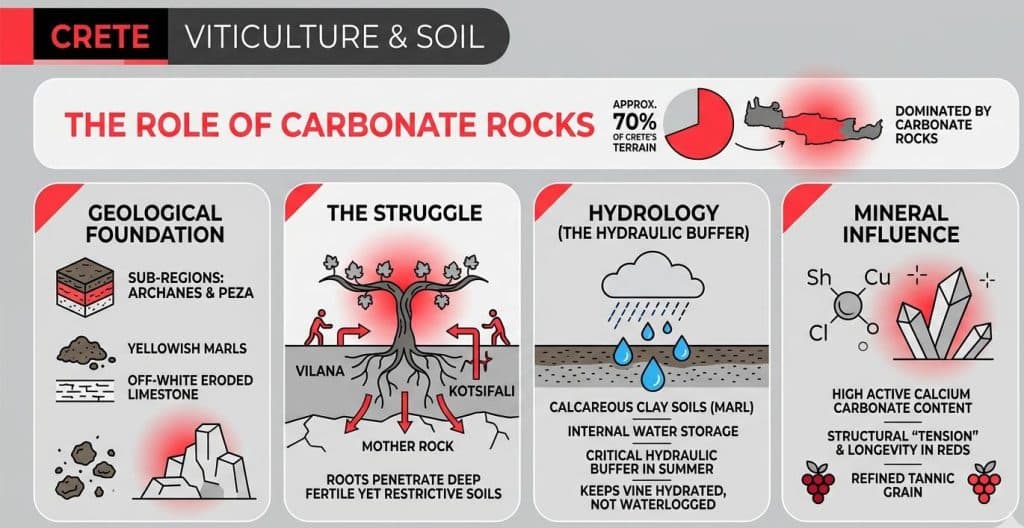
Approximately 70% of Crete’s terrain is defined by carbonate rocks. In the premium sub-regions of Archanes and Peza, the landscape is dominated by yellowish marls and off-white eroded limestone. These “fertile” yet restrictive soils force the roots of Vilana and Kotsifali to penetrate deep into the mother rock.
-
Hydrology: Calcareous clay soils (Marl) possess a unique ability to flocculate, creating internal water storage spaces. This acts as a critical hydraulic buffer during the intense Mediterranean summer, ensuring the vine remains hydrated without becoming waterlogged.
-
Mineral Influence: The high active calcium carbonate content is responsible for the structural “tension” and longevity found in Archanes reds, contributing to a refined tannic grain.
Metamorphic Diversity: Phyllite-Quartzite and Schist
In the rugged landscapes of western Crete, particularly in Kissamos and the foothills of the White Mountains, the geology shifts toward the Phyllite-Quartzite series. These are older, metamorphic formations consisting of shining greenish shales, schists, and quartzites.
-
Drainage: These rocky, well-draining soils are exceptionally poor in organic matter, which is ideal for varieties like Vidiano. The struggle for nutrients results in a lower yield of highly concentrated berries.
-
The Sensory Link: Vines grown on these metamorphic schists often exhibit a distinct “slate-like” or flinty mineral undertone, which complements the stone-fruit and herbal aromatics of the indigenous white grapes.
Iron-Rich Clays: Terra Rossa
In specific pockets such as the Dafnes appellation, the soil is characterized by Terra Rossa (red earth). These are residual clays produced by the weathering of limestone, rich in iron and aluminum oxides.
-
The Liatiko Connection: Terra Rossa is highly prized for the cultivation of Liatiko. The iron content is believed to contribute to the variety’s specific aromatic profile, often described as having notes of “sotto bosco” (undergrowth) and truffle.
-
Thermal Retention: These darker soils absorb and retain more solar heat, aiding the physiological ripening of late-maturing varieties while maintaining the structural integrity of the tannins.
Alluvial and Ophiolitic Formations
In the valley floors and certain eastern reaches like Sitia, alluvial gravels and rarer ophiolitic (volcanic) rocks can be found.
-
Alluvial Fans: These sites offer excellent drainage and reflect light back into the canopy, promoting even ripening.
-
Sitia’s Mineral Grip: The combination of sandy-loam over limestone in the east ensures that even in semi-arid conditions, the wines retain a saline, savory “grip” that is the hallmark of the Sitia cru.
This pedological diversity ensures that Crete is not a monolithic wine region but a “color island” where every plot offers a different chemical interaction. Understanding this subterranean complexity is the key to mastering the diverse expressions of the Cretan vineyard, from the ethereal whites of the mountain plateaus to the muscular reds of the iron-rich valleys
The Regional Breakdown: Climate, Soil, and Geology by Sub-Region
The regional identity of Crete is not defined by a single unified landscape, but rather by a series of distinct pedological and atmospheric “islands” within the island itself. To understand the viticultural output of the region, one must analyze the specific geological fractures and localized micro-climates that differentiate the northern maritime slopes from the semi-arid southern plateaus. Each sub-region operates under a unique chemical and thermal signature, where the age of the limestone bedrock, the presence of metamorphic schist, and the intensity of the Meltemi winds converge to dictate the varietal expression.
This breakdown examines the technical foundations of the island’s primary districts, mapping the transition from the clay-heavy rolling hills of the center to the rugged, high-altitude plateaus of the east and west. By dissecting these sub-regions through the lens of geology and hydrology, we can decode why a variety like Vidiano or Liatiko exhibits radically different structural profiles depending on the specific cru from which it originates. The following analysis provides the oenological mapping necessary to navigate the complex tapestry of Crete’s most prestigious appellations and vineyards.
Heraklio District
The heart of Cretan viticulture, Heraklion hosts the majority of the island’s protected designations. The terrain is characterized by rolling hills and hidden valleys protected by the Psiloritis massif.
Peza
As one of the most productive appellations, Peza features a landscape dominated by calcareous clay. The hydrology here is excellent, with the clay retaining enough moisture to sustain the vines through the dry summer. The Vilana produced in Peza displays a distinctive citrus and herbal profile, a direct result of the balanced mineral uptake in these alkaline soils. The Mandilaria and Kotsifali blends from this region benefit from the soil’s ability to provide steady nutrients, resulting in wines with soft tannins and bright red fruit.
Archanes
Situated at a slightly higher elevation, Archanes is renowned for its red wines. The soil is a mix of limestone and marl, which provides a refined structure to the Kotsifali and Mandilaria. The proximity to the mountains ensures a cooler night-time temperature than the surrounding plains, preserving the floral aromatics of the grapes.
Dafnes
This sub-region is the spiritual home of Liatiko. The soils in Dafnes are notably poorer and more stony than in Peza, featuring significant deposits of calcium carbonate. This soil stress is crucial for Liatiko, which can become overly vigorous in richer environments. The high limestone content yields a wine with a characteristic earthy, “sotto bosco” (undergrowth) aroma and a refined tannic spine that is a hallmark of the Dafnes cru.
Lasithi District
The easternmost part of the island is home to some of its most extreme viticultural conditions, defined by aridity and high winds.
Sitia
The Sitia appellation is a masterclass in wind-influenced viticulture. The soils are predominantly sandy-loam over a limestone base, providing exceptional drainage. The dryness of the climate here concentrates the sugars and phenolics in the Liatiko and Vilana grapes. The wines often exhibit a saline, mineral finish, reflecting the maritime influence and the mineral-rich topsoils. Within this region, the Ziros plateau represents a unique high-altitude micro-terroir where the vines must endure significant UV stress and cold nights.
Rethymno District
Rethymno is the frontier of the “New Crete” movement, focusing on high-altitude white wines and the revival of lost varieties.
Monastiraki and Amari Valley
While not a formal PDO, the Amari Valley is a crucial site for Vidiano. The soils are a complex blend of schist and limestone. The altitude here, often exceeding 600 meters, creates a prolonged ripening season. This allows for the development of the signature apricot and chamomile notes of Vidiano, supported by a vibrant acidity that is directly linked to the cool, mountain-influenced hydrology of the valley.
Chania District
The western end of the island is cooler and more humid, influenced by the Lefka Ori and the proximity to the northern coast.
Kissamos
In the northern part of Chania, the Kissamos region features more alluvial and schist-based soils. The increased rainfall compared to the east requires viticulturists to manage canopy growth more aggressively. The Romeiko grape thrives here, producing wines with a unique oxidative potential and high levels of tartaric acid, shaped by the sandy, well-draining soils that prevent waterlogging.
Human Intervention and Viticultural Mastery
The mastery of Cretan viticulture lies in the dialogue between ancient wisdom and modern precision. Man’s primary role here is the management of light and water. To adapt to the diverse soils described, growers often employ specific rootstocks that are resistant to drought and compatible with high calcium carbonate levels. Pruning techniques are vital; while the traditional “kouloura” or bush-vine method is seen in the windiest areas to protect the fruit, many modern vineyards utilize the Cordon or Single Guyot systems. These allow for better canopy management and mechanical assistance, ensuring that the fruit is shaded from the intense midday sun while still benefiting from the cooling Meltemi.
In the cellar, the philosophy has shifted toward a “minimal intervention” approach that seeks to amplify the terroir’s voice. This involves careful temperature control during fermentation to preserve the volatile thiols and esters of the indigenous grapes. The use of large-format oak or amphorae is becoming more common, as these vessels allow for a slow micro-oxygenation that softens the rugged tannins of Mandilaria without masking the site-specific mineral nuances of the limestone soils. Precision in the timing of the harvest is the ultimate human intervention; in a landscape with such dramatic altitude changes, a difference of 100 meters can mean a two-week delay in picking, requiring the Lead Oenologist to possess an intimate, plot-by-plot knowledge of the land.
From Knowledge to Experience
The technical data of Crete—the pH of the marl, the velocity of the wind, the chemical composition of the limestone—forms the skeleton of its wine culture. Yet, these facts are merely the prologue. Wine is a living liquid, a temporal capture of a specific season and a specific stone. To truly understand the verticality of a Vidiano from the Psiloritis slopes or the sun-drenched power of a Sitia red, one must stand where the vine stands.
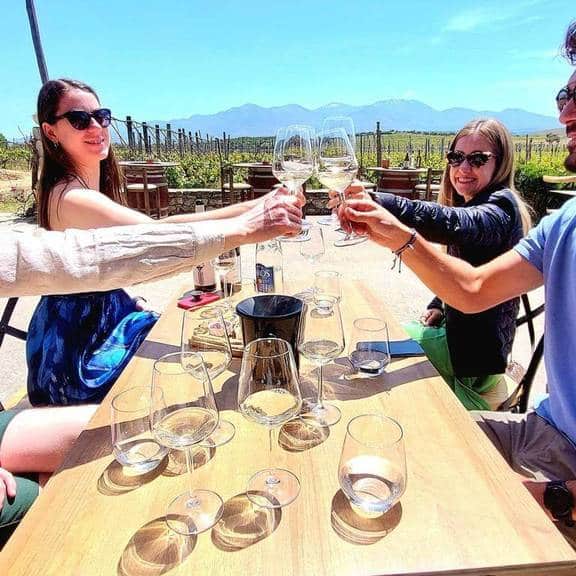
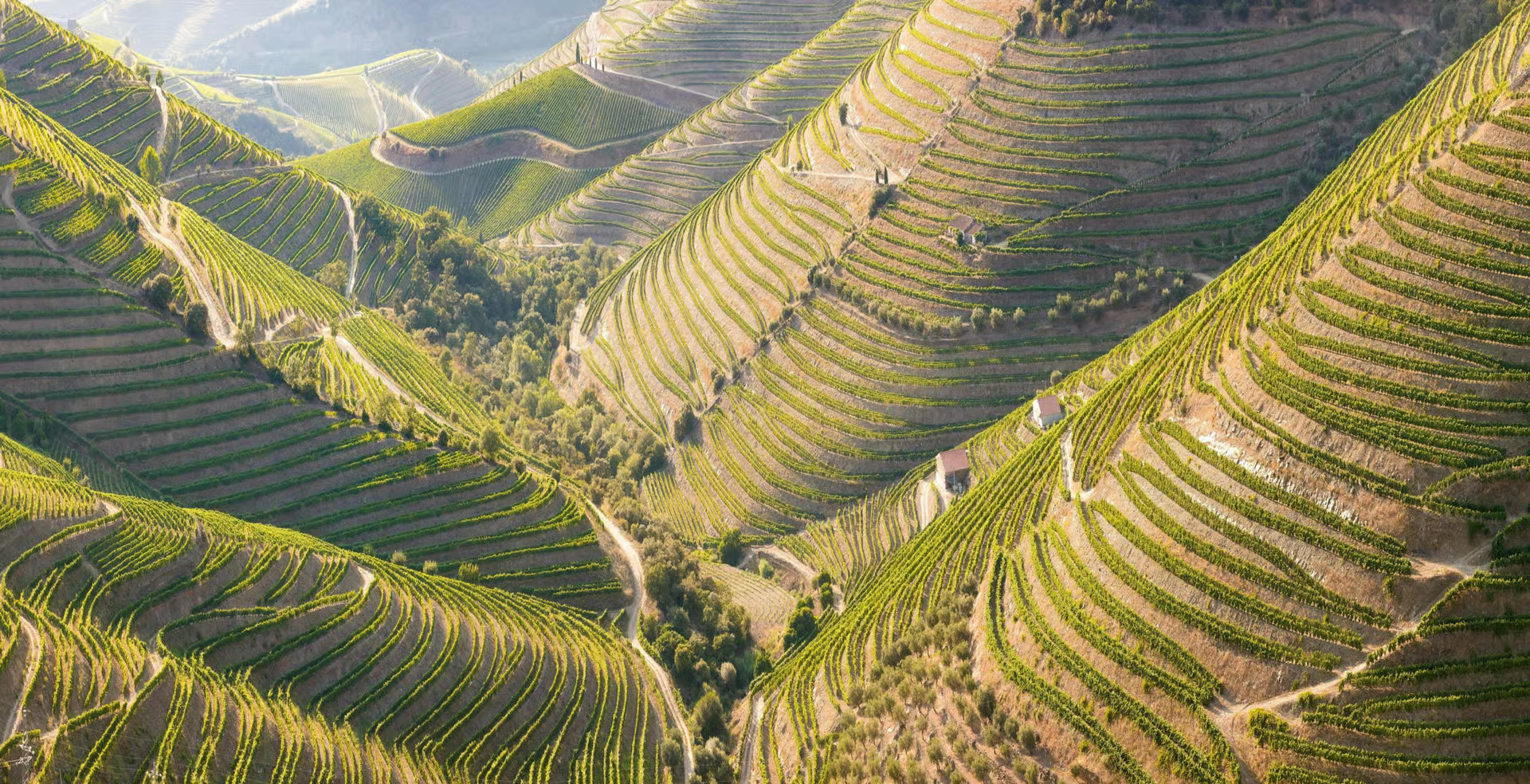
We invite the discerning connoisseur to move beyond the glass and into the landscape. Our curated wine tours offer a sophisticated immersion into the heart of the Cretan terroir. You will have the opportunity to walk the ancient terraces, feel the cooling breath of the Meltemi, and touch the very limestones and clays that define these world-class liquids. This is a journey for those who recognize that the greatest wines are not merely made, but are born from the earth. Join us for an exclusive exploration of the island’s most prestigious vineyards and experience the liquid history of Crete in situ.