Table of Contents
This authoritative California Wine Appellations Guide serves as the definitive technical resource for professionals, collectors, and enthusiasts seeking to navigate the complex hierarchy of the American Viticultural Area (AVA) system. In the United States, wine regions are officially designated and regulated by the Alcohol and Tobacco Tax and Trade Bureau (TTB). Unlike European models, the AVA system focuses primarily on geographic boundaries and climate, yet within these borders lies a sophisticated tapestry of terroir that defines the global authority of California wine.
This guide provides an exhaustive deep-dive into every major region and sub-appellation, detailing the unique geological markers, climatic influences, signature wine styles, and the critical aging potential of each. From the fog-shrouded ridges of the North Coast to the limestone-rich transverse valleys of the Central Coast, this document follows the official hierarchical structure to ensure total accuracy for SEO authority and viticultural research.
Uncork the Coast
North Coast AVA
The North Coast AVA is the undisputed epicenter of premium American viticulture, encompassing a vast and rugged territory of over 3 million acres north of San Francisco. This massive regional appellation serves as the primary umbrella for the state’s most prestigious counties, including Napa, Sonoma, Mendocino, and Lake.
The defining characteristic of the North Coast is its intimate relationship with the Pacific Ocean and the San Pablo Bay. The “marine layer”—a thick, cooling fog—is pulled inland every evening through coastal gaps, acting as a natural air conditioner that mitigates the intense California sun. This creates a long, steady growing season that is vital for the development of complex phenolic ripeness while maintaining the high natural acidity required for world-class aging potential.
The topography here is a dramatic mix of mountain peaks, rolling hills, and alluvial valley floors, with soils ranging from ancient volcanic ash and obsidian to gravelly riverbed loams. As a result, the North Coast sets the international gold standard for varieties such as Cabernet Sauvignon, Pinot Noir, and Chardonnay, consistently producing wines with structural elegance, depth, and a clear sense of place.
-
Wine Style: Characterized by intense fruit concentration, high aromatic complexity, and a sophisticated balance of power and acidity.
-
Aging Potential: Exceptional; the flagship red wines from this macro-region are globally recognized for their ability to evolve over 15 to 35 years.
Napa Valley AVAs
Napa Valley (Regional)
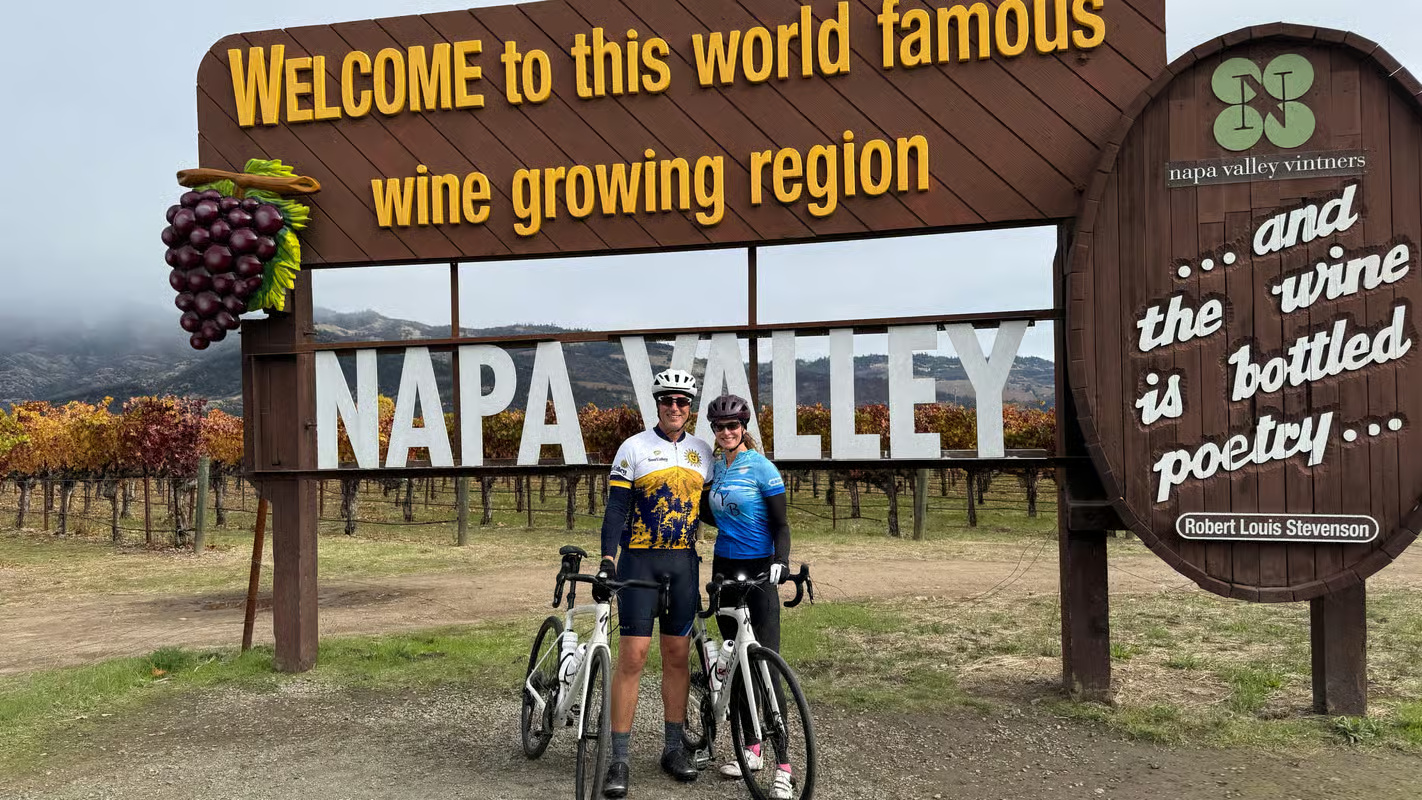
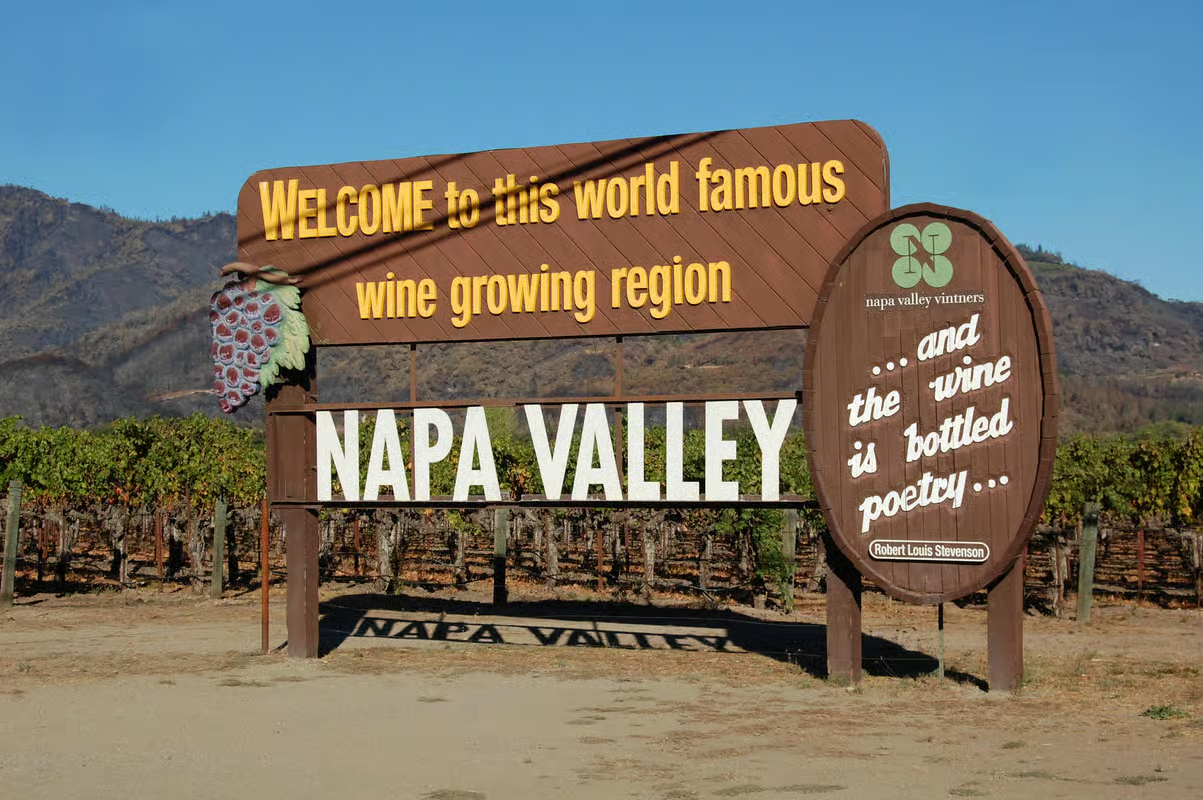
Napa Valley is the most famous wine appellation in the United States and a global leader in viticultural authority. Despite producing only 4% of California’s total wine volume, its economic and cultural impact is unmatched. The valley is a narrow corridor flanked by the Vaca Mountains to the east and the Mayacamas Mountains to the west. This unique geography provides a Mediterranean climate found in only 2% of the world. The soils are incredibly diverse, with 33 different soil series and hundreds of variations, providing a perfect laboratory for high-end Cabernet Sauvignon.
-
Wine Style: Known for “Napa Power”—full-bodied, opulent, and velvety Cabernet Sauvignon with notes of dark fruit, cassis, and polished oak.
-
Aging Potential: World-class; top estates produce wines that reach peak maturity between 15 and 25 years.
The Mountain Appellations Atlas Peak, Diamond Mountain District, Howell Mountain, Mount Veeder, Spring Mountain District
These AVAs are situated high on the mountain ridges above the valley floor, often sitting well above the fog line. The vines struggle in thin, rocky, volcanic soils, leading to tiny berries with thick skins. This results in wines with massive concentration and structural integrity. The higher elevation also provides more direct UV light, which thickens grape skins and intensifies the tannin profile. These regions are prized by collectors for their rugged personality and deep mineral complexity, often reflecting the harsh volcanic history of the mountain ranges themselves.
-
Wine Style: Muscular, tannic, and intensely structured with dark fruit and a distinct mineral/earthy undertone.
-
Aging Potential: Remarkable; these wines often require 10 years of cellar time just to soften and can age for 30+ years.
The Valley Floor & Benchlands: Calistoga, Chiles Valley District, Coombsville, Oak Knoll District of Napa Valley, Oakville, Rutherford, St. Helena, Stags Leap District, Yountville
These regions represent the historical “heart” of Napa, where deep alluvial fans meet the valley floor. Rutherford is legendary for its “dusty” tannins, while Oakville is home to some of the most expensive and refined Cabernet Sauvignon vineyards on Earth. The benchlands—the transitional zones between the valley floor and the mountains—provide the perfect balance of drainage and nutrients. This allows for the production of wines that possess both the power of the mountains and the elegance and fruit purity of the valley floor, creating some of the most sought-after bottles in the world.
-
Wine Style: Sophisticated, plush, and seamless. Expect dark cherry, blackberry, and integrated spice.
-
Aging Potential: Typically peaks between 12 and 20 years.
Cross-Border AVAs: Los Carneros (Napa/Sonoma), Wild Horse Valley (Napa/Solano)
These AVAs are the “cool-climate” anchors of the region, sitting closest to the San Pablo Bay. The wind and fog here are constant, making it the premier location for Burgundian varieties that demand lower temperatures. Because these AVAs span multiple counties, they represent a unique collaborative terroir where the maritime influence of the bay is the primary driver of quality. The soils are typically shallower and more clay-heavy, which restricts vine vigor and concentrates the bright fruit flavors and natural acidity of Chardonnay and Pinot Noir.
-
Wine Style: Elegant, high-acid, and mineral-driven; the benchmark for California Chardonnay and Pinot Noir.
-
Aging Potential: Chardonnay is best within 5–8 years; Pinot Noir can age gracefully for 10–12 years.
Sonoma County AVAs
Northern Sonoma: Alexander Valley, Chalk Hill, Dry Creek Valley, Knights Valley, Russian River Valley
Northern Sonoma represents a masterclass in geological and climatic diversity, acting as the engine room for the county’s most prestigious exports. This sub-region is anchored by the Russian River Valley, a viticultural sanctuary defined by the “Petaluma Gap” and the Russian River itself, which serves as a conduit for thick, cooling maritime fog. This fog is the lifeblood of the region, lingering until mid-morning to protect the delicate acidity of Pinot Noir and Chardonnay.
The soils here are a storied collection of “Goldridge” sandy loam—ancient seabed remains that provide impeccable drainage and a distinct mineral signature. Adjacent to this cool-climate haven lies the Alexander Valley, where the mercury rises, and the soils transition to gravelly clay, creating the perfect cradle for supple, “cherry-bright” Cabernet Sauvignon. To the east, Knights Valley perches on the foot of Mount St. Helena, benefiting from volcanic soils and a lack of maritime fog, producing some of the most structured and “mountain-style” Cabernets in Sonoma.
Meanwhile, Dry Creek Valley remains the global headquarters for Zinfandel, utilizing benchland gravels to produce wines of immense spicy depth.
-
Wine Style: Ranging from the lush, cola-inflected Pinot Noir of Russian River to the spicy, brambly Zinfandel of Dry Creek.
-
Aging Potential: Pinot Noir (7–10 years); Alexander Valley Cabernet (15–20 years).
Coastal & Marine influenced Fort Ross-Seaview, Fountaingrove District, Green Valley of Russian River Valley, Petaluma Gap, Rockpile, Sonoma Coast, West Sonoma Coast
These are the most extreme viticultural sites in California, facing the full brunt of the Pacific Ocean. The Petaluma Gap is a literal wind tunnel that forces grapes to develop thick skins and high acidity to survive the cold. Many of these vineyards are planted on steep ridges above the fog line, where they receive intense sunlight while being battered by cold coastal winds. This combination results in wines of incredible tension and aromatic purity, reflecting a wild, untamed terroir that is difficult to farm but yields extraordinary rewards for those who master it.
-
Wine Style: High-tension, saline-driven wines with lower alcohol, bracing acidity, and intense floral aromatics.
-
Aging Potential: Excellent; the high acidity preserves these wines for 12–15 years of evolution.
Sonoma Valley & Southern: Bennett Valley, Moon Mountain District, Sonoma Mountain, Sonoma Valley
The Sonoma Valley AVA, often called the “Valley of the Moon,” is the historic cradle of California’s premium wine industry, where Agoston Haraszthy founded Buena Vista Winery in 1857. This sub-region is a complex corridor tucked between the Mayacamas and Sonoma Mountains, benefiting from a unique climate that bridges the gap between the cool San Pablo Bay and the warmer northern reaches.
Within this storied valley lies the Moon Mountain District, a high-altitude sanctuary famous for its iron-rich, volcanic soils that produce some of the state’s most profound and muscular Zinfandels and Cabernets. Similarly, the Sonoma Mountain AVA perches above the morning fog, allowing for long, sun-drenched days that facilitate deep phenolic ripeness. In the cooler pockets, like Bennett Valley, the morning mists linger longer, creating an ideal environment for cool-climate Syrah and Merlot.
The sheer diversity of topography here—from high-elevation volcanic ridges to ancient alluvial valley floors—allows Sonoma Valley to maintain its status as an authoritative region for balance, heritage, and structural complexity.
-
Wine Style: Concentrated and mineral-focused; these wines often show intense dark fruit, savory volcanic earthiness, and a signature spicy complexity. Moon Mountain reds are noted for their grippy tannins and blackberry depth, while Bennett Valley Syrah is lauded for its cracked black pepper and violet aromatics.
-
Aging Potential: Sturdy reds from these mountain elevations and heritage valley sites age reliably for 15–25 years, with Zinfandels often hitting their peak at 10–12 years.
Mendocino & Lake County AVAs
Mendocino Anderson Valley, Cole Ranch, Covelo, Dos Rios, Eagle Peak Mendocino County, Mendocino Ridge, McDowell Valley, Potter Valley, Redwood Valley, Yorkville Highlands
Mendocino is a rugged, wild region characterized by its commitment to organic and biodynamic farming. Anderson Valley is the premier location for sparkling wine and aromatic whites, while Mendocino Ridge is unique for being a “non-contiguous” AVA consisting only of mountain peaks above the fog.
This isolation allows for the cultivation of varieties that would fail in warmer regions, resulting in wines with high natural acidity and a distinct “forest floor” character. The region is a favorite among those seeking high-authority wines with a strong emphasis on environmental stewardship.
-
Wine Style: Lean, ethereal, and earth-driven; famous for tart Pinot Noir and world-class Gewürztraminer.
-
Aging Potential: Pinot Noir is best at 5–8 years; sparkling wines can age for 10+ years.
Lake County Benmore Valley, Big Valley District, Clear Lake, Guenoc Valley, High Valley, Kelsey Bench, Red Hills Lake County
Defined by high elevation (up to 3,000 feet) and pure volcanic soils surrounding Clear Lake. It receives intense UV light, which leads to thick-skinned grapes with high phenolic content and vibrant color. This region is often considered the “next frontier” for high-quality Cabernet Sauvignon, offering mountain-grown intensity at a more accessible price point than Napa. The clean air and high altitudes create a unique growing environment that produces wines with explosive aromatics and a firm, age-worthy structure.
-
Wine Style: Intensely colored and tannic; known for bold Cabernet Sauvignon and high-acid Sauvignon Blanc.
-
Aging Potential: Cabernet from the Red Hills can age reliably for 12–18 years.
Central Coast AVA
The Central Coast AVA is a massive and geographically diverse region extending roughly 250 miles from San Francisco down to Santa Barbara. Its defining viticultural feature is the “transverse” mountain ranges—the only mountains on the Pacific coast that run east-to-west rather than north-to-south. This unique geological configuration acts as a giant vacuum, pulling cold Pacific air and maritime fog deep into the inland valleys. This results in a “thermal rainbow,” where temperatures can vary by 30 to 40 degrees within a single sub-AVA. The growing season here is among the longest in the world, allowing for “hang time” that results in incredible flavor development without excessive sugar levels. The soils are a complex mix of ancient seabed limestone, marine shale, and sandy loam. This region has become a global authority for Rhône varieties like Syrah and Grenache, as well as high-tension, saline-driven Pinot Noir and Chardonnay. The Central Coast represents the modern, experimental frontier of California wine.
-
Wine Style: Characterized by vibrant acidity, spicy “cool-climate” aromatics, and a distinct mineral or saline backbone.
-
Aging Potential: The natural acidity provides a long lifespan; top-tier Syrahs and Chardonnays often peak at 10–15 years.
San Francisco Bay & Northern Central Coast
San Francisco Bay (Regional)
This regional designation encompasses the counties surrounding the bay. It is a historical region that bridges the gap between the North Coast and the true Central Coast, offering a moderating maritime climate that is ideal for a wide variety of grapes. The influence of the bay ensures that the vineyards do not overheat during the peak of summer, maintaining fruit purity and aromatic balance. This regional AVA is essential for understanding the transition from the warmer inland valleys to the cool coastal sites that define the modern California wine guide.
-
Wine Style: Balanced and approachable; often featuring ripe fruit with a soft, cooling finish.
-
Aging Potential: Intended for consumption within 5–7 years.
Alameda & Contra Costa: Livermore Valley, Lamorinda
Livermore Valley is one of California’s oldest wine regions, featuring unique gravelly soils that were deposited by ancient rivers. It is the ancestral home of the “Wente clone” Chardonnay, which defines the style of much of California’s white wine.
The region enjoys a unique east-west orientation that facilitates the flow of cooling winds from the bay. This allows for the production of balanced wines that retain acidity despite the inland warmth, resulting in structured Cabernets and rich, textural Chardonnays that have stood the test of time for over a century.
-
Wine Style: Known for rich, tropical Chardonnay and structured, herb-tinged Cabernet Sauvignon.
-
Aging Potential: Cabernet from Livermore can age gracefully for 12–15 years.
Santa Clara & San Benito: San Ysidro District, Santa Clara Valley, Cienega Valley, Lime Kiln Valley, Mt. Harlan, Paicines
San Benito County contains some of the highest-elevation vineyards in the Central Coast, tucked into the Gabilan Mountains. Mt. Harlan is legendary for its limestone soils, producing some of the state’s most mineral-driven and long-lived Pinot Noir.
The remote nature of these vineyards and the presence of rare calcareous soils make this a high-authority destination for terroir purists. The wines often possess a wild, savory quality and a structural density that sets them apart from the more fruit-forward styles of the valley floors.
-
Wine Style: Taut and mineral-focused; Pinot Noirs from here show wild berry and forest floor notes.
-
Aging Potential: High-quality Pinot Noir and Chardonnay from these sites can age for 10–12 years.
The Outliers: Santa Cruz Mountains, Ben Lomond Mountain
Legally separate from the Central Coast boundary, these regions sit on high, rugged ridges overlooking the Pacific. The terroir is defined by high altitude, marine influence, and decomposed granite and sandstone soils. This is “mountain viticulture” at its most extreme, with vineyards often surrounded by redwood forests. The wines are celebrated for their elegance, high acidity, and intense mineral expression, often behaving more like European wines in their youth and requiring significant time in the cellar to reach their full potential.
-
Wine Style: Elegant, high-acid, and earthy; Cabernets from here are often lower in alcohol and more structural.
-
Aging Potential: Santa Cruz Mountain Cabernets are legendary for their 25+ year aging potential.
Monterey County AVAs
Monterey (Regional)
Monterey viticulture is dictated by the “Blue Grand Canyon”—a massive underwater canyon in the bay that generates intense wind and fog. This is one of the coolest regions in the state, particularly in the northern areas closest to the water.
The constant wind acts to thicken the skins of the grapes and slow the ripening process, resulting in wines with incredibly vibrant fruit flavors and a bracing natural acidity. It is a region where Chardonnay and Pinot Noir find an ideal home, producing wines with a distinct maritime signature.
-
Wine Style: Intense tropical fruit notes in Chardonnay and a characteristic “smoky” or “savory” note in reds.
-
Aging Potential: Best consumed within 5–8 years.
Sub-Appellations: Arroyo Seco, Carmel Valley, Chalone, Hames Valley, San Antonio Valley, San Bernabe, San Lucas, Santa Lucia Highlands
The Santa Lucia Highlands (SLH) is the crown jewel, producing powerful, dark-fruited Pinot Noir from vineyards perched on the terraces of the mountain range. Chalone is unique for its high-altitude, limestone-rich desert environment, producing singular, mineral-heavy Chardonnay. These sub-appellations showcase the extreme diversity of Monterey, from the heat of the Carmel Valley to the fog-swept slopes of the SLH, providing a comprehensive guide to the region’s versatility.
-
Wine Style: SLH Pinot is lush and spicy; Chalone Chardonnay is famously lean and mineral-driven.
-
Aging Potential: SLH Pinots (8–12 years); Chalone whites (10–15 years).
San Luis Obispo & Santa Barbara AVAs
Paso Robles Adelaida District, Creston District, El Pomar District, Estrella District, Geneseo District, Highlands District, San Juan Creek, San Miguel District, Santa Margarita Ranch, Templeton Gap District, Willow Creek District
Paso Robles is a powerhouse featuring the largest concentration of calcareous (limestone) soils in California. This terroir makes it the “Rhône Zone” of America, where Syrah, Grenache, and Mourvèdre thrive in the hot days and cool nights. The Templeton Gap provides a crucial cooling influence, allowing the grapes to maintain balance despite the intense sun. This is a region of innovation and bold flavors, where winemakers push the boundaries of traditional blends to create some of the state’s most popular and authoritative wines.
-
Wine Style: Bold, opulent, and high-alcohol; known for lush “GSM” blends and massive Cabernet Sauvignon.
-
Aging Potential: Built for the long haul, often peaking at 10–20 years.
San Luis Obispo Coastal Arroyo Grande Valley, Edna Valley, San Luis Obispo Coast
These are some of the coolest vineyards in California, just miles from the Pacific. The soils are dominated by marine sediment and volcanic ash, providing a unique mineral profile. Edna Valley is particularly famous for its long growing season and its ability to produce Chardonnay with a distinct “lemon-curd” and saline character. The constant maritime influence ensures that the wines remain fresh and vibrant, making this a premier location for those who value elegance and acidity over raw power.
-
Wine Style: Bracingly acidic and floral; Edna Valley Chardonnay is famous for its bright citrus profile.
-
Aging Potential: Whites and reds are best within 5–10 years.
Santa Barbara County: Alisos Canyon, Ballard Canyon, Happy Canyon of Santa Barbara, Los Olivos District, Santa Maria Valley, Santa Ynez Valley, Sta. Rita Hills
Sta. Rita Hills is a world-class site for saline, high-acid Pinot Noir, while Happy Canyon is a warm pocket dedicated to sleek, herbal Bordeaux varieties. The east-west orientation of the valleys here allows for a perfect progression of climate, from the cold, foggy coast to the warm inland hills. This allows Santa Barbara to produce a wider range of high-quality varietals than almost any other county in the state, from crisp Sauvignon Blanc to powerful Syrah and delicate Pinot Noir.
-
Wine Style: Sta. Rita Hills Pinot is “stemmy” and savory; Happy Canyon Cabernet is structured and complex.
-
Aging Potential: Sta. Rita Hills Pinot (7–12 years); Santa Maria Chardonnay (5–10 years).
Inland & Sierra Foothills
The Inland and Sierra Foothills regions represent the historic soul of California wine. This area is dominated by a continental climate, characterized by hot summer days and significantly cooler nights. The Sierra Foothills are defined by their elevation (up to 3,000 feet) and unique soils of decomposed granite and volcanic rock. This is home to some of the oldest vines in the U.S., particularly “Old Vine” Zinfandel dating to the 19th century. Lodi, sitting at the edge of the Delta, is the “engine room” of the state, benefiting from the cooling “Delta Breeze” that pulls in air from the Pacific. These regions are essential for understanding the heritage of California wine, where historic vineyard sites are being rediscovered and revitalized by a new generation of winemakers seeking authentic, high-authority expressions of the land.
-
Wine Style: Sun-drenched and fruit-forward with ripe tannins and a spicy finish.
-
Aging Potential: While many are designed for early enjoyment, “Old Vine” Zinfandels and mountain Syrahs can age beautifully for 10–15 years.
Lodi & The Delta
Lodi (Regional)
Lodi is the “Zinfandel Capital of the World,” situated at the northern end of the San Joaquin Valley. It benefits from a Mediterranean climate and deep, sandy soils that allow vines to grow on their own roots, unprotected from phylloxera. This has allowed for the preservation of some of the oldest Zinfandel vines on the planet. The region’s commitment to sustainability and its unique river-delta terroir make it a primary source for rich, flavorful, and historically significant wines that represent the very best of California’s viticultural tradition.
-
Wine Style: Silky, jammy, and aromatic Zinfandels with soft tannins.
-
Aging Potential: Best within 5–10 years.
Lodi Sub-AVAs: Alta Mesa, Borden Ranch, Clements Hills, Cosumnes River, Jahant, Mokelumne River, Sloughhouse
These seven sub-AVAs offer distinct soil profiles, from rocky terrain to fine sandy loams. Each sub-AVA has its own personality, with some focusing on the production of elegant, floral reds and others producing more muscular and tannic wines. This diversity allows Lodi to offer a comprehensive range of styles, from refreshing whites to deep, concentrated reds. Understanding these sub-appellations is key to appreciating the complexity and quality that the Lodi region is capable of producing at a world-class level.
-
Wine Style: Varies from the elegant reds of Mokelumne to the muscular wines of Borden Ranch.
-
Aging Potential: 5–12 years.
.
Sierra Foothills AVA
Sub-Appellations: California Shenandoah Valley, El Dorado, Fair Play, Fiddletown, North Yuba
High-altitude AVAs with high UV exposure, resulting in thick grape skins and intense color. The volcanic and granitic soils provide a distinct mineral “cut” to the wines, balancing the ripe fruit flavors that come from the intense sunshine. These regions are famous for their “mountain-style” Zinfandel and Syrah, which possess a structural backbone and a peppery spice that is unique to the foothills. The remote, high-elevation vineyard sites are some of the most beautiful and challenging in California, producing wines of great character and longevity.
-
Wine Style: “Mountain-style” Zinfandel and Syrah with high acidity and cracked-pepper notes.
-
Aging Potential: 12–18 years.
Central Valley (Other)
Notable AVA's Clarksburg, Diablo Grande, Dunnigan Hills, Madera, Merritt Island, Salado Creek, Tracy Hills
Clarksburg is the standout here, famous for its high-quality Chenin Blanc that thrives in the cooling winds of the Delta. These regions are often overlooked but represent a vital part of the California wine guide, offering high-value wines that are consistently well-made and fruit-driven. The combination of modern viticultural techniques and a reliable, sunny climate ensures that these AVAs provide the backbone for many of California’s most popular wine brands, while also producing boutique, terroir-focused bottles that surprise and delight the experts.
-
Wine Style: Accessible and fruit-driven.
-
Aging Potential: Primarily 3–5 years.
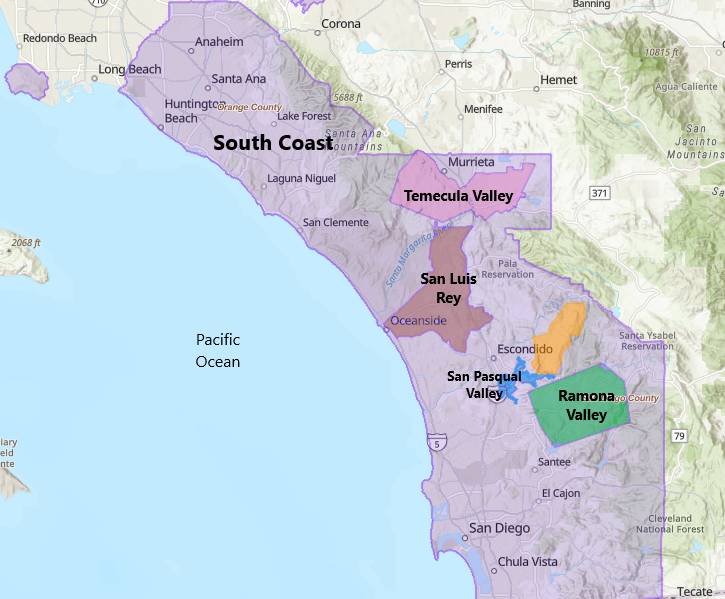
Sout Coast California wine region
South Coast AVA
The South Coast AVA is a historical region stretching from Los Angeles to the Mexican border. It features high plateaus and unique “rainbow gaps” in the mountains that pull in ocean air to cool the vineyards. This was the first area in California where grapes were planted by Spanish missionaries, and it retains a strong sense of historical authority. The soils are predominantly granitic, providing excellent drainage and a specific mineral profile to the wines. Today, the region is a leader in the production of Mediterranean and Italian varietals, which find a perfect home in the warm, sunny climate and unique coastal-inland meso-climates.
-
Wine Style: Full-bodied, ripe, and fruit-forward with moderate acidity and soft tannins.
-
Aging Potential: Generally 3–10 years; top-tier Temecula Syrahs can age longer.
Inland: Temecula Valley, Cucamonga Valley, Ramona Valley, San Pasqual Valley
Temecula is the most prominent, specializing in Syrah and Mediterranean varieties. The high altitude and cooling winds allow for the production of balanced wines with great intensity. These inland AVAs are a testament to California’s ability to produce high-quality wine in diverse and challenging environments. The granitic soils and intense sunshine create wines with deep color and bold fruit profiles, making them a favorite for those who enjoy powerful, sun-ripened reds with a soft, accessible texture.
-
Wine Style: Rich and sun-ripened with bold fruit flavors of plum and leather.
-
Aging Potential: 5–8 years.
Coastal Malibu Coast, Palos Verdes Peninsula, Saddle Rock-Malibu, Malibu-Newton Canyon
Small, boutique AVAs on rugged hillsides overlooking the Pacific. These are some of the most exclusive and difficult-to-farm vineyards in California, with vines clinging to steep slopes above the ocean. The maritime influence is extreme, resulting in wines with a distinct saline character and bright, high-toned fruit. These “urban” AVAs represent the surprising versatility of the South Coast, proving that world-class wine can be produced even in the shadows of one of the world’s largest metropolitan areas.
-
Wine Style: Elegant and aromatic with a distinct saline note and bright berry fruit.
-
Aging Potential: 5–10 years.
California AVA wine appelations in a nutshell
There are 147 American Viticultural Areas (AVAs) and regional classifications listed in the provided structure for California.
-
1 North Coast: 47 AVAs/Classifications
-
2 Central Coast: 42 AVAs/Classifications
-
3 Inland & Sierra Foothills: 45 AVAs/Classifications
-
4 South Coast: 13 AVAs/Classifications
Based on the official TTB (Alcohol and Tobacco Tax and Trade Bureau) classifications, here is the hierarchical structure for California’s wine regions and AVAs, following the requested model:
1 North Coast AVA
1.1 Napa Valley AVAs 1.1.1 Napa Valley (Regional) 1.1.2 The Mountain Appellations: Atlas Peak, Diamond Mountain District, Howell Mountain, Mount Veeder, Spring Mountain District 1.1.3 The Valley Floor & Benchlands: Calistoga, Chiles Valley District, Coombsville, Oak Knoll District of Napa Valley, Oakville, Rutherford, St. Helena, Stags Leap District, Yountville 1.1.4 Cross-Border AVAs: Los Carneros (Napa/Sonoma), Wild Horse Valley (Napa/Solano)
1.2 Sonoma County AVAs 1.2.1 Northern Sonoma: Alexander Valley, Chalk Hill, Dry Creek Valley, Knights Valley, Russian River Valley 1.2.2 Coastal & Marine influenced: Fort Ross-Seaview, Fountaingrove District, Green Valley of Russian River Valley, Petaluma Gap, Rockpile, Sonoma Coast, West Sonoma Coast 1.2.3 Sonoma Valley & Southern: Bennett Valley, Moon Mountain District, Sonoma Mountain, Sonoma Valley
1.3 Mendocino & Lake County AVAs 1.3.1 Mendocino: Anderson Valley, Cole Ranch, Covelo, Dos Rios, Eagle Peak Mendocino County, Mendocino Ridge, McDowell Valley, Potter Valley, Redwood Valley, Yorkville Highlands 1.3.2 Lake County: Benmore Valley, Big Valley District, Clear Lake, Guenoc Valley, High Valley, Kelsey Bench, Red Hills Lake County
2 Central Coast AVA
2.1 San Francisco Bay & Northern Central Coast 2.1.1 San Francisco Bay (Regional) 2.1.2 Alameda & Contra Costa: Livermore Valley, Lamorinda 2.1.3 Santa Clara & San Benito: San Ysidro District, Santa Clara Valley, Cienega Valley, Lime Kiln Valley, Mt. Harlan, Paicines 2.1.4 The Outliers: Santa Cruz Mountains, Ben Lomond Mountain (Legally separate from the Central Coast AVA boundary)
2.2 Monterey County AVAs 2.2.1 Monterey (Regional) 2.2.2 Sub-Appellations: Arroyo Seco, Carmel Valley, Chalone, Hames Valley, San Antonio Valley, San Bernabe, San Lucas, Santa Lucia Highlands
2.3 San Luis Obispo & Santa Barbara AVAs 2.3.1 Paso Robles: Adelaida District, Creston District, El Pomar District, Estrella District, Geneseo District, Highlands District, San Juan Creek, San Miguel District, Santa Margarita Ranch, Templeton Gap District, Willow Creek District 2.3.2 San Luis Obispo Coastal: Arroyo Grande Valley, Edna Valley, San Luis Obispo Coast 2.3.3 Santa Barbara County: Alisos Canyon, Ballard Canyon, Happy Canyon of Santa Barbara, Los Olivos District, Santa Maria Valley, Santa Ynez Valley, Sta. Rita Hills
3 Inland & Sierra Foothills
3.1 Lodi & The Delta 3.1.1 Lodi (Regional) 3.1.2 Lodi Sub-AVAs: Alta Mesa, Borden Ranch, Clements Hills, Cosumnes River, Jahant, Mokelumne River, Sloughhouse
3.2 Sierra Foothills AVA 3.2.1 Sub-Appellations: California Shenandoah Valley, El Dorado, Fair Play, Fiddletown, North Yuba
3.3 Central Valley (Other) 3.3.1 Notable AVAs: Clarksburg, Diablo Grande, Dunnigan Hills, Madera, Merritt Island, Salado Creek, Tracy Hills
4 South Coast AVA
4.1 Southern California AVAs 4.1.1 Inland: Temecula Valley, Cucamonga Valley, Ramona Valley, San Pasqual Valley 4.1.2 Coastal: Malibu Coast, Palos Verdes Peninsula, Saddle Rock-Malibu, Malibu-Newton Canyon