Table of Contents
The viticultural identity of Napa Valley is an intricate tapestry woven from millions of years of geological upheaval, maritime influence, and relentless human ambition. This narrow corridor, stretching a mere thirty miles, has ascended to the status of a global benchmark, not merely through the quality of its yields but through a profound connection to a diverse and ancient landscape. The “soul” of the region is defined by its dramatic topography, where the jagged heights of the Mayacamas and Vaca Mountains frame a valley floor composed of complex alluvial fans and volcanic remnants. To understand this terrain is to recognize terroir as a form of cultural heritage, where the physical characteristics of the earth—the grit of the Oakville gravels and the iron-rich dust of Rutherford—are translated into a liquid narrative of prestige and power.
The allure of this landscape for the luxury traveler lies in its sensory depth and historical significance. From the mid-19th century pioneers to the modern visionaries who established its international dominance, the region has evolved into a living laboratory of excellence. Every vineyard represents a precise intersection of specific pedological traits and micro-climatic nuances, creating a mosaic of growing conditions that rivals any historic European estate. This guide serves as the definitive technical exploration of those foundations, analyzing the cooling fogs, the radiant solar heat, and the half-dozen soil orders that coalesce to produce wines of unparalleled structure and elegance.
Uncork the Magic of Napa Valley


Soils of Napa Valley The Complex Chemistry of Soil and Bedrock
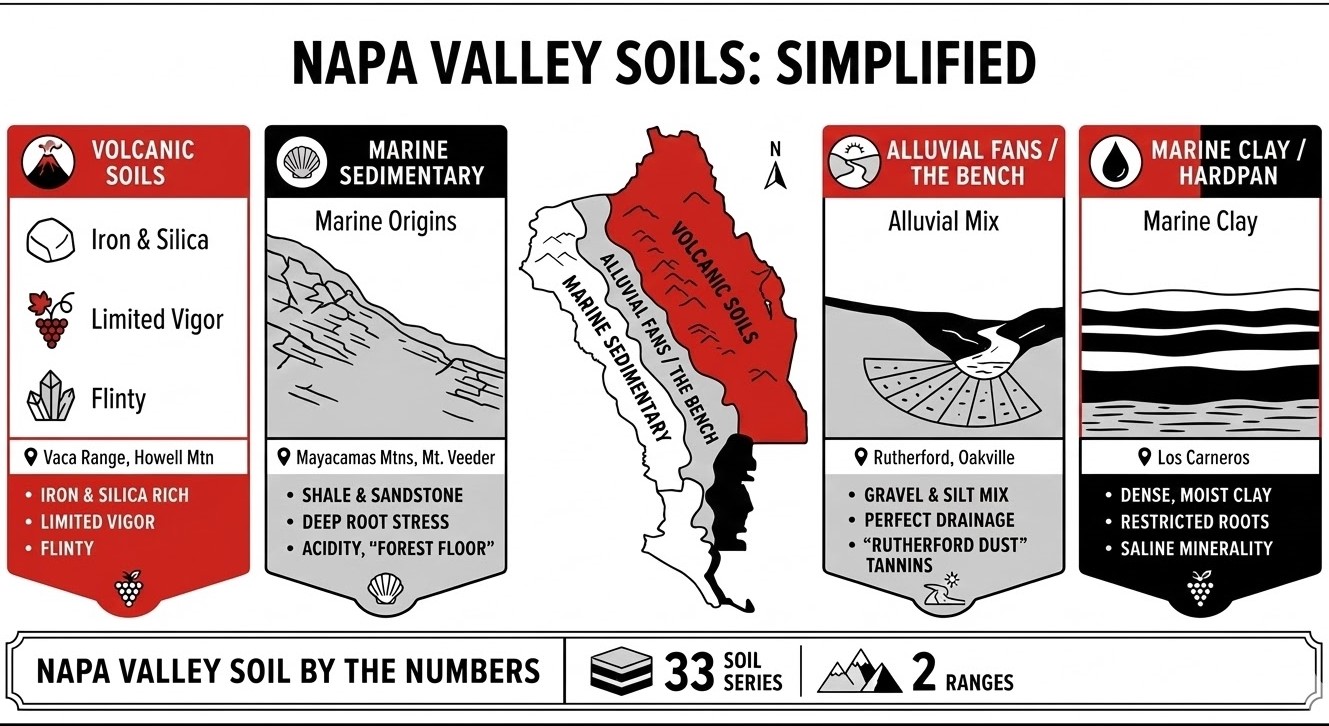
The geological history of the region is a saga of tectonic collision, volcanic eruption, and marine retreat, resulting in a pedological map of extraordinary complexity that contains 33 different soil series and half of the world’s soil orders. To understand the wines of this valley, one must delve into the deep chemistry of the bedrock and the varying textures of the surface soil.
Volcanic Parent Material: The Vaca and Northern Influence
The eastern Vaca Range and the northern reaches of the valley are dominated by the Sonoma Volcanics, a series of lava flows and ash deposits from the Pliocene epoch. These soils are primarily composed of weathered basalt, andesite, and rhyolite. In high-elevation areas like Pritchard Hill and Atlas Peak, the soil is often the Aiken series—a vibrant red, iron-rich loam. The high iron content is a critical chemical component; it acts as a catalyst in the synthesis of certain flavor compounds and is frequently linked to the “bloody,” “rusty,” or mineral-savory notes found in the resulting wines.
In contrast, the volcanic ash or “tufa” found in parts of Coombsville and Howell Mountain creates a very different environment. These soils, such as the Keefers or Forward series, are light-colored and porous. They provide excellent drainage but also act as a thermal insulator, keeping the root zones cooler during the heat of the day. This volcanic ash is rich in silica, which can impart a flinty or “pencil lead” aromatic profile to the Cabernet Sauvignon. The lack of organic matter in these volcanic soils naturally limits the vigor of the vine, forcing it to focus its energy on fruit production rather than leaf growth, resulting in small, thick-skinned berries with immense phenolic depth.
Marine Sediments and Shales: The Mayacamas Heritage
The western Mayacamas Mountains feature more ancient marine sedimentary soils, remnants of an uplifted seabed that predates the volcanic activity of the east. These include sandstone, shale, and conglomerate materials from the Franciscan Complex. In sub-appellations like Mount Veeder and Spring Mountain District, the soils are characterized by the Felton and Laugenour series—thin, stony, and nutrient-poor.
These marine soils are often more acidic and contain different trace minerals than their volcanic counterparts. The presence of decomposed shale and sandstone creates a physical barrier that forces the vines to send roots deep into the fractured bedrock in search of moisture and nutrients. This struggle is reflected in the wine’s structure; marine-influenced mountain wines often exhibit a high degree of “tension,” with elevated acidity and a distinct “forest floor” or “dried herb” aromatic profile. The clay content in some of these sedimentary soils allows for a slow release of water, which is essential during the dry summer months, providing the vines with just enough hydration to prevent shutdown without encouraging excessive vigor.
Alluvial Fans and the Hierarchy of the Bench
The valley floor is defined by its alluvial fans—tapering deposits of sediment washed down from the mountain canyons over millennia. This is where the concept of “the bench” originates, referring to the slightly elevated, well-drained slopes at the foot of the mountains. The most celebrated soil series here is the Bale Loam, which defines the Oakville and Rutherford benches.
Bale Loam is a complex mixture of gravel, sand, and silt. The physical structure of this soil is its greatest asset; the gravel provides instantaneous drainage, while the silt and clay components retain just enough nutrients to support healthy, balanced growth. This balance allows the vine to achieve perfect physiological ripeness. In areas like Oakville, the high gravel content in the Pleasanton or Zamora soil series ensures that the root zone remains warm, facilitating early bud break and even ripening.
Furthermore, the hydrology of these alluvial fans is unique. As water moves through the gravelly layers, it carries minerals from the mountains above, enriching the soil chemistry of the valley floor. The “Rutherford Dust” is not merely a metaphor; it is a sensory manifestation of this specific soil chemistry—a fine-grained, cocoa-like tannin structure that occurs when the vine reaches its ideal stress level in these porous, mineral-rich alluvial deposits.
Clay and Marine Hardpan: The Southern Frontier
In the southern reaches of the valley, particularly in Los Carneros, the geology shifts again toward marine-derived clays. The Haire and Coombs soil series dominate this landscape. These soils are heavy, retain significant moisture, and sit atop an impervious marine hardpan. This environment is naturally cooler and more restrictive for the roots, making it the premier site for Chardonnay and Pinot Noir. The high magnesium and calcium levels often found in these marine clays contribute to the vibrant, saline minerality and “nerve” that define the white wines of the region.
Macro-Climate and Viticultural Foundations In Napa Valley
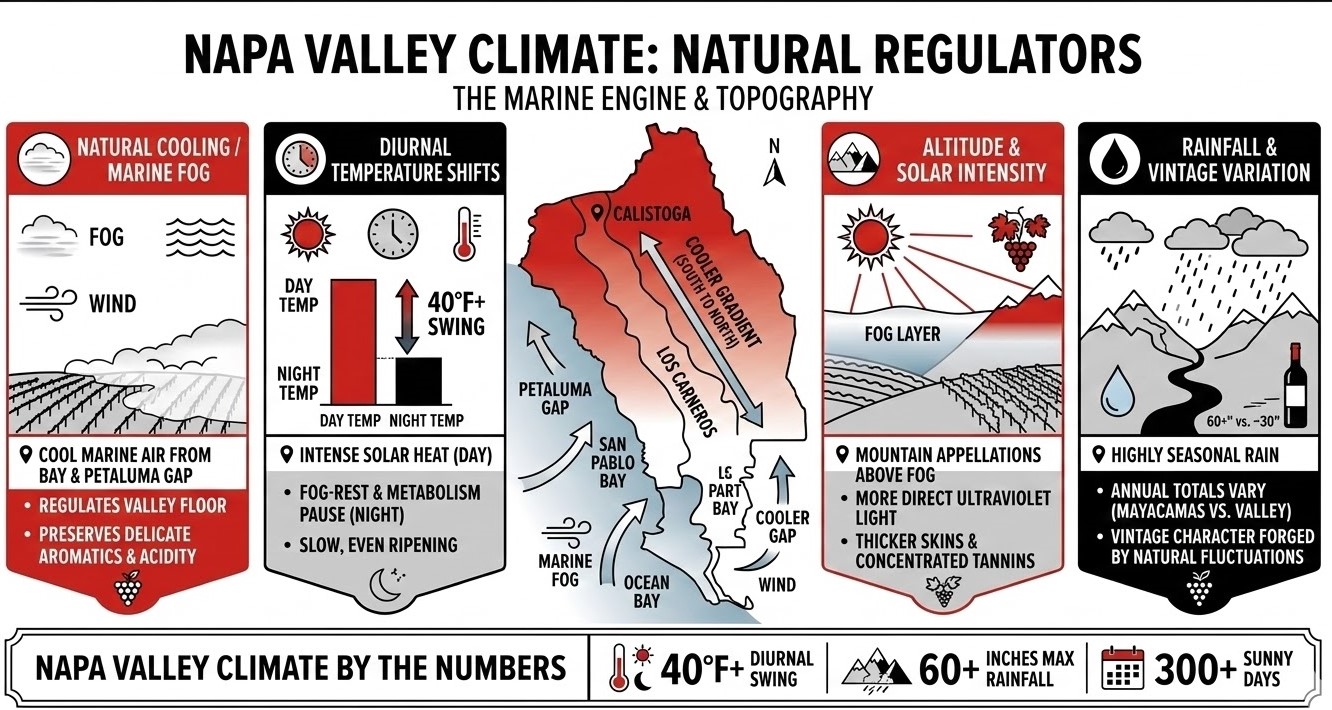
The success of the region is predicated on a classic Mediterranean climate, characterized by warm, arid summers and mild, wet winters. However, the macro-climate is defined by a sophisticated natural cooling system that mitigates the potential for excessive heat accumulation, ensuring that the fruit maintains a balance between physiological ripeness and structural acidity. This climatic equilibrium is what allows the region to produce wines that possess both opulent fruit and a firm, age-worthy backbone.
Wind and Water: The Marine Engine
The primary cooling influence is the intrusion of marine air and fog from the San Pablo Bay to the south and the Petaluma Gap to the west. This “fog engine” creates a significant thermal gradient across the valley; southern areas such as Los Carneros are profoundly influenced by these maritime breezes, remaining significantly cooler than the northern reaches of Calistoga. As the interior valley floor warms during the day, the rising air creates a vacuum that pulls the cool, dense marine layer inland. This movement of air acts as a natural regulator, preserving the delicate aromatic precursors in the grapes and preventing the rapid degradation of acidity that can occur in hotter climates. The fog typically blankets the valley floor during the night and early morning, retreating toward the bay as the sun rises, which provides the vines with a gentle awakening and protects the fruit from the initial intensity of the morning sun.
Diurnal Temperature Shifts
The region is famous for its dramatic diurnal temperature swings, which can often exceed 40 degrees Fahrenheit within a single twenty-four-hour cycle. During the daylight hours, intense solar radiation facilitates the development of sugars and complex phenolic compounds, including tannins and anthocyanins. When the sun sets and the marine fog rolls in, the sudden temperature drop effectively “rests” the vines, slowing their metabolism. This pause is critical for the development of “nervosity” in the wine, allowing for a long, slow ripening period that maximizes flavor complexity without sacrificing the structural integrity provided by natural malic and tartaric acids. This cycle ensures that while the grapes achieve full phenolic maturity, they do not become overripe or flabby, maintaining a vibrant tension on the palate.
Altitude and Solar Intensity
Topography introduces a vertical dimension to the climate. While the valley floor relies on fog for cooling, the mountain appellations—including Howell Mountain, Mount Veeder, Spring Mountain District, and Diamond Mountain District—frequently sit above the fog line, a phenomenon known as the thermal inversion layer. These high-altitude sites are exposed to more direct and intense ultraviolet light, which stimulates the production of thicker grape skins and more robust, concentrated tannin profiles. Because these mountain sites stay warmer at night than the valley floor (as they remain above the cool air trapped in the valley), they experience a remarkably consistent ripening environment. This results in mountain wines that are characterized by deep color, profound structure, and a distinct mineral intensity that differs sharply from the more plush, fruit-forward profiles of the valley floor.
Rainfall Patterns and Vintage Variability
Rainfall is highly seasonal, with the vast majority of precipitation occurring between November and April. Annual totals vary wildly across the region; the Mayacamas Mountains can receive over 60 inches of rain, while the valley floor near St. Helena may see less than half of that. This variability, alongside the periodic influence of “atmospheric rivers,” defines the character of each vintage. In dry years, the vines produce smaller berries with high skin-to-juice ratios, leading to immense concentration and firm structures. In wetter years, the focus shifts to expert canopy management to ensure fruit purity and prevent disease. The regional reputation is forged through the mastery of these natural fluctuations, where the winemaker must adapt to the specific “voice” of the year.
Napa Valley Climate, Soil, and Geology by Sub-Region
The Valley Floor: Alluvial Mastery
The valley floor represents the heart of the region’s historical and economic dominance, defined by a series of expansive alluvial fans that have created some of the most sought-after viticultural real estate in the world. These “benchlands” are characterized by a unique hydrological balance where the fertile power of the valley is tempered by the excellent drainage provided by mountain runoff.
In this zone, the mastery of the soil is found in its texture; the combination of ancient riverbed gravels and silty loams allows the vines to self-regulate, producing fruit with a high degree of phenolic maturity and a legendary structural elegance. The valley floor is where the concept of “plushness” meets “precision,” creating the gold standard for New World Cabernet Sauvignon. growing.
This region is geographically defined by its rugged coastal ranges and interior valleys that act as conduits for cooling marine air, allowing for a diverse range of varieties to reach optimal phenolic maturity. It is here that the intersection of tectonic activity and ancient volcanic legacy has produced some of the most complex soil profiles on the planet.
Oakville
Situated in the heart of the valley, Oakville represents the peak of alluvial precision. The geology is defined by the massive fans extending from the Mayacamas, primarily composed of the Bale and Pleasanton loam series. These gravel-heavy soils yield wines with a polished, “liquid silk” power. Notable vineyards such as the To Kalon Vineyard, Martha’s Vineyard, and Harlan Estate sit upon these benches, where the drainage dictates a hierarchy of quality that is undisputed.
Rutherford
Adjacent to the north, Rutherford sits on a wider part of the valley where the fans are even more expansive. The soil contains a higher proportion of volcanic wash-off, contributing to the famous “Rutherford Dust” tannins. Historic estates like Inglenook, Beaulieu Vineyard, and Staglin Family Vineyard produce wines with a distinct earthy-mineral core and notes of cedar and black cherry.
Stags Leap District
Located along the eastern Vaca Range, the Stags Leap District is defined by basalt “talus” slopes—rocky debris that has fallen from the cliffs above. The soil is a mix of this volcanic rock and old riverbed gravels. This creates a unique micro-climate where the rocks radiate heat, yet the district is cooled by breezes from the bay. The wines from Stag’s Leap Wine Cellars and the Fay Vineyard are known for their “fist in a velvet glove” texture.
Los Carneros
At the southern boundary, Los Carneros is defined by its shallow, clay-dominant soils. The proximity to the San Pablo Bay makes it the coolest sub-region. The Pinot Noir and Chardonnay from sites like the Hyde Vineyard and Hudson Vineyard are prized for their high acidity and distinct saline edge, a direct result of the marine clay influence.
The Mountain Appellations: Rugged Intensity
As one ascends the slopes of the Vaca and Mayacamas ranges, the viticultural landscape transforms into an environment of rugged intensity and profound environmental stress. The mountain appellations are defined by their separation from the valley’s cooling fog and their foundation on ancient, nutrient-poor bedrocks—be they volcanic ash or uplifted marine shale. Here, the “rugged” nature of the terroir is a literal description of the terrain, where vines must compete for survival in thin, stony soils. This results in naturally low yields and berries that are small and concentrated. The wines of the mountains are not defined by the opulence of the valley floor, but by their massive structural integrity, deep color, and a persistent mineral “grip” that reflects the uncompromising nature of the heights.
Howell Mountain
Howell Mountain is characterized by its volcanic “white ash” and red Aiken soils. Sitting high above the fog, it receives intense solar radiation. The wines, such as those from Dunn Vineyards and La Jota Vineyard, are noted for their massive tannins and notes of graphite and wild mountain berries..
Mount Veeder
The steepest slopes in the region are found on Mount Veeder, where the soils are primarily uplifted marine sedimentary. The cool climate and poor soils lead to the longest growing season in the valley. The Cabernet Sauvignon from Mayacamas Vineyards and The Hess Collection exhibits a briary, savory complexity and high structural acidity.
Pritchard Hill
Though not an official AVA, Pritchard Hill is a high plateau of red volcanic rock with exceptional iron content. It is home to elite producers like Colgin Cellars, Continuum, and Chappellet. The wines here are defined by a singular mineral-blood orange note and an intensity that rivals any Grand Cru site in the world.
The Human Touch: The Art of Viticultural Mastery
The expression of terroir is never accidental; it is the result of meticulous human adaptation to the diverse geological and climatic variables of the region. Growers must interpret the land, making technical decisions that either highlight or harmonize the natural characteristics of each site.
Adaptation to Soil and Slope
Man adapts to the diverse soils by selecting specific rootstocks that can thrive in varying conditions. In the rocky, volcanic soils of Diamond Mountain District, drought-tolerant rootstocks like 110R or 1103P are utilized to ensure the vine’s survival in thirsty conditions. Conversely, in the more fertile clays of Los Carneros, vigor-reducing rootstocks like 101-14 or 3309C are chosen to prevent excessive leaf growth and ensure fruit concentration. Pruning methods such as Double Guyot or Cordon are applied based on the specific architecture of the vine, ensuring an optimal balance between the canopy and the fruit.
Precision in the Vineyard and Cellar
Technical precision is required to manage the intense solar radiation. Vertical Shoot Positioning (VSP) is common, but in the heat of Calistoga, growers may allow for more “sprawl” to provide shade for the fruit. Row orientation is often calculated to be 45 degrees off North-South to minimize direct afternoon sun exposure on the grape clusters, preventing “raisining.” In the cellar, a philosophy of “minimal intervention” has become the modern standard. By using gravity-flow systems to handle fruit gently, native yeast fermentations to capture the local microbiology, and a judicious use of French oak, winemakers ensure that the specific chemical signature of the Bale Loam or Aiken Loam is preserved in the final glass.
Napa Valley terroir: From Knowledge to Experience
The science of geology and the technicality of viticulture are written in the stones and the vines, but the wine itself is a living liquid that serves as the ultimate synthesis of these elements. To truly understand the relationship between the marine sediments of the west and the volcanic loams of the east, one must experience them in situ. The theoretical knowledge of a soil’s pH or a region’s degree-day accumulation is merely a prelude to the sensory reality of the landscape.
We invite you to transition from the theoretical to the experiential. This is a professional, high-end invitation to join curated wine tours that allow you to walk the very soils—the gravels of Oakville, the volcanic ash of Howell Mountain, and the iron-rich clays of Pritchard Hill—described in this guide. To stand in the To Kalon Vineyard as the morning fog retreats is to understand the “soul” of this region in a way that no text can fully convey. While the geology is eternal, the experience of a single vintage in the heart of the valley is a fleeting, sophisticated opportunity to connect with one of the world’s most prestigious and complex landscapes.