Table of Contents
The Mâconnais represents a vital, sun-drenched transition in the heart of Burgundy, serving as the luminous gateway between the continental rigors of the north and the Mediterranean warmth of the south. To understand this region is to understand a landscape defined by rolling limestone ridges and verdant valleys that have been cultivated for over a millennium. Established as a global benchmark for Chardonnay, the Mâconnais offers a unique expression of the grape that balances opulence with a structural mineral core. This is a land where history is etched into the very stones of the Romanesque churches, a testament to the Benedictine monks of Cluny who first recognized the divine potential of these specific slopes.
The soul of the Mâconnais is found in its topographical diversity. Unlike the linear escarpment of the Côte d’Or, here the land ripples in a series of North-South faults, creating a mosaic of micro-climates that allow for an extraordinary range of stylistic expressions. As a luxury travel destination, it offers an authentic, grounded elegance; to walk through the vineyards of Pouilly-Fuissé or to look up at the monumental Rock of Solutré is to engage with a cultural heritage where viticulture is the primary language. This region does not merely produce wine; it translates a complex geological history into a living liquid that captures the precise vibration of the limestone underfoot. For the discerning enthusiast, the Mâconnais is a premier destination for those seeking the intersection of geological precision and prehistoric majesty
Journey to the Heart of Mâconnais
Soils of Mâconnais The Complex Chemistry of Soil and Bedrock
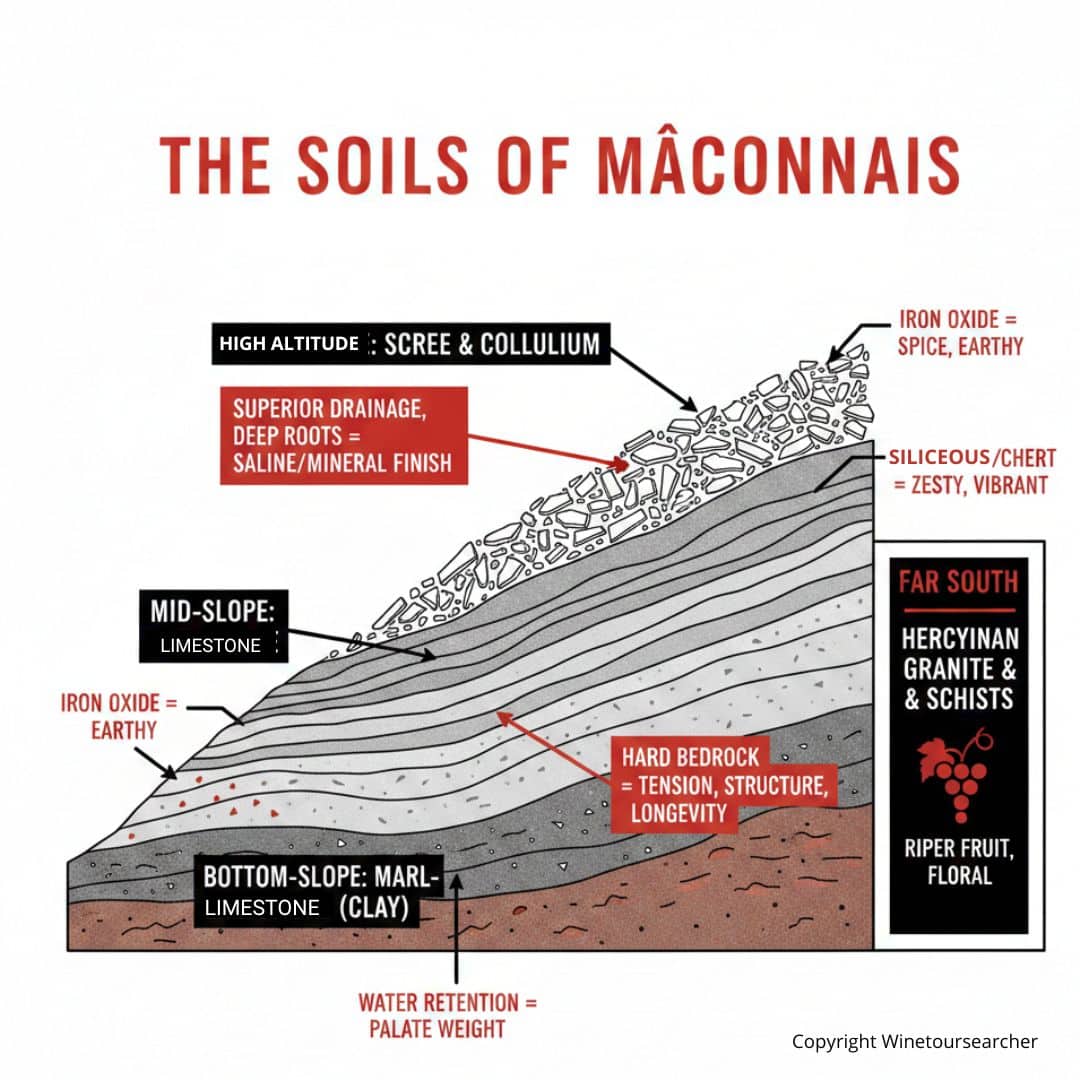
The geological foundation of the Mâconnais is a complex tapestry of Middle and Upper Jurassic formations, primarily dominated by various iterations of limestone and marl. The diversity of these soils is what necessitates the intricate breakdown of communal and regional appellations.
In the southern reaches, the geology shifts to include Hercynian granites and volcanic schists. However, the prestige of the region is built upon its limestone. The Bathonian limestone, specifically, is a hard rock that yields wines with great tension and longevity. Overlying this bedrock, one finds Marno-calcaires (marl-limestone), where the clay content increases. This clay is essential for water retention during the warmer summers, providing a steady supply of hydration to the vines, which translates into a broader palate weight in the finished wine.
Specific sites also feature Scree or Colluvium—loose rock fragments that have moved down-slope over millennia. These soils provide exceptional drainage, forcing the root systems to penetrate deep into the bedrock in search of nutrients. This deep rooting is often credited with the mineral or saline finish found in the high-altitude sectors. Furthermore, the presence of iron oxide in certain clay pockets can impart a subtle spice and earthy complexity to the wines.
Macro-Climate and Viticultural Foundations In Mâconnais
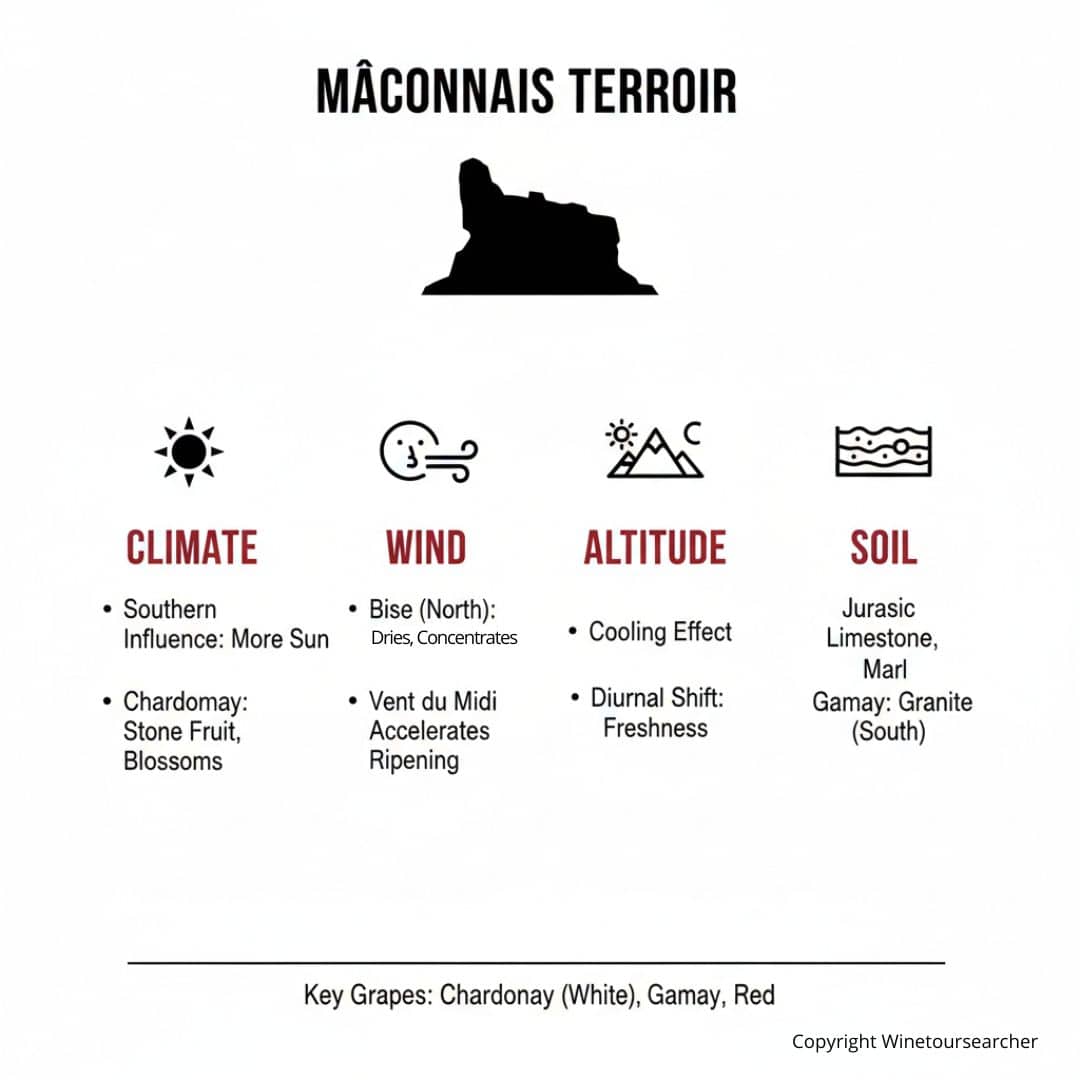
The climate of the Mâconnais acts as the primary architect of its wine’s generous character. While still classified as a semi-continental climate, it is significantly influenced by its proximity to the south, resulting in higher average temperatures and more sunshine hours than its northern neighbors. This slight increase in thermal units is critical for the reliable ripening of Chardonnay, leading to the characteristic notes of stone fruit and white blossoms.
Wind
The wind plays a dual role in the health and profile of the vineyards. The prevailing westerly winds bring moisture, but it is the “Bise”—a cold, dry wind from the north—that is most coveted by oenologists. The Bise acts as a natural antiseptic, drying the canopy after rainfall and concentrating the sugars and acids within the berries by reducing water volume. Conversely, the warm southern winds can accelerate ripening, sometimes necessitating an earlier harvest to preserve the vital acidity that prevents the wines from becoming overly heavy.
Water
Rainfall patterns in the Mâconnais are generally well-distributed, though summer thunderstorms can be intense, presenting a risk of erosion on the steeper slopes. Vintage variability is often defined by the timing of these rains; a dry late summer produces the powerful, concentrated wines, while a cooler, wetter season highlights the bright, citrus-driven profiles. The drainage capabilities of the soil are paramount here, ensuring that excess water does not dilute the mineral intensity of the fruit.
Altitude
The vineyards are situated at altitudes that provide a crucial cooling influence. This altitude facilitates significant diurnal temperature shifts—the difference between daytime heat and nighttime coolness. These shifts are essential for viticultural balance; while the daytime sun builds sugar levels, the cool nights slow the breakdown of malic acid, ensuring that even the most opulent wines retain a refreshing structural integrity.
Mâconnais Climate, Soil, and Geology by Sub-Region
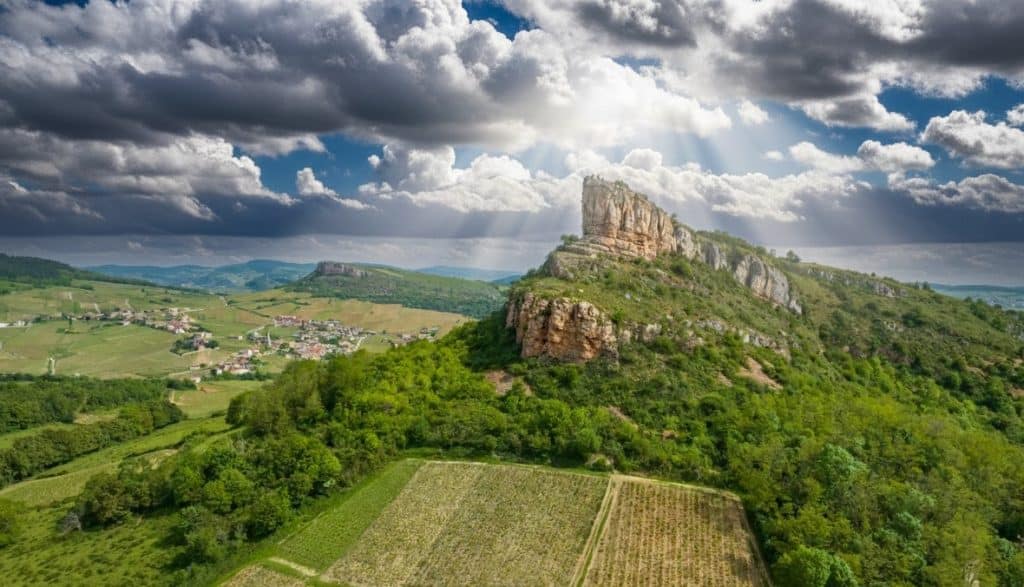
Rock of Solutré
Pouilly-Fuissé
This is the undisputed crown jewel of the Mâconnais, recognized with its own hierarchy of Premier Cru climats. The sub-region is defined by a dramatic amphitheatre of limestone centered around the villages of Fuissé, Solutré-Pouilly, Vergisson, and Chaintre.
Pouilly-Fuissé Premier Cru
The geology here is dominated by Bajocian limestone and fossiliferous marls. The high calcium carbonate content is the defining factor of the profile, yielding wines of immense power and longevity. In Fuissé, the soils are often heavier in clay, producing a plush, opulent texture with notes of ripe peach and hazelnut.
In contrast, the vineyards tucked under the Rock of Vergisson, such as La Maréchaude, sit on thinner, stonier soils. The excellent drainage and high mineral uptake here result in a distinctive gunflint or smoky aromatic profile. The Premier Cru status of specific plots is dictated by their mid-slope positioning, which maximizes sun exposure while ensuring the vines are never sitting in excess water.
Saint-Véran Appellation
The northern part, including Davayé, sits on Jurassic limestone, while the southern part near Chasselas and Leynes begins to show the transition toward granitic soils. This geological split is what makes Saint-Véran fascinating. The limestone-dominant sectors provide a chalky, citrus-forward wine with high acidity, while the plots with higher sand and flint content yield a softer, more floral expression. The hydrology of these slopes is excellent, with the porous limestone acting as a filter that regulates mineral uptake, contributing to the wine’s vibrant mouthfeel.
Viré-Clessé
Located further north, this appellation represents a unique micro-climate characterized by two parallel limestone ridges.
The terroir here is unique due to the presence of Cray, a specific type of white, chalky soil. This soil, combined with a slightly more humid micro-climate, allows for a very late ripening of the grapes. Historically, this led to wines with a touch of residual sugar, and even today, the dry wines possess an exotic fruit profile underpinned by a distinct honeyed note. The drainage in the slopes is moderated by the clay content, which ensures the wines have a characteristic weight and “gras” (fatness) on the mid-palate.
Mâcon-Villages and Communal Appellations
The broader Mâcon-Villages designation covers many high-quality sub-zones, each with its own geological thumbprint.
Mâcon-Lugny
One of the most recognized names, Lugny sits on a vast limestone plateau. The soil is predominantly Grèzes litées—small limestone fragments from the Quaternary period. This produces a wine that is consistently crisp and intensely floral.
Mâcon-Uchizy
Located on the northern edge, Uchizy benefits from a cooler influence, and its limestone soils have a high proportion of active lime. This leads to a wine with a very high aromatic intensity, often smelling of white flowers and lemon zest.
Mâcon-Ige and Mâcon-Azé
In these sub-appellations, the presence of iron oxide in the Calcareous clay creates a distinctive terroir. The high iron content in the clay yields a distinctive truffle note and an earthy complexity that sets these communal wines apart from the more citrus-driven styles of the south.
Milly-Lamartine
The vineyards of Milly-Lamartine are situated at higher elevations on thin, stony limestone. The hydrology here is sharp, with rapid drainage that stresses the vines just enough to produce high-acidity fruit. This results in wines with a vertical structure and a crystalline purity.
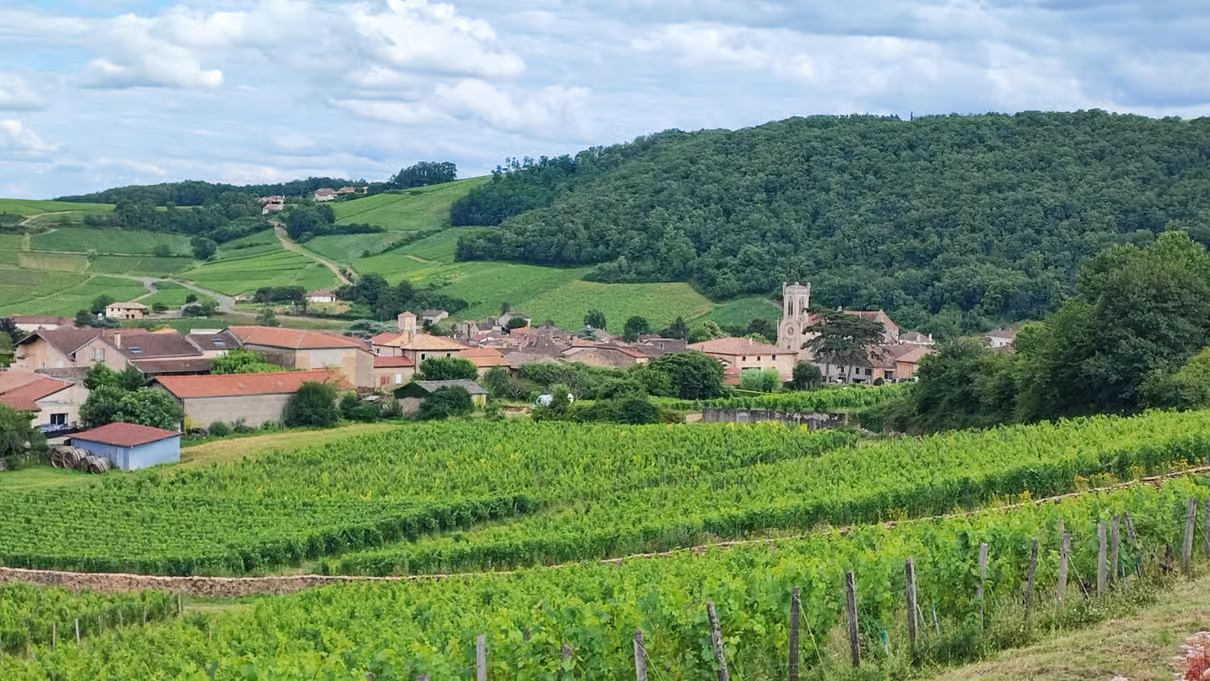
Village of Fuissé
The Human Touch: The Art of Viticultural Mastery
The role of the oenologist is to act as a transparent medium through which the diverse soils can express themselves. Because the region is warmer than northern Burgundy, man must adapt with precision. Pruning is typically handled via the Guyot or Cordon systems, which allow for careful control of yields. Canopy management is a rigorous year-round task; growers practice row orientation and leaf-thinning to ensure the grapes reach phenolic maturity without losing their delicate aromatics.
In the cellar, the philosophy has shifted toward minimal intervention. While many Pouilly-Fuissé wines are fermented in oak to add complexity, there is a growing movement toward technical precision to preserve the terroir’s expression. The goal is to ensure that the wine in the glass is a direct reflection of the Kimmeridgian marl or Granite from which it was born.
Mâconnais terroir: From Knowledge to Experience
While the science of geology is written in stone, the wine is a living liquid that must be experienced in situ. To truly understand the hierarchy of Grand Cru and Premier Cru plots, one must stand among the vines and feel the soil.
We invite you to join our curated wine tours to walk the very soils—the gravels, the limestones, the clays—described above. Experience the sophisticated intersection of history and geology in a high-end setting. The Mâconnais is calling; come and witness how the earth itself is transformed into liquid gold.