
Table of Contents
Western Europe's Great Wine Rivers at a Glance
Western Europe‘s great rivers have shaped the continent’s vineyards for over two thousand years. Beyond supplying water, they create favorable microclimates, moderate temperatures, improve drainage, and provide natural trade routes that helped establish many of Europe’s most famous wine regions.
From the Rhine and Moselle to the Loire, Rhône, Garonne, and Dordogne, these waterways have influenced where vineyards were planted, how grapes ripen, and how wines reached markets across Europe and beyond. Their valleys remain among the world’s most celebrated wine landscapes, combining exceptional terroirs with centuries of viticultural heritage.
| Feature | Western Europe's Wine Rivers at a Glance |
|---|---|
| Main Rivers | Rhine, Moselle, Loire, Rhône, Garonne, Dordogne, Seine and Meuse. |
| Primary Functions | Create favorable vineyard microclimates, shape terroirs, regulate temperatures, and support historic wine transportation. |
| Major Wine Regions | Bordeaux, Loire Valley, Mosel, Rheingau, Mittelrhein, Rhône Valley, Bergerac and Saint-Émilion. |
| Terroir Benefits | Temperature moderation, sunlight reflection, air circulation, alluvial soils, excellent drainage, and reduced frost risk. |
| Historic Importance | Roman vineyard expansion, medieval trade routes, monastery viticulture, and the rise of Europe's great wine cities. |
| UNESCO Landscapes | Upper Middle Rhine Valley, Loire Valley, Saint-Émilion and, more broadly, the Wachau Valley as a comparable European river wine landscape. |
| Famous Wine Cities | Bordeaux, Mainz, Koblenz, Trier, Strasbourg, Nantes and Rouen. |
| Why It Matters | Western Europe's great rivers continue to define vineyard locations, wine styles, regional identities, and one of the world's richest wine heritages. |
Why Rivers Became the Cradle of Western European Vineyards
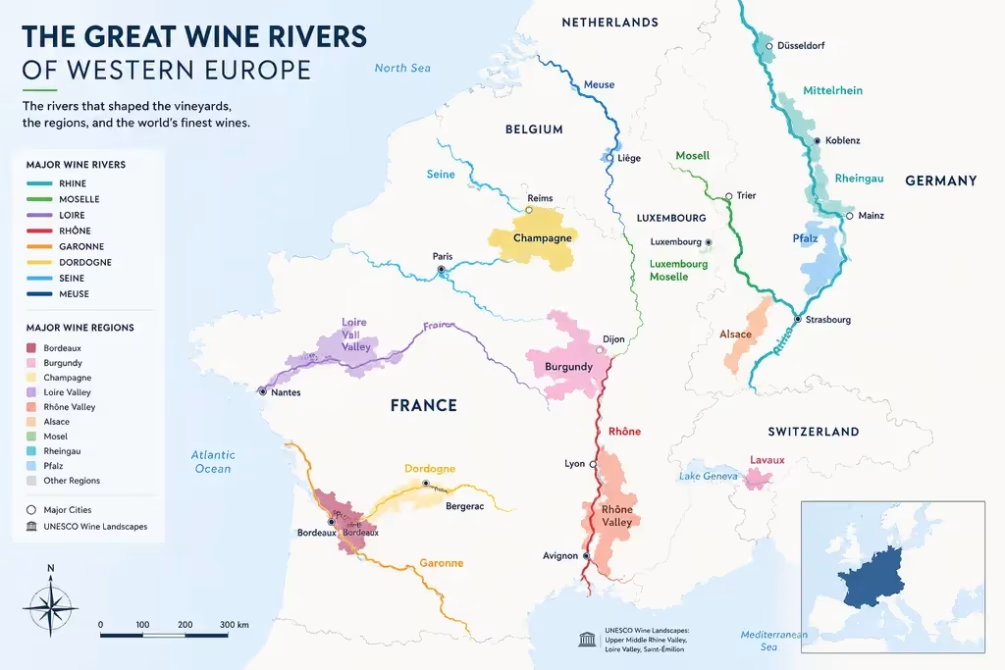
Long before modern irrigation, highways, or railways, rivers determined where people settled, farmed, and traded. Across Western Europe, they also became the natural foundation of some of the continent’s most celebrated wine regions. From the Rhine and Moselle in Germany to the Loire, Rhône, and Garonne in France, river valleys offered an exceptional combination of environmental conditions that allowed vineyards to flourish for centuries.
One of the greatest advantages of river valleys is their ability to create favorable microclimates. Large bodies of flowing water absorb heat during the day and release it slowly at night, helping to moderate temperature swings that can damage vines. This natural regulation reduces the risk of spring frost in many locations while extending the growing season, giving grapes more time to ripen gradually and develop complex aromas.
Topography is equally important. Rivers often carve steep valleys with slopes that receive abundant sunlight, particularly those facing south or southwest in the Northern Hemisphere. These hillside vineyards capture more solar energy than surrounding flatlands, improving grape ripening even in cooler climates. Famous examples include the dramatic slate-covered vineyards of Germany’s Moselle Valley and the terraced hillsides overlooking the Rhine.
Rivers also contribute to excellent soil conditions. Over thousands of years, they have deposited layers of gravel, sand, silt, and other alluvial materials that improve drainage while encouraging vine roots to grow deeper in search of water and nutrients. In many regions, vineyards combine these river deposits with underlying limestone, schist, granite, or volcanic bedrock, creating the diverse terroirs that give Western European wines their distinctive character.
Morning mists and humidity generated by rivers further influence vineyard conditions. While excessive moisture can increase disease pressure, carefully balanced humidity slows grape dehydration during hot summers and can create ideal conditions for noble rot (Botrytis cinerea) in certain regions. This naturally occurring fungus is responsible for some of Europe’s finest sweet wines, including those produced near the Garonne and Dordogne rivers in southwestern France.
Reliable access to fresh water also supported the growth of vineyard communities. Although mature grapevines generally require little irrigation, rivers supplied water for local populations, livestock, cooperages, and early winemaking operations. Their fertile valleys encouraged permanent settlements, many of which evolved into thriving wine-producing towns that continue to shape Europe’s wine culture today.
Perhaps most importantly, rivers connected vineyards to markets. Before the development of railroads and modern road networks, barrels of wine could be transported far more efficiently by boat than overland. Wine regions situated along navigable rivers gained direct access to major trading cities, ports, and international markets, allowing their reputations to spread across Europe and beyond.
The enduring relationship between rivers and vineyards demonstrates that great wine is never the result of a single factor. Climate, geology, topography, and human history all intersect along Europe’s great waterways, making river valleys some of the most remarkable wine landscapes in the world.
The Great Wine Rivers of Western Europe
Rhine
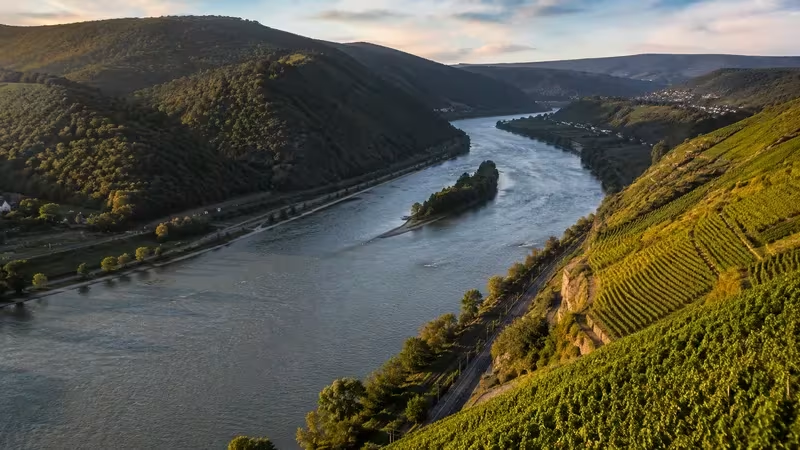
Flowing from the Swiss Alps to the North Sea, the Rhine is one of Europe’s most iconic wine rivers. Its steep valleys and south-facing slopes provide ideal conditions for vineyards, particularly in Germany’s renowned regions such as Rheingau, Mittelrhein, and parts of the Palatinate. The river moderates temperatures, reflects sunlight onto the vines, and helps reduce frost risk during the growing season.
Riesling is the grape most closely associated with the Rhine, producing wines celebrated for their vibrant acidity, mineral character, and remarkable aging potential. Beyond viticulture, the Rhine served as a major commercial highway throughout the Roman era and the Middle Ages, allowing wines to reach markets across Northern Europe.
Moselle/ Mosel
The Moselle, a tributary of the Rhine, is famous for its dramatic slate-covered hillsides that rank among the steepest vineyards in the world. Despite its cool climate, the river creates favorable conditions by reflecting sunlight onto the vines while the dark slate soils store heat and release it during the night.
These combined influences allow grapes to ripen slowly, producing elegant wines with intense aromatics and crisp acidity. The Moselle is internationally renowned for its Riesling wines, although Pinot Blanc, Elbling, and Pinot Noir are also cultivated. Its winding valley has become one of Europe’s most recognizable wine landscapes and remains a benchmark for cool-climate viticulture.
Loire
Stretching across central and western France, the Loire is the country’s longest river and supports one of its most diverse wine regions. Vineyards extend from the Atlantic-influenced vineyards near Nantes to the continental climate of Sancerre in the east.
The river moderates temperatures while its numerous tributaries create a wide range of local microclimates. This diversity allows growers to cultivate an exceptional variety of grape varieties, including Sauvignon Blanc, Chenin Blanc, Melon de Bourgogne, Cabernet Franc, and Pinot Noir. The Loire Valley is equally renowned for its historic châteaux, picturesque villages, and centuries-old wine traditions that have earned international recognition.
Rhône
Originating in the Swiss Alps before flowing south to the Mediterranean Sea, the Rhône supports two very different wine regions. The Northern Rhône is characterized by steep granite slopes producing world-famous Syrah, while the broader Southern Rhône benefits from a warmer Mediterranean climate that favors blends dominated by Grenache, Syrah, and Mourvèdre.
The river helps regulate temperatures, channels cooling winds such as the Mistral, and has deposited gravel and alluvial soils that contribute to excellent vineyard drainage. Throughout history, the Rhône also served as an important commercial corridor linking inland France with Mediterranean trade routes.
Garonne
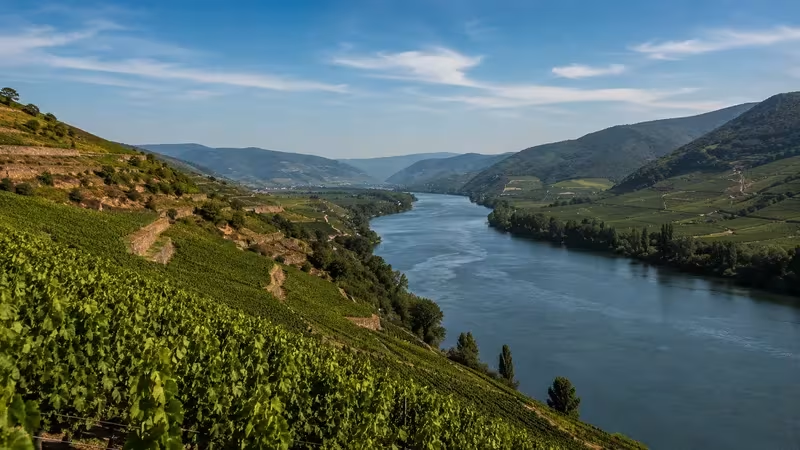
The Garonne rises in the Spanish Pyrenees before flowing northwest through southwestern France to Bordeaux, where it joins the Dordogne to form the Gironde Estuary. The river has played a central role in the success of Bordeaux by moderating temperatures, reducing frost risk, and depositing gravel-rich soils that are particularly well suited to Cabernet Sauvignon.
Morning mists created where the Garonne meets the cooler Ciron River also encourage the development of noble rot, making possible the legendary sweet wines of Sauternes. For centuries, the river carried Bordeaux wines to international markets, helping establish the region as one of the world’s leading wine capitals.
Dordogne
Flowing across central and southwestern France, the Dordogne contributes significantly to the vineyards of Bergerac and Saint-Émilion before joining the Garonne near Bordeaux. Its limestone hills, rolling valleys, and fertile terraces provide varied growing conditions for both red and white grape varieties.
Together with the Garonne, the Dordogne forms the Gironde Estuary, one of Europe’s most important historic gateways for wine exports. The river’s influence extends beyond viticulture, supporting picturesque villages, medieval towns, and landscapes that have become synonymous with France’s wine heritage.
Seine
Although less famous for vineyards than other European rivers, the Seine played an important historical role in the distribution of wine. Flowing through Paris before reaching the English Channel, it connected wine-producing regions of central France with one of Europe’s largest urban markets.
During the Middle Ages, countless barrels of wine traveled along the Seine to supply the growing population of Paris. While relatively little commercial viticulture exists along the river today, its importance in the history of France’s wine trade remains considerable.
Meuse
The Meuse flows through France, Belgium, and the Netherlands, linking several regions where viticulture has existed since Roman times. Although cooler conditions have traditionally limited large-scale wine production, vineyards along the Meuse are experiencing renewed interest as climate change gradually expands suitable growing areas.
The river has long served as a strategic commercial route connecting inland Europe with the North Sea, supporting the exchange of wine, agricultural products, and cultural influences. Today, emerging vineyards along the Meuse reflect the continuing evolution of Western European wine geography.
Together, these great rivers illustrate how waterways have done far more than shape the physical landscape. They have influenced climate, determined settlement patterns, facilitated commerce, and helped establish many of Western Europe’s most prestigious wine regions. Even today, their valleys remain among the continent’s most productive and scenic vineyard landscapes, demonstrating the enduring relationship between rivers and the art of winemaking.
How Rivers Built Europe's Historic Wine Trade
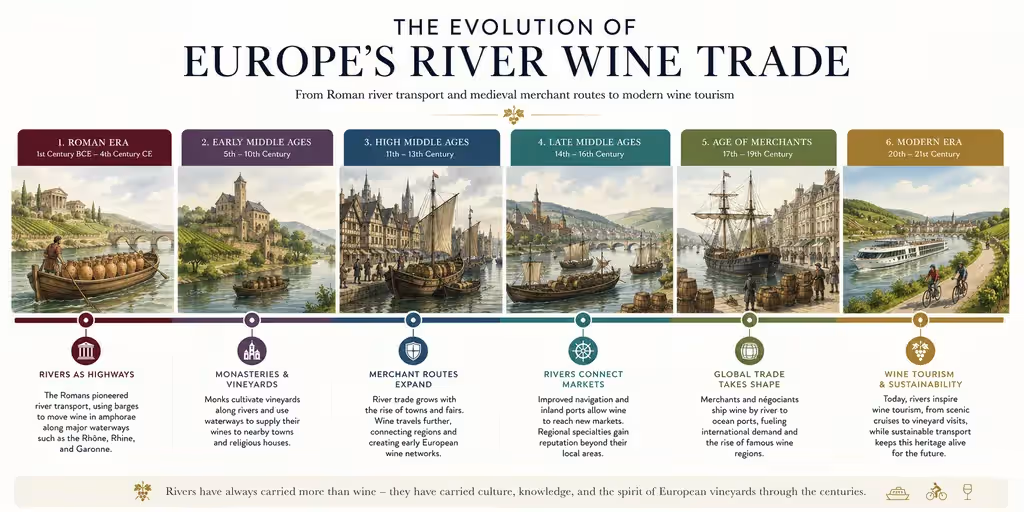
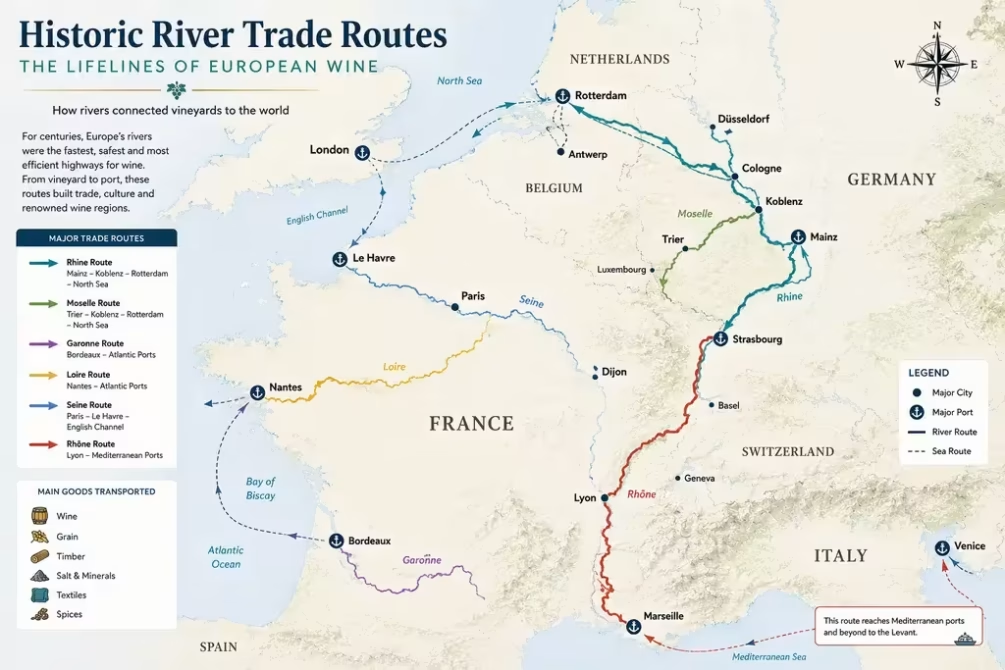
Long before railways, highways, and refrigerated transport, Europe’s rivers formed the continent’s most efficient trade network. For centuries, barrels of wine traveled downstream on barges and merchant vessels, connecting vineyards with growing cities, major seaports, and international markets. This access to reliable transportation transformed many river valleys into prosperous wine regions whose reputations extended far beyond their local borders.
Water transport offered significant advantages over overland travel. A single boat could carry dozens of heavy oak barrels that would have required many carts and draft animals to move by road. River navigation was generally faster, less expensive, and safer than crossing rough terrain, making it the preferred method for transporting wine from inland vineyards to coastal ports. These logistical benefits encouraged vineyard expansion along navigable waterways, where producers could reach customers more easily and at lower cost.
The Romans were among the first to recognize the strategic importance of Europe’s rivers for viticulture. As they expanded across Gaul and Germania, they established vineyards near major waterways such as the Rhine, Rhône, Moselle, and Garonne. These rivers supplied military settlements, growing towns, and frontier outposts while creating trade routes that linked wine-producing areas with the wider Roman Empire. Even after the empire’s decline, many of these river-based trade networks continued to flourish under medieval kingdoms and monastic communities.
During the Middle Ages, monasteries became some of Europe’s most influential vineyard owners, and rivers allowed them to distribute wine across vast distances. Benedictine and Cistercian monks cultivated vineyards near navigable waterways, using rivers to transport wine to religious houses, royal courts, and commercial centers. Their careful vineyard management and record-keeping helped improve wine quality while strengthening the reputation of many famous wine regions.
Several river ports grew into major commercial hubs because of the wine trade. Bordeaux became one of Europe’s leading export centers thanks to its position on the Garonne and the Gironde Estuary, where ships carried wines to England, the Low Countries, and beyond. Along the Rhine, cities such as Mainz, Koblenz, and Cologne prospered as merchants bought, stored, and redistributed wines from surrounding vineyards. Farther north, Rotterdam connected inland European trade with international shipping routes, while London became one of the largest foreign markets for French wines arriving by sea.
The Hanseatic League also contributed to the expansion of Europe’s wine commerce. This powerful alliance of merchant cities dominated trade across the North Sea and Baltic Sea from the 13th to the 17th centuries. Although the league is often associated with grain, timber, and textiles, its extensive trading network also facilitated the movement of wines from the Rhine and other river valleys to northern European markets, helping establish enduring commercial relationships.
River trade influenced not only the economy but also the evolution of wine styles. Regions with reliable export routes could specialize in producing wines that appealed to distant consumers, encouraging improvements in vineyard management, winemaking techniques, and barrel production. Competition between trading centers also stimulated innovation, while wealthy merchants invested in vineyards, storage facilities, and shipping infrastructure.
Although modern transportation has largely replaced river commerce, the legacy of these historic waterways remains visible today. Many of Western Europe’s most prestigious wine regions still follow ancient river corridors, and numerous wine towns owe their prosperity to centuries of trade carried on flowing water. The rivers that once transported barrels by barge continue to define Europe’s wine heritage, linking geography, commerce, and culture in ways that are still evident in the continent’s vineyards today.
Rivers, Terroir and Microclimates
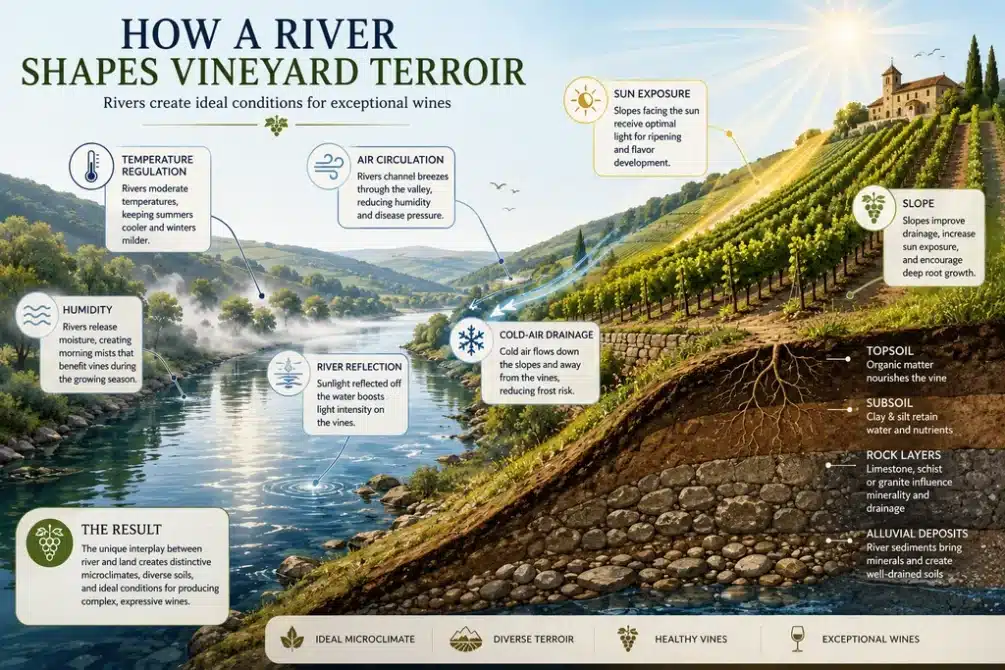
A river does far more than provide water. It influences temperature, sunlight, humidity, soil formation, and air circulation, creating a unique environment that can dramatically affect how grapevines grow and how wines taste. These interactions form an essential part of a vineyard’s terroir, helping explain why many of Western Europe’s finest wines are produced along river valleys.
One of the most significant benefits rivers provide is temperature regulation. Water warms and cools more slowly than land, absorbing heat during the day and gradually releasing it at night. This moderating effect reduces extreme temperature fluctuations, creating a more stable growing environment for vines. In cooler regions such as the Rhine and Moselle valleys, this additional warmth can make the difference between grapes that fully ripen and those that remain overly acidic.
Rivers also increase the amount of sunlight reaching the vines. Their reflective surfaces bounce solar radiation back toward nearby vineyards, particularly those planted on steep south-facing slopes. This natural reflection enhances photosynthesis and promotes more even grape ripening, an advantage that is especially valuable in northern wine regions where sunlight can be limited during the growing season.
Air circulation is another key factor. Cool air naturally flows downhill and often follows river valleys, reducing the likelihood of frost settling around vineyards. At the same time, gentle breezes improve ventilation within the canopy, lowering humidity around grape clusters and reducing the risk of fungal diseases. These natural airflow patterns allow growers to maintain healthier vines while relying less on intervention.
Humidity generated by rivers can have both positive and negative effects. Excessive moisture may encourage mildew and other vineyard diseases, requiring careful canopy management and monitoring. However, moderate humidity helps prevent grapes from drying out during warm weather and can create ideal conditions for the development of Botrytis cinerea, or noble rot. In regions such as Sauternes, where cool morning mists form as the Ciron River meets the Garonne, this fungus concentrates sugars and flavors to produce some of the world’s most celebrated sweet wines.
River systems also shape vineyard soils over thousands of years. Seasonal flooding deposits gravel, sand, silt, and clay across river terraces, creating diverse alluvial soils with excellent drainage. These deposits often combine with underlying limestone, granite, slate, schist, or volcanic rock, producing the complex geological foundations that define many famous European terroirs. Well-drained soils encourage vine roots to penetrate deeply, improving resilience during dry periods and allowing vines to access a wider range of minerals and nutrients.
Topography further amplifies the influence of rivers. Valleys often feature steep slopes that maximize sun exposure while providing natural drainage for both water and cold air. Terraced vineyards, common along the Moselle, Rhine, and parts of the Rhône, make use of these slopes to cultivate vines in locations that would otherwise be too rugged for agriculture. Although these sites require intensive manual labor, they frequently produce grapes of exceptional quality due to their favorable exposure and low natural yields.
Climate change is adding a new dimension to the relationship between rivers and vineyards. Rising temperatures, altered rainfall patterns, and more frequent droughts are increasing pressure on water resources while changing the suitability of traditional wine-growing areas. Some cooler river valleys are now producing increasingly ripe fruit, whereas warmer regions must adapt through improved water management, canopy techniques, and the selection of grape varieties better suited to evolving conditions.
The interaction between rivers, climate, geology, and topography illustrates why terroir is far more than a simple description of soil. River valleys create entire ecosystems that influence every stage of grape development, from budburst in spring to harvest in autumn. Their combined effects continue to shape the distinctive identities of Western Europe’s wine regions, making rivers one of the most important natural forces behind the character and quality of European wines.
The Historic Wine Cities Built on Rivers
Western Europe’s great wine cities did not emerge by chance. Most developed along major rivers that provided reliable water, fertile land, and efficient transportation long before modern infrastructure existed. These waterways allowed vineyards to flourish while connecting producers with merchants, consumers, and international markets. Over centuries, river cities became centers of commerce, winemaking, and cultural exchange, helping establish the reputations of many of Europe’s most famous wine regions.
Bordeaux
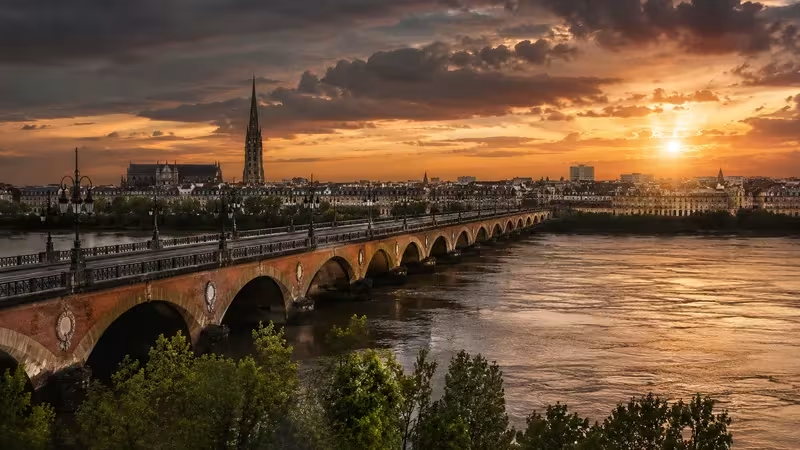
Located on the Garonne River near its meeting point with the Dordogne, Bordeaux grew into one of the world’s most influential wine trading cities. Its access to the Gironde Estuary allowed ships to transport wine directly to England, the Low Countries, and other European markets. From the Middle Ages onward, merchants developed an extensive export network that transformed Bordeaux into a global symbol of fine wine. The city’s commercial success also encouraged investment in surrounding vineyards, many of which remain among the most prestigious wine estates in the world.
Mainz
Situated on the Rhine River where it meets the Main, Mainz has been closely linked to viticulture since Roman times. Its strategic location made it an important center for wine production, storage, and distribution throughout the Holy Roman Empire. Today, Mainz serves as the gateway to several renowned German wine regions, including Rheinhessen and the Rheingau, while preserving a long tradition of wine festivals and regional wine culture.
Koblenz
Koblenz occupies one of Germany’s most significant river junctions, where the Moselle flows into the Rhine. This strategic position enabled merchants to collect wines from multiple vineyard regions before transporting them north toward commercial centers along the Rhine. Surrounded by steep vineyard-covered hillsides, Koblenz has long been a meeting point for growers, traders, and travelers exploring Germany’s historic wine landscapes.
Trier
Often regarded as Germany’s oldest city, Trier lies on the banks of the Moselle River and has cultivated vines for nearly two thousand years. Founded by the Romans, it became an early center of viticulture and wine commerce in northern Europe. The surrounding Moselle Valley remains internationally renowned for producing elegant Riesling wines, while Trier continues to celebrate its Roman heritage alongside its enduring wine traditions.
Strasbourg
Nantes
Rouen
Located along the Seine River, Rouen played an important role in the historic distribution of French wines to northern France and England. During the medieval period, merchants transported barrels along the Seine to supply Paris and other growing urban centers before continuing toward the English Channel. Although Rouen is no longer a major wine-producing city, its strategic river location contributed significantly to France’s early wine commerce.
Rivers That Created Enduring Wine Capitals
Despite their differences, these cities share a common foundation: each owes much of its historical prosperity to the river flowing through it. Their waterways connected vineyards with consumers, encouraged economic growth, and fostered centuries of cultural exchange that helped define Western Europe’s wine heritage. Even today, these historic river cities remain gateways to some of the continent’s most celebrated wine regions, illustrating how geography continues to influence both the business and culture of wine.
River Landscapes Recognised by UNESCO
Some of Western Europe’s most spectacular wine landscapes have earned recognition as UNESCO World Heritage Sites, reflecting not only their natural beauty but also the centuries of interaction between people, rivers, and vineyards. These cultural landscapes demonstrate how generations of winegrowers adapted steep hillsides, fertile valleys, and river terraces to create sustainable agricultural systems that continue to produce world-class wines today.
Upper Middle Rhine Valley
Loire Valley
Saint-Émilion
Although best known as one of Bordeaux’s most prestigious wine regions, Saint-Émilion also forms part of the wider Dordogne river basin. UNESCO designated the area as an outstanding cultural landscape because of its uninterrupted history of viticulture dating back to Roman times. Vineyards surround a remarkably preserved medieval town, where limestone plateaus, gentle slopes, and river-influenced valleys combine to create exceptional terroirs for Merlot and Cabernet Franc. The designation recognizes both the quality of the vineyards and the enduring relationship between wine production and human settlement.
Wachau Valley
While geographically located in Austria and therefore slightly beyond the traditional boundaries of Western Europe, the Wachau Valley is frequently cited as one of Europe’s greatest river wine landscapes. Following the Danube River between Melk and Krems, the valley is famous for its steep terraced vineyards, dry stone walls, and picturesque villages. Riesling and Grüner Veltliner thrive on rocky slopes overlooking the river, demonstrating how carefully managed river landscapes can produce wines of exceptional character. The Wachau provides an instructive comparison with the Rhine and Moselle, illustrating common patterns found across Europe’s historic wine valleys.
Why UNESCO Protects Wine Landscapes
Famous Wine Regions Along Western Europe's Great Rivers
| River | Major Wine Regions | Signature Wines & Grapes |
|---|---|---|
| Rhine | Rheingau, Mittelrhein, Pfalz | Riesling, Spätburgunder (Pinot Noir) |
| Moselle | Mosel | Riesling, Elbling, Pinot Blanc |
| Loire | Muscadet, Anjou, Saumur, Touraine, Sancerre, Pouilly-Fumé | Sauvignon Blanc, Chenin Blanc, Cabernet Franc, Melon de Bourgogne |
| Rhône | Northern Rhône, Southern Rhône | Syrah, Grenache, Mourvèdre, Viognier |
| Garonne | Bordeaux, Graves, Sauternes | Cabernet Sauvignon, Merlot, Sémillon, Sauvignon Blanc |
| Dordogne | Bergerac, Monbazillac, Saint-Émilion | Merlot, Cabernet Franc, Malbec, Sémillon |
| Seine | Historic trade corridor, Île-de-France vineyards | Limited modern production; historic wine transport route |
| Meuse | Belgian and Dutch river vineyards | Pinot Noir, Chardonnay, Solaris, Johanniter |
Although these rivers differ greatly in size, climate, and geography, they all demonstrate how closely Europe’s finest vineyards are linked to their surrounding landscapes. Cool northern rivers such as the Rhine and Moselle favor fresh, aromatic white wines with vibrant acidity, while warmer rivers like the Rhône and Garonne support the production of fuller-bodied reds and world-renowned sweet wines. The Loire stands apart for its remarkable diversity, producing everything from sparkling wines and crisp whites to elegant reds across more than 1,000 kilometers of river valley.
The relationship between rivers and wine extends far beyond the vineyard itself. River valleys encouraged the growth of towns, monasteries, and trading centers, creating networks that allowed local wines to gain international recognition. Many of today’s most prestigious appellations developed precisely because their wines could be transported efficiently to major markets by river and sea.
Even in regions where commercial viticulture is relatively limited today, such as along the Seine or the Meuse, rivers continue to shape local wine culture and influence the revival of vineyards. As climate conditions evolve, some of these lesser-known river valleys are once again attracting attention from winegrowers seeking new opportunities.
Together, these regions illustrate why the greatest wine landscapes of Western Europe are rarely isolated from water. Rivers have influenced where vineyards were planted, how grapes ripen, how wines were traded, and ultimately how many of Europe’s most famous wine regions came to achieve worldwide recognition.