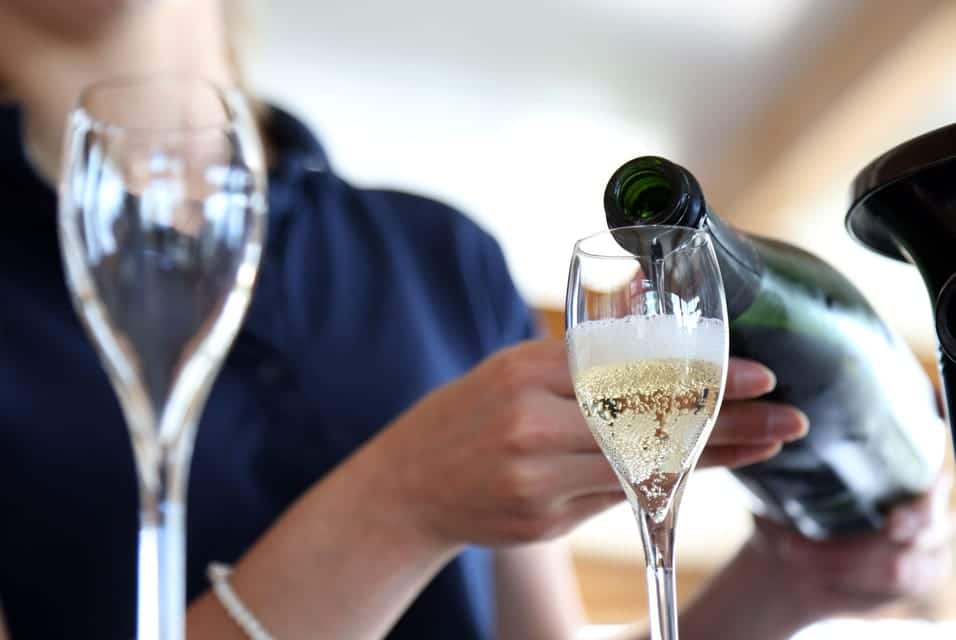
Picture a British merchant in the fading winters of the late 1600s, pacing a damp London cellar, staring at a landscape of empty racks where barrels of French claret should be. For centuries, the English upper classes had a predictable, deeply entrenched routine: they drank the light, dry red wines of Bordeaux. This trade was not just a commercial preference; it was a cultural pillar. But overnight, the geopolitics of Europe shifted, and the familiar flow of French wine evaporated.
The cause was not a failed harvest or a changing climate, but the brutal mechanics of economic warfare. A series of bitter military conflicts between England and France prompted the English government to levy massive, punitive tariffs, culminating in an outright embargo on French goods. Suddenly, a nation of thirsty, wealthy consumers was cut off from its primary source of alcohol. The demand had not disappeared, but the supply chain had been completely severed.
English merchants were forced to search the coastlines of Europe for a swift and reliable alternative. This search set off a chain of events that would completely redefine the global wine landscape. It is the core story of how a wartime trade ban accidentally created Port wine. This monumental shift was not born from a flash of creative genius or a sudden breakthrough in agricultural science. Instead, it emerged as a messy, desperate, and highly pragmatic response to politics, geographical distance, and the physical problem of getting delicate alcohol safely to market across treacherous seas.
For modern travelers planning a journey through Portugal, this history is vital because Port is never just a style of sweet wine sitting on a dessert menu. It is an artifact of survival. It represents a physical trade route, a brutal river culture, a beautifully harsh mountain landscape, and a masterclass in how logistical constraints can fundamentally reshape human taste for centuries. Few liquids on earth are as tightly bound to historical treaties and geological friction as Port, and few destinations reward intellectual curiosity quite like Portugal’s Douro Valley and the historic twin cities of Porto and Vila Nova de Gaia.
The Geopolitical Catalyst and the Messy Truth of Accident
The phrase fortified by accident sounds beautifully clean, evoking an image of a lone, clever merchant casually dumping a flask of brandy into a barrel and creating a global phenomenon. The historical reality is far messier and infinitely more fascinating. Port did not arrive on British tables overnight as a finished masterpiece. It was forged slowly by a sequence of economic crises, international treaties, and maritime realities that gradually pushed winemakers and English traders away from traditional winemaking toward a highly stable, completely unique product.
When the French embargoes hit, English merchants sailed south toward Portugal, a nation with which England shared long-standing diplomatic ties, anchored by the Treaty of Windsor back in 1386. Initially, merchants set up operations in the northern coastal town of Viana do Castelo, exporting the light, high-acid, astringent red wines from the verdant Minho region. The British market, however, found these early red Portugal table wines thin, sour, and thoroughly unappealing compared to the smooth claret they craved. Seeking richer, darker, and more robust liquids, adventurous traders pushed further inland, scaling the rugged mountain ranges to discover the deeply concentrated, sun-baked wines grown along the steep banks of the Douro River.
But this geographical shift introduced a logistical nightmare. The journey from these isolated inland vineyards to British dining rooms was an exhausting, multi-stage odyssey. The wine had to be barreled at the estates, loaded onto primitive wooden boats, navigated down a wild and unpredictable river system, transferred to coastal warehouses, and then subjected to a rough, multi-week voyage across the choppy waters of the Atlantic Ocean.
In an era long before the invention of automated temperature control, sterile bottling lines, or modern preservatives, durability was not a secondary concern for an exporter—it was the entire game. Delicately balanced table wines routinely succumbed to the heat of the journey. By the time the wooden casks were rolled onto the docks of London or Bristol, the wine inside had frequently turned into a cloudy, sour, volatile vinegar, representing a total financial loss for the merchants.
To mitigate this constant financial risk, resourceful traders began experimenting with a crude form of preservation: splashing a bucket of high-proof grape spirit, or primitive brandy, directly into the barrels of finished wine just before they were loaded onto the ships. They discovered that raising the total alcohol content acted as a powerful natural preservative, killing off spoilage bacteria and stabilizing the liquid for its journey through the Atlantic waves.
Crucially, this early technique was completely different from how modern Port is produced. In the late 1600s, the spirit was added to already finished, dry wine purely as a practical shield against decay. However, over decades of transport, an evolutionary leap occurred. Winemakers and merchants noticed that the fortified wine picked up a rich, oaky flavor from the barrels during the long voyage—a distinct taste profile that British drinkers actually grew to prefer.
Slowly, intentionally, producers began moving the fortification step further up in the production timeline. They realized that if they added the high-proof spirit during the active fermentation process, rather than after it, the sudden spike in alcohol would instantly kill the yeast cells before they could finish consuming the natural sugars of the grapes. This halted the fermentation in its tracks, trapping the natural grape sweetness while elevating the final alcohol content to a robust 19 to 22 percent. What had started as a crude commercial fix to survive a wartime shipping crisis had transformed into a deliberate, coveted style with its own prestigious culinary identity.
The Methuen Treaty and the Politics of Profit
While the initial wartime ban created the structural opening for Portuguese wine, it was formal government policy and corporate profit that turned this temporary substitute into a permanent global empire. The absolute turning point came in 1703 with the signing of the Methuen Treaty, an agreement negotiated by the English diplomat John Methuen between Queen Anne of England and King Pedro II of Portugal.
Signed during the sprawling conflicts of the War of the Spanish Succession, the Methuen Treaty was a classic piece of bilateral geopolitical engineering. Its terms were deceptively simple, contained within just a few concise paragraphs: Portugal agreed to lift its ban on the importation of British woolen textiles, allowing English cloth to flood the Portuguese domestic market completely free of traditional trade restrictions. In return, England granted Portuguese wine an extraordinary fiscal advantage: customs duties on Portuguese wines imported into Britain would permanently be set at one-third less than the duties levied on equivalent volumes of French wines.
The economic fallout from this treaty was swift, massive, and deeply lopsided. While the influx of cheap English industrial textiles ultimately crippled Portugal’s domestic textile manufacturing sectors, it ignited an unprecedented gold rush in the vineyards of the Douro Valley. Overnight, Portuguese wine became significantly cheaper to buy in London than French claret. British merchants, realizing the astronomical profit margins available to them, flooded into the coastal city of Porto to establish permanent trading houses.
Names that remain famous today—such as Taylor’s, Warre’s, Croft, and Graham’s—began as mercantile partnerships during this lucrative boom. These firms built enormous, thick-walled stone warehouses along the waterfront, anchoring a distinctly British cultural footprint in Portuguese soil that persists to this day. It is why, when visiting a historic Port lodge today, travelers are still greeted by distinct British names and perfect English-speaking hosts. The political context of the 1703 treaty underlines an important historical nuance: Port wine was not born from romantic viticultural experimentation or artistic inspiration. It was explicitly shaped by international warfare, codified by trade treaties, and aggressively driven forward by corporate profit.
The Treacherous River and the Terraces of the Douro
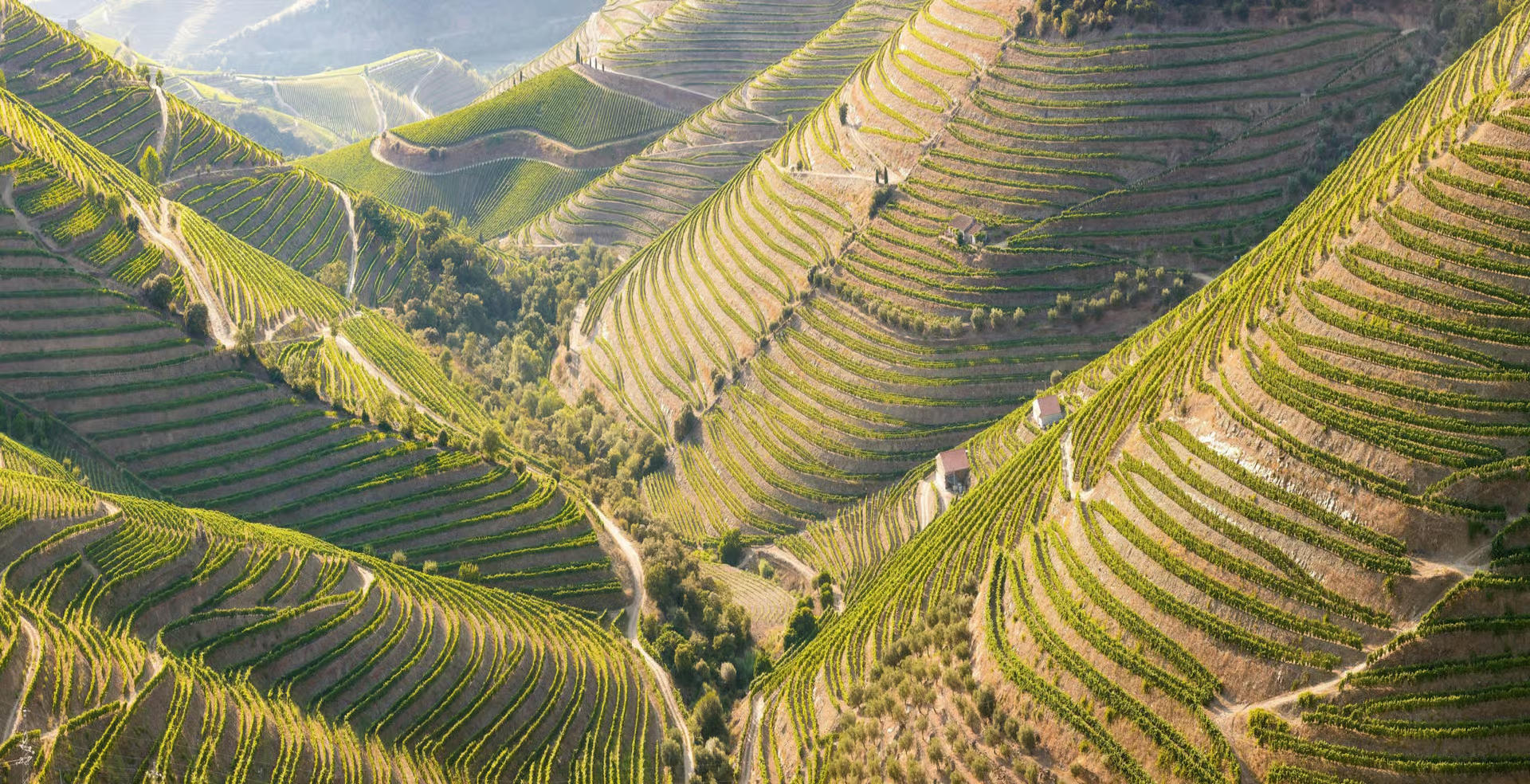
To truly understand the liquid in the glass, a traveler must understand the brutal, unforgiving landscape that gave it birth. If the coastal city of Porto gave the wine its commercial name, the remote, sun-baked interior of the Douro Valley gave it its rugged soul. Located roughly 60 miles inland from the Atlantic coast, the Douro is one of the most visually spectacular and topographically challenging wine regions on earth.
The geology of the valley is dominated by schist, a dense, layered metamorphic rock that fractures easily. For centuries, human hands have painstakingly carved steep, narrow terraces directly into these sheer schist cliffs, creating vertical stone staircases that cling precariously to the banks of the river. The climate here is extreme and unforgiving, shielded from the cooling maritime breezes of the Atlantic by the towering Marão mountain range. The locals describe the valley’s weather with a gritty proverb: Nine months of winter, three months of hell. Winters are sharply cold and rain-swept, while summers are oppressive, dry ovens where temperatures regularly soar past 104 degrees Fahrenheit.
Yet, this environmental hostility is precisely what makes Port magnificent. In the arid, rocky soil, grapevines cannot survive on the surface. To find water, their roots are forced to drill deep into the vertical fractures of the schist rock, tunneling up to 30 feet beneath the surface to tap into hidden underground water reserves stored during the winter. This intense environmental struggle limits the vines’ energy, resulting in tiny, thick-skinned grapes with exceptionally low yields but an unparalleled concentration of sugars, tannins, and complex flavors.
The region relies heavily on an array of tough, indigenous grape varieties uniquely adapted to this thermal stress. Chief among them is Touriga Nacional, a low-yielding variety that offers deep color, massive structure, and intense black-fruit flavors. It is blended alongside Touriga Franca, which provides floral aromas and elegant tannins; Tinta Roriz, which adds bright acidity and spice; and Tinta Barroca and Tinto Cão, which bring warmth, sugars, and long-term aging potential to the blend.
Historically, harvesting these grapes was only half the battle; the real terror lay in transporting the young wine out of the valley. Before the river was tamed by massive hydroelectric dams in the mid-20th century, the Douro River was a wild, raging torrent that cut through deep, narrow mountain gorges, filled with hidden rocks, violent rapids, and sudden drops.
Every spring, workers loaded the heavy casks of young wine onto rabelo boats—traditional wooden cargo vessels equipped with a large, square sail and a long, sweeping steering oar operated by a crew standing on a raised platform at the stern. Navigating a fully laden rabelo through the un-dammed rapids of the Douro gorge was a high-stakes, life-threatening career. Dozens of boats smashed against the rocks every season, swallowing crews and cargo alike. The survivors of this wild river ride eventually reached the calm estuary at the mouth of the river, delivering their precious liquid cargo to the calm cellars of the coast.
Corruption, Fraud, and the Marquis of Pombal’s Masterstroke
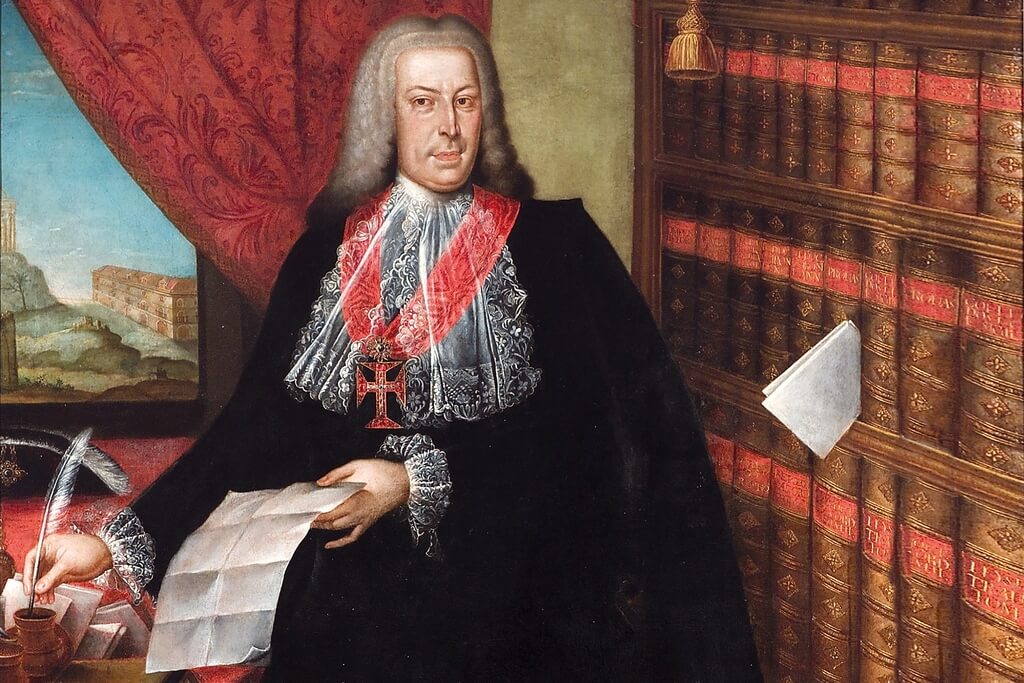
Marques de Pombal
By the mid-18th century, the global success of Port wine threatened to destroy it. The insatiable demand from the British market had triggered a wave of unprincipled greed within the trade. Unscrupulous producers and merchants, eager to stretch their profit margins, began engaging in systematic, widespread fraud.
To boost production volumes, growers began planting high-yielding, low-quality grapes on flat, fertile soils outside the traditional boundaries of the valley. To hide the thin, watery nature of these inferior wines, producers developed a laundry list of deceptive additions. They dumped cheap sugar into the vats to mimic Port’s natural sweetness. They added synthetic flavorings, and worse, they mixed massive quantities of dried elderberry juice into the fermenting juice to artificially darken the color and add a false sense of body and spice. By the early 1750s, the British market noticed the sharp decline in quality. Rumors of rampant adulteration spread through London’s coffee houses, consumer confidence shattered, and international shipments plummeted, plunging the Portuguese wine economy into a terrifying depression.
Enter Sebastião José de Carvalho e Melo, better known to history as the formidable Marquis of Pombal. As the iron-fisted Prime Minister of Portugal, Pombal was a visionary administrator who understood that saving the state’s economy required saving the absolute integrity of Port wine. In 1756, he executed a revolutionary masterstroke: he established a state-backed monopoly tasked with controlling every element of the Port trade.
Pombal’s most enduring achievement was mapping out the exact geographical boundaries of the Douro Valley, legally declaring that only grapes grown on these specific, historic hillsides could officially bear the name Port Wine. To enforce this physical boundary, Pombal ordered the creation and placement of 335 massive granite boundary pillars, known as marcos pombalinos, across the mountain landscape. Any vineyard sitting outside those stone markers was banned from the export market.
Furthermore, Pombal initiated an exhaustive classification system for every single vineyard plot within the zone, rating them based on soil, slope, aspect, and grape variety—nearly a century before Bordeaux famously classified its estates in 1855. He banned the use of elderberry trees within the region entirely, ordering them to be physically uprooted from the valley. The Marquis of Pombal’s draconian actions met with furious resistance from both local riots and British merchants, but his masterstroke worked brilliantly. By using state power to legally guarantee a wine’s origin and quality, he created the world’s first formally demarcated and regulated wine appellation. It is a system that served as the direct structural blueprint for modern European wine laws.
The Coastal Twin Cities and the Architecture of Aging
While the Douro Valley is the undisputed birthplace of the grapes, the structural magic of Port aging happens at the coast, split across the Douro River between the vibrant city of Porto and the historic waterfront of Vila Nova de Gaia. This geographical division of labor is unique in the wine world and created a fascinating collaboration between the agricultural interior and the mercantile coast.
After surviving the treacherous downriver journey on the rabelo boats, the young casks of Port were unloaded on the southern banks of the river in Vila Nova de Gaia. The climate change between the two regions is stark. While the Douro Valley is a scorching, landlocked oven, Gaia sits directly on the lip of the Atlantic Ocean. It is cool, humid, and constantly blanketed by maritime breezes, experiencing minimal temperature fluctuations throughout the year.
This specific microclimate is absolutely crucial for the slow, graceful maturation of fine wine. In the searing heat of the valley, wine inside a wooden barrel evaporates too quickly, causing the liquid to bake and turn bitter. In the cool, damp atmosphere of Gaia’s stone lodges, the wine breathes gently through the porous oak staves, aging at a slow, predictable pace over years, decades, or even centuries.
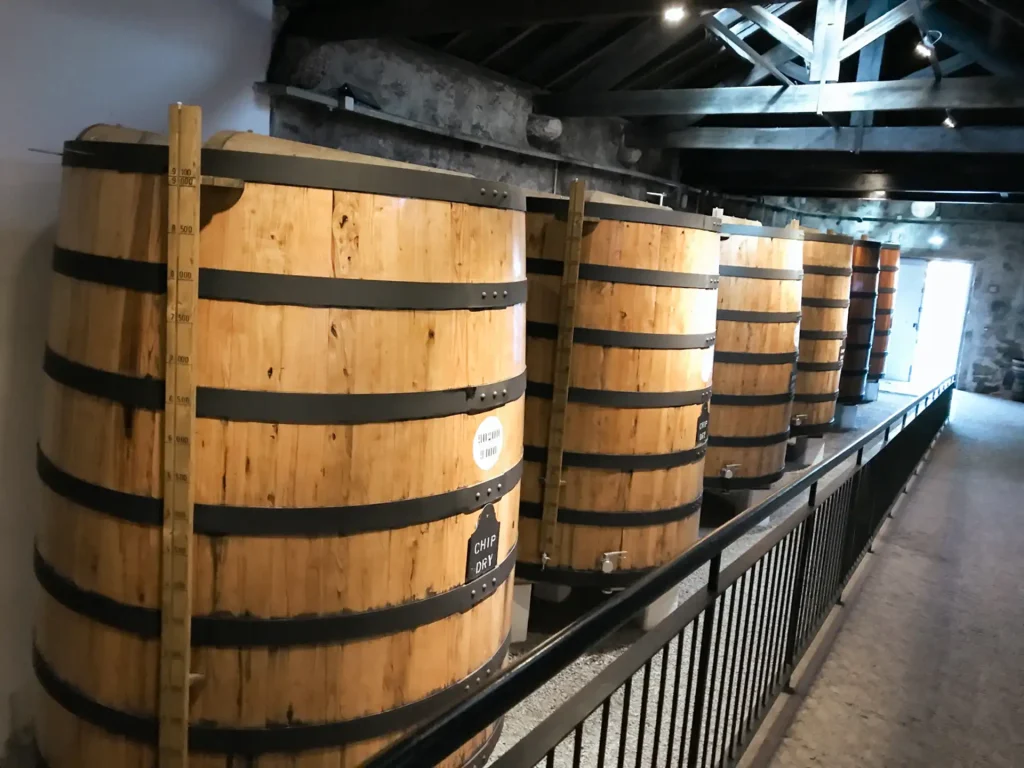
This coastal aging tradition fundamentally altered the physical architecture of Porto and Gaia. The waterfront of Gaia became a dense grid of long, low, granite warehouses roofed with red clay tiles, built with thick walls to keep the interiors dark and cool. Inside these cathedrals of wine, millions of liters of Port sit undisturbed in massive oak vats or small 550-liter barrels known as pipes.
The late 18th century brought one final technological transformation that perfected the aging of Port: the evolution of the glass bottle. Historically, wine bottles were hand-blown, broad-based, and onion-shaped, designed purely to carry wine from a tavern barrel to a table; they could not be stacked on their sides. By the 1770s, industrial manufacturing allowed factories to produce cheap, uniform, cylindrical glass bottles.
This structural shift changed everything. For the first time, wine bottles could be corked and stacked horizontally in dark cellars for long-term storage. This tight seal kept the cork moist, completely blocked out oxygen, and allowed the wine to age slowly in the glass rather than the wood. This technological leap birthed the ultimate expression of the region: Vintage Port.
The Spectrum of Style: From Young Ruby to Ancient Tawny
What began as a uniform solution to a 17th-century shipping crisis has exploded into a diverse spectrum of distinct wine styles. Every bottle of Port starts its life in the exact same way—with intense extraction and fortification during fermentation. Its ultimate identity, however, is decided by human choices in the dark cellars of Gaia, specifically concerning its relationship with wood, time, and oxygen.
To truly understand Port, a traveler or collector must understand the two divergent evolutionary paths a barrel can take: reductive aging, which is shielded from air, and oxidative aging, which is exposed to air.
The Reductive Family: Fruit and Fire
Reductive Ports are designed to preserve the intense, primary fruit characters of the grapes by minimizing any contact with oxygen. They spend relatively little time in porous wood before being moved into stainless steel tanks or directly into glass bottles.
Ruby Port
Ruby Port is the entry point into the style. It is aged in large inert vats for three years, preserving a deep crimson color and a vibrant, robust profile packed with primary flavors of fresh blackberries, red cherries, and plums. It is sweet, fiery, and built for immediate consumption. Reserve Ruby is a step up in quality, made from higher-caliber grapes and aged slightly longer. It offers a smoother, more concentrated burst of black fruit and spice.
Late Bottled Vintage
Late Bottled Vintage is an exceptionally popular style for consumers. It is a wine harvested from a single, high-quality vintage that spends four to six years maturing in large vats before bottling. This extended time in the vat coaxes out a rich maturity, offering plush tannins, chocolatey depth, and dark fruit notes. Because it is filtered before bottling, it is ready to drink immediately without needing to be decanted.
Vintage Port
Vintage Port is the absolute pinnacle of the pyramid, representing less than two percent of all Port production. Vintage Port is made only in extraordinary years that are officially declared by the producers. The wine is bottled after just two years in wood, completely un-fined and unfiltered. It is a sleeping giant: intensely dark, aggressively tannic, and packed with monumental fruit power. A fine Vintage Port requires a minimum of fifteen to thirty years of horizontal cellaring to soften, slowly throwing a heavy sediment as it transforms into a silky, complex masterpiece of dried violets, leather, spice, and dark cacao.
The Oxidative Family: Wood, Nut, and Time
Oxidative Ports take the opposite path. They are poured into small 550-liter oak pipes that allow tiny amounts of oxygen to constantly seep through the wood staves over decades. This deliberate exposure to air strips away the young red color, alters the texture, and fundamentally transforms the flavor profile.
Tawny Port
A basic Tawny Port is a light, amber-brown wine aged for a few years in wood, offering a simple, sweet profile of soft red fruit and caramel. Aged Tawny Ports, marked as 10, 20, 30, 40, or over 50 years old, are magnificent achievements in blending. The age statement on the label is not a statement of a single harvest, but rather the target profile of the blend inside, verified by the official Port wine institute. As the wine sits in oak pipes for decades in the Gaia lodges, it undergoes a radical metamorphosis. The bright red colors fade into golden-amber and deep topaz. Water slowly evaporates through the wood, concentrating the liquid into a viscous elixir. The fresh fruit notes disappear, replaced by an intricate matrix of toasted walnuts, dried figs, dates, orange peel, coffee, burnt sugar, and exotic spices, all balanced by a bright, vibrant acidity.
Colheita Port
Colheita Port is a rare and highly prized variation. A Colheita is a Tawny Port harvested from a single exceptional year but aged in oak pipes for a minimum of seven years—though often for decades—before being bottled. It combines the complex, oxidative character of an Aged Tawny with the unique, historic fingerprint of a single harvest.
Modern Innovations
Modern innovations have also expanded into White Port, made exclusively from indigenous white grape varieties like Malvasia Fina, Gouveio, and Viosinho. It ranges from bone-dry to intensely sweet. While aged versions exist, young dry White Port has become a global favorite when poured over ice, drowned in premium tonic water, and garnished with a slice of fresh orange and a sprig of mint—the quintessential summer aperitif known across Portugal as a Porto Tónico. Rosé Port is another highly modern innovation introduced in the early 2000s. By using minimal skin contact during the initial extraction of red grapes, winemakers create a vibrant pink liquid bursting with fresh raspberry, strawberry, and honey notes, designed exclusively for refreshing summer cocktails.
The Resonant Landscape of Wine Travel
The phrase fortified by accident: how a wartime trade ban created port wine is much more than a catchy title for a history textbook. It is a complete explanation of why the region feels so deeply layered and emotionally resonant when you experience it in person today. When you lift a glass of Port to your lips while sitting on the banks of the Douro, you are not merely consuming an alcoholic beverage; you are tasting a complex, physical crystallization of European history. In that single pour lives the anger of 17th-century trade embargoes, the diplomatic ink of the 1703 Methuen Treaty, the dangerous bravery of the rabelo river crews, the iron-willed discipline of the Marquis of Pombal, and the slow, quiet breathing of oak wood in the Atlantic air of Gaia.
For modern wine travelers who want more than just a beautiful view and a sweet sip, this region is an unmatched playground. The landscape tells its own story with complete transparency. When you stand on a Quinta hillside in the Upper Douro, looking down at the hand-carved stone walls slicing through the schist cliffs, you see the jaw-dropping physical labor required to wring life out of an arid mountain desert. When you walk through the dim, cool alleys of the Gaia lodges, listening to the soft dripping of moisture and smelling the rich, sweet aroma of evaporating alcohol—known beautifully as the angel’s share—you see the deliberate patience required to turn harsh necessity into fine art.
This journey reminds us that the world’s most enduring luxuries are rarely born from comfortable, seamless, or ideal conditions. More often, greatness is forged through severe constraint. Style emerges because human beings are forced to rapidly adapt to structural crises before they can even begin to refine their craft. Port wine was invented because a group of desperate merchants needed to stop their inventory from rotting at sea during a global war.
For anyone building a travel itinerary to Portugal, Port demands time, reverence, and slow exploration rather than a hurried tasting stop on a checklist. A quiet river cruise snaking through the carved canyons of the valley, a dusty walk through the vineyards of an ancient inland Quinta, and an evening spent listening to Fado music inside a centuries-old coastal cellar each reveal a separate, vital chapter of the narrative. This is the exact kind of deeply layered, historically grounded wine travel that elevates a simple holiday into a transformative experience.
The next time you raise a glass of Port at the end of a meal, look past the initial warmth and the dark sweetness. Take a moment to think about the long, stormy journey that brought it to your table. You are drinking a brilliant, historic solution to a forgotten geopolitical crisis—a beautiful accident of geography and war that human craftsmanship transformed into an immortal masterpiece.