Table of Contents
.Champagne, the effervescent crown of the viticultural world is far more than a beverage; it is a profound liquid geography, a cultural heritage etched into the cool, white hillsides of northern France over millennia. As a global benchmark for excellence, this region represents the ultimate triumph of viticulture at the extreme edge of possibility, where the “soul” of the landscape is defined by a precarious balance of light, cold, and stone. The historical significance of this land is unparalleled, serving as the site of royal coronations and the birthplace of the traditional method that has captivated the global palate for centuries.
To walk the vineyards of Montagne de Reims, Côte des Blancs, or the Vallée de la Marne is to engage with a living museum of geology. The prestige of the region is rooted in its unique ability to transform a challenging, marginal climate into wines of ethereal complexity and structural longevity. This guide serves as an invitation to explore the intricate mosaic of sub-appellations and crus that define the region. We delve into the silence of the deep chalk cellars and the windswept slopes of the Aube, where the concept of terroir transcends mere dirt and becomes a sensory language.
For the discerning traveler and connoisseur, understanding the region requires an appreciation of the specific plots, from the grandest Grand Cru villages to the most secluded Premier Cru slopes, where the interaction of climate and pedology creates a synergy found nowhere else on the planet. This is a journey through the chalky veins of France, where every glass tells a story of survival, mastery, and the enduring elegance of the land.
Your Passport to Effervescence
Macro-Climate and Viticultural Foundations
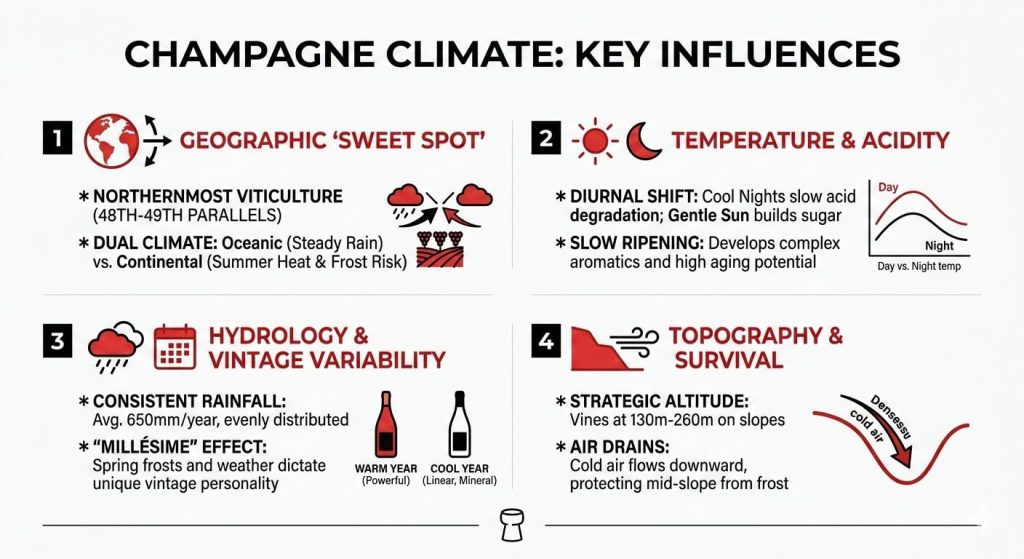
The viticultural identity of this region is dictated by its position at the northernmost limits of viable grape cultivation, situated precisely between the 48th and 49th parallels. This geographic positioning creates a dual climatic influence—a constant tug-of-war between oceanic and continental systems—which forms the technical foundation of its global reputation. The oceanic influence provides a steadying hand, bringing regular rainfall and modest temperature ranges that prevent the vines from experiencing extreme desiccation. Conversely, the continental influence introduces the constant threat of winter frosts but provides the essential summer heat required for phenolic ripening. This marginality is the region’s greatest asset, forcing the vine to struggle and thus concentrate the character of the soil into the fruit.
The Influence of Temperature and Diurnal Shifts
In this high-latitude environment, the diurnal temperature shift—the variation between daytime solar radiation and nighttime cooling—is the primary mechanism for maintaining the high natural acidity that defines the region’s wines. During the growing season, the cool nights significantly slow the degradation of malic acid within the berries. Simultaneously, the gentle daytime sun, often filtered through a light cloud cover characteristic of the oceanic influence, facilitates a slow and steady accumulation of sugars.
This extended, languid growing season allows for the development of complex aromatic precursors and precursors to autolytic character without the risk of over-ripening or excessive potential alcohol. The resulting balance between a low pH and a sophisticated phenolic profile is what allows these wines to age for decades, evolving from primary fruit into the brioche and honeyed notes of maturity.
Hydrological Patterns and Vintage Variability
Rainfall patterns across the region are remarkably consistent, averaging approximately 650 millimeters per year. This moisture is evenly distributed throughout the vegetative cycle, ensuring the vines remain hydrated even during the peak of summer. However, the precarious nature of the northern climate means that vintage variability is a defining characteristic of the region’s reputation. Variations in spring frost, the timing of flowering, and late-season rainfall dictate the distinctive personality of each year’s millésime.
A vintage characterized by a late, warm autumn may produce powerful, vinous wines, whereas a cooler year highlights the bracing linearity and mineral tension of the chalk. This variability reinforces the region’s status as a place where nature’s whims are both a challenge to the vigneron and a gift to the connoisseur, as no two years ever tell the same story.
The Terroir of Joy
Altitude and Airflow Dynamics
The rolling topography of the region provides essential natural drainage and frost protection. Most vineyards are strategically situated on slopes at altitudes ranging from 130 to 260 meters. This specific elevation, combined with the undulating landscape of the Montagne de Reims or the steep inclines of the Vallée de la Marne, creates vital “air drains.”
During the dangerous spring frost windows, cold air, which is denser than warm air, flows downward off the plateaus and into the valley floors, sparing the precious mid-slope vines from the most devastating effects of radiation frost. The orientation of these slopes—often facing East or South—further maximizes solar interception, ensuring that even in this cool climate, the grapes reach the necessary threshold of ripeness to produce world-class base wines.
Pedological Depth: The Complex Chemistry of Soil and Bedrock In Champagne
The true secret of this terroir lies beneath the surface in a thick mantle of sedimentary rock. The dominant feature is Cretaceous chalk, a porous, fine-grained limestone composed of the calcified remains of prehistoric marine microorganisms. To understand the viticultural supremacy of this region, one must analyze the pedological architecture that allows for such high-precision viticulture. The soil is not a passive medium but an active chemical engine that regulates water, temperature, and mineral availability with unparalleled consistency.
The Geochemical Superiority of Belemnite and Micraster Chalk
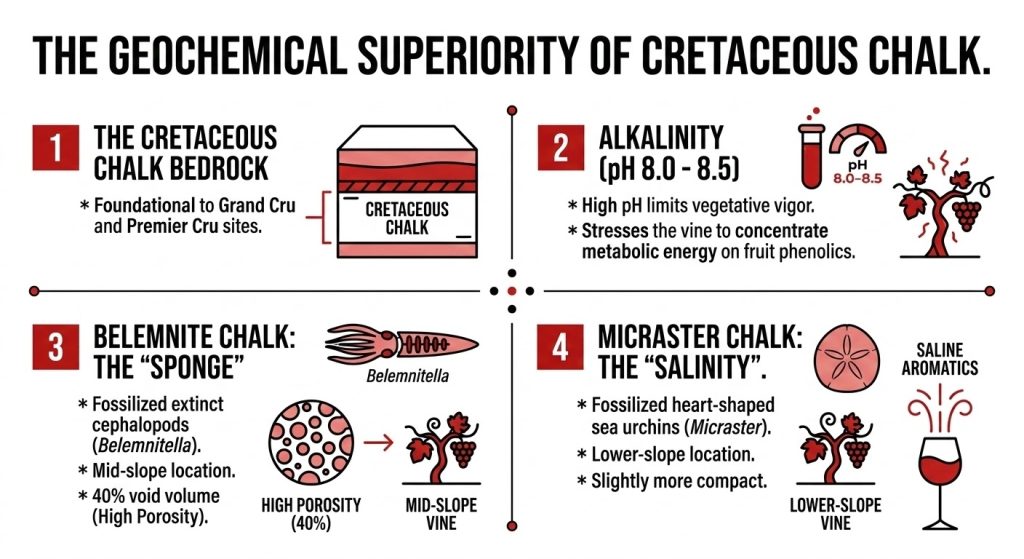
Belemnite and Micraster Chalk in Champagne
At the heart of the region’s most prestigious Grand Cru and Premier Cru sites lies the Cretaceous chalk, specifically the Belemnite and Micraster variants. Belemnite chalk, found predominantly on the mid-slopes of the Côte des Blancs and the Montagne de Reims, is composed of the fossilized internal skeletons of extinct cephalopods (Belemnitella). Its crystalline structure is highly porous—up to 40 percent of its volume consists of voids. This creates a capillary effect of extraordinary efficiency; the chalk acts as a massive subterranean reservoir, drawing water upward during the arid summer months while simultaneously ensuring that the roots are never saturated during periods of heavy deluge.
In contrast, Micraster chalk, named for the fossilized heart-shaped sea urchins it contains, is typically situated on the lower slopes. While slightly more compact, it still provides the high calcium carbonate content necessary for the synthesis of the precise, saline aromatics favored in high-end cuvées. The alkalinity of these soils—often reaching a pH of 8.0 to 8.5—forces the vine to adapt, subtly stressing the plant in a way that limits vegetative vigor and directs metabolic energy toward the concentration of phenolics in the fruit.
Structural Variations: Marl, Clay, and Ancient Shells
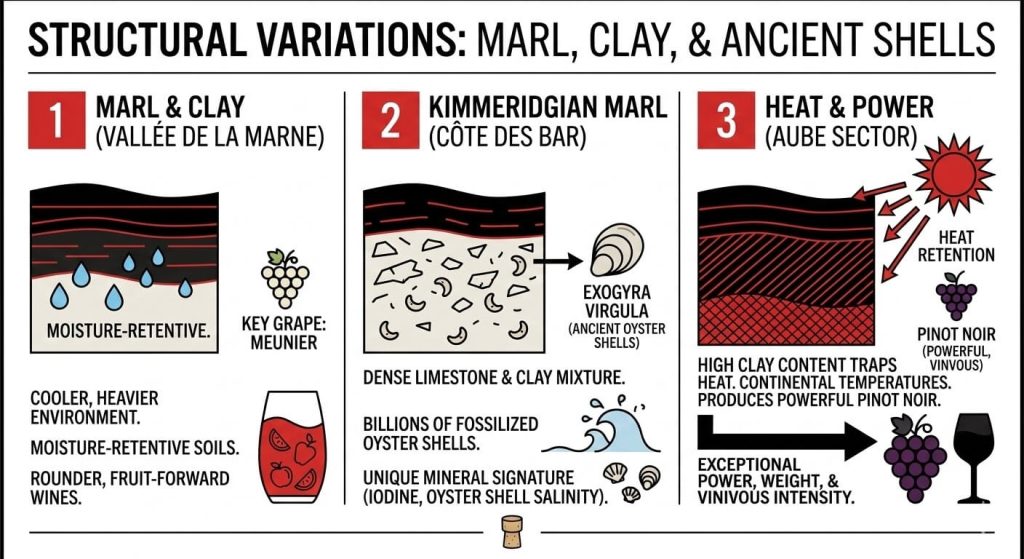
As we move away from the pure chalk outcroppings of the Côte des Blancs, the pedology becomes significantly more complex. In the Vallée de la Marne, the chalk is buried beneath thick layers of marl and clay. Marl is a sediment composed of clay and calcium carbonate, offering a cooler and heavier environment for the roots. This structure is particularly vital for the Meunier grape, which thrives in these moisture-retentive soils, resulting in wines with a rounder, more fruit-forward profile.
Further south in the Côte des Bar, the geology shifts dramatically to Kimmeridgian marl, the same ancient bedrock found in Chablis. This soil is a dense mixture of limestone and clay punctuated by billions of fossilized oyster shells (Exogyra virgula). These shells provide a unique mineral signature, often described by oenologists as “iodine” or “oyster shell” salinity. The presence of clay in these southern sectors allows for greater heat retention, which, when coupled with the higher continental temperatures of the Aube, produces Pinot Noir of exceptional power, weight, and vinous intensity.
Mineral Cation Exchange and Drainage Dynamics
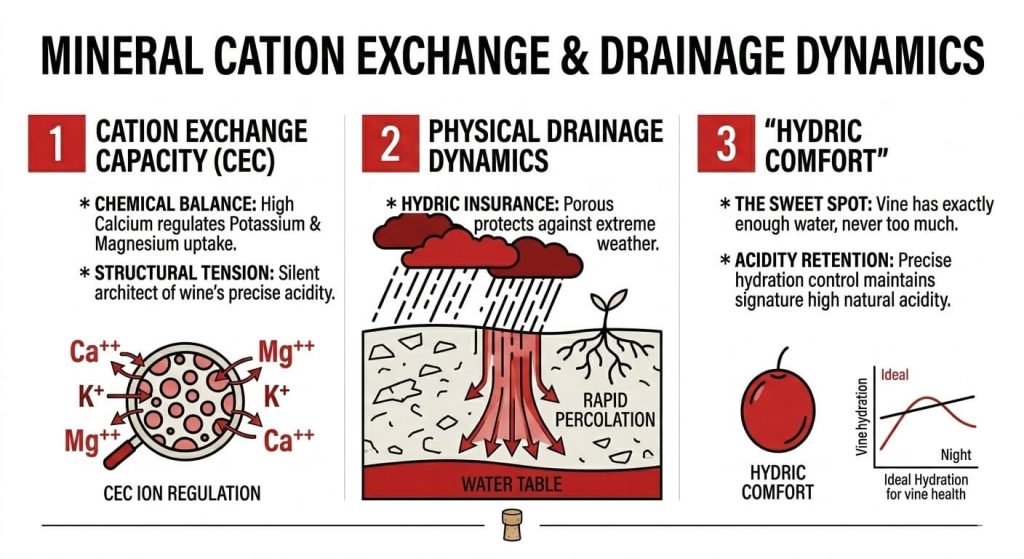
The technical mastery of this soil is most evident in its cation exchange capacity (CEC). The high concentration of calcium ions in the soil solution regulates the uptake of other essential minerals such as potassium and magnesium. This chemical balance is the silent architect behind the wine’s structural tension. Furthermore, the physical drainage properties of the chalk bedrock are a viticultural insurance policy.
Even after the most violent autumn rainstorms, the porous limestone allows excess water to percolate rapidly into the deep water table, preventing the root rot and berry swelling that would otherwise dilute the vintage’s quality. This constant state of “hydric comfort”—where the vine has exactly enough water but never too much—is the reason the region can maintain such high levels of natural acidity even in warmer years.
The Regional Breakdown: Climate, Soil, and Geology by Sub-Region
The true genius of the region lies in its internal diversity. Each sub-appellation acts as a specific lens, focusing the macro-climate through the prism of local geology and exposure. To master the terroir, one must differentiate between the structural power of the north and the ethereal transparency of the central chalk ridges.
Montagne de Reims: The Bastion of Pinot Noir Structure
The Montagne de Reims is a massive, horseshoe-shaped plateau situated south of the city of Reims. It is a region of immense geological complexity, where the chalk bedrock is often capped by thick layers of Silex, clay, and Lignite. This sub-region is primarily celebrated for Pinot Noir, which finds its most muscular and architectural expression here.
The Cold Northerly Exposure: Verzenay and Mailly-Champagne
In the Grand Cru villages of Verzenay and Mailly-Champagne, the vineyards face north, a seemingly counter-intuitive orientation for high-quality viticulture. However, this cooler exposure, combined with exceptionally thin soils over deep Belemnite chalk, produces a style of wine characterized by piercing acidity and immense structural tension. The high iron content in the clay of Verzenay specifically yields a distinctive smoky, flinty note, often compared to gunflint. These are the “backbone” wines of the region, providing the necessary lift for long-lived prestige cuvées.
The Solar Warmth of the South: Ambonnay and Bouzy
Conversely, the southern slopes of the plateau, home to the Grand Cru villages of Ambonnay and Bouzy, enjoy a full southerly aspect. Here, the soils contain a significantly higher proportion of Calcareous clay, which absorbs and radiates heat. This result is a Pinot Noir of unparalleled power, richness, and vinosity. The wines from Bouzy are famous for their red fruit depth and spicy complexity, while Ambonnay is prized for its combination of weight and crystalline elegance.
Côte des Blancs: The Verticality of Pure Chalk
The Côte des Blancs represents the most geologically homogeneous and technically demanding sub-region for the Chardonnay grape. This east-facing escarpment is characterized by a sheer dominance of Cretaceous chalk that is often visible to the naked eye, covered only by a thin, fragile mantle of topsoil. The wines produced here are the ultimate expression of mineral transparency, valued for their citrus precision and uncompromising longevity.
Le Mesnil-sur-Oger: The Fortress of Mineral Tension
In the Grand Cru of Le Mesnil-sur-Oger, the Belemnite chalk is at its hardest and most exposed. The topsoil is virtually non-existent in notable vineyards like Les Chétillons, forcing the vine roots to descend directly into the cold, mineral-rich bedrock. This pedological extreme produces Chardonnay of staggering acidity and steely tension. The sensory link is profound; the wine exhibits notes of crushed stone and saline sea spray. These wines often require extended aging on the lees and post-disgorgement to resolve their fierce structural integrity.
Cramant and Chouilly: The Opulence of the North
At the northern end of the ridge, in the Grand Cru of Cramant and Chouilly, the slopes are more protected and the soils contain a higher percentage of clay and silt. In vineyards like Bouron du Bas, the additional organic matter and heat retention result in a broader, more opulent style of Chardonnay. These wines trade the razor-sharp edge of the south for a creamy, floral texture and a profile of ripe stone fruits and acacia honey.
Avize and Oger: The Exotic Micro-ClimatesThe Opulence of the North
The Grand Cru of Avize sits on a unique convex fold of the slope, creating a series of micro-parcels with varying solar aspects. Vineyards like Les Chantereines benefit from this concentrated luminosity, producing wines with an exotic, tropical fruit character—pineapple and passionfruit—balanced by a vibrant chalky finish. Neighboring Oger is situated in a slight depression, making it one of the warmest sites on the Côte des Blancs. This heat yields Chardonnay of significant weight and volume, often serving as the “flesh” in prestige blends.
Vertus: The Gateway to the South
Further south, the Premier Cru of Vertus marks a transition where the chalk begins to mix with sand and ferruginous clays. The wines here are more approachable in their youth, offering a soft, rounded mineral character. Notable plots like Les Barilletts showcase how the introduction of sand into the chalky matrix can provide a delicate, lace-like structure to the wine, distinct from the power of the northern crus.
Vallée de la Marne: The Mosaic of Meunier and Marl
Following the meandering path of the Marne River, this sub-region is characterized by heavier soils and a more humid micro-climate.
The Power of Aÿ and Mareuil-sur-Aÿ
The Grand Cru of Aÿ stands as a prestigious exception within the valley. Its steep, south-facing slopes are dominated by chalk, producing a Pinot Noir that rival the best of the Montagne de Reims in elegance and power. Nearby, the Premier Cru of Mareuil-sur-Aÿ is home to the legendary Clos des Goisses, a walled vineyard with a 45-degree slope that captures maximum solar radiation, resulting in one of the most powerful and structured wines in the entire region.
The Heart of Meunier: Rive Droite and Rive Gauche
Further west, in appellations like Châtillon-sur-Marne and Venteuil, the soil shifts toward Illite clay and green marl. This is the realm of Meunier. The high water-retention of these soils provides a soft, supple texture to the wine, with a sensory profile dominated by yellow fruits and a distinctive “forest floor” or truffle note that develops with age.
Côte des Bar: The Kimmeridgian Frontier
The Côte des Bar, situated in the southern department of the Aube, represents a radical geological departure from the northern sectors. Here, the landscape is defined by the Upper Jurassic era, specifically the Kimmeridgian stage, which separates this sub-region from the Cretaceous dominance of Reims and Épernay. Geographically and pedologically, this area is a cousin to the vineyards of Chablis and Sancerre, characterized by a rugged, undulating terrain of steep valleys and dense forests.
The Saline Edge of Les Riceys
In the village of Les Riceys, the vineyards are planted on stony, Kimmeridgian limestone. The warmer, more continental climate here allows for a full ripening of Pinot Noir, but it is the soil that provides the defining saline, savory edge. The Rosé des Riceys appellation is a testament to this unique terroir, offering a wine of wild strawberry aromatics and a profound mineral finish that could only come from these ancient oyster-shell beds.
Human Intervention and Viticultural Mastery
The mastery of this region lies in the ability of the vigneron to adapt to the extreme diversity of the soils and the precarious nature of a marginal climate. Human intervention here is a precise and highly regulated art form, designed to channel the raw energy of the terroir into the bottle without dilution or distortion. To maintain the equilibrium between the vine and the chalk, practitioners employ a suite of technical measures that have been refined over centuries of observation.
Technical Precision in Pruning and Canopy Management
Pruning is perhaps the most critical intervention in the vineyard cycle, as it dictates the potential yield and the health of the perennial wood. Four primary systems are permitted by the appellation authority, each selected based on the specific requirements of the grape variety and the cru. The Chablis system is favored for Chardonnay, particularly in the Côte des Blancs, where it encourages the development of fruitful shoots while maintaining excellent airflow to prevent botrytis.
For Pinot Noir, the Cordon de Royat and Guyot (both simple and double) systems are extensively used to limit vigor and ensure that the clusters remain well-spaced for even solar exposure. In the Vallée de la Marne, the Vallée de la Marne pruning system—a variation of the Guyot—is specifically adapted for Meunier, allowing for better frost resistance in the humid river valleys.
Row orientation is another calculated strategy. In the steep slopes of Aÿ or Mareuil-sur-Aÿ, rows are often planted perpendicular to the slope to facilitate manual labor and manage erosion, but they are also oriented to maximize the absorption of morning and evening light. Canopy management, including trellising and leaf thinning, is executed with surgical precision.
Vignerons must balance the need for photosynthesis with the risk of sunscald, ensuring that the clusters remain shaded by a light leaf curtain while maintaining enough ventilation to mitigate the humidity-induced diseases common in northern France.
The Philosophy of the Cellar: Preserving the Terroir Expression
In the cellar, the philosophy of the modern era is marked by a tension between ancestral tradition and state-of-the-art oenological science. The concept of “minimal intervention” has gained significant traction, particularly among the elite grower-producers of the Montagne de Reims and the Côte des Bar.
This approach involves the use of indigenous yeasts to initiate fermentation, capturing the microbiological signature of the specific vineyard plot. The reduction of sulfur use and the avoidance of fining or filtration are further steps taken to ensure that the delicate mineral nuance of the chalk is not masked by chemical additives.
However, this minimalism is always underpinned by technical precision. The choice of fermentation vessel is a strategic decision that alters the textural profile of the wine. While stainless steel tanks are prized for their ability to preserve the crystalline, primary fruit notes of Le Mesnil-sur-Oger, the use of small oak barrels—pioneered by houses like Krug and Bollinger—adds a micro-oxygenation effect that builds mid-palate weight and aromatic complexity. T
he long aging on the lees, often extending for a decade or more for the finest Grand Cru millésimes, is a human-led process that transforms the bracing acidity of the base wine into a sophisticated, autolytic masterpiece through the process of yeast autolysis. Every step, from the “remuage” (riddling) to the final “dosage” (the addition of a small amount of sugar), is a calculated act of mastery intended to elevate the soul of the land into a sensory experience.
From Knowledge to Experience
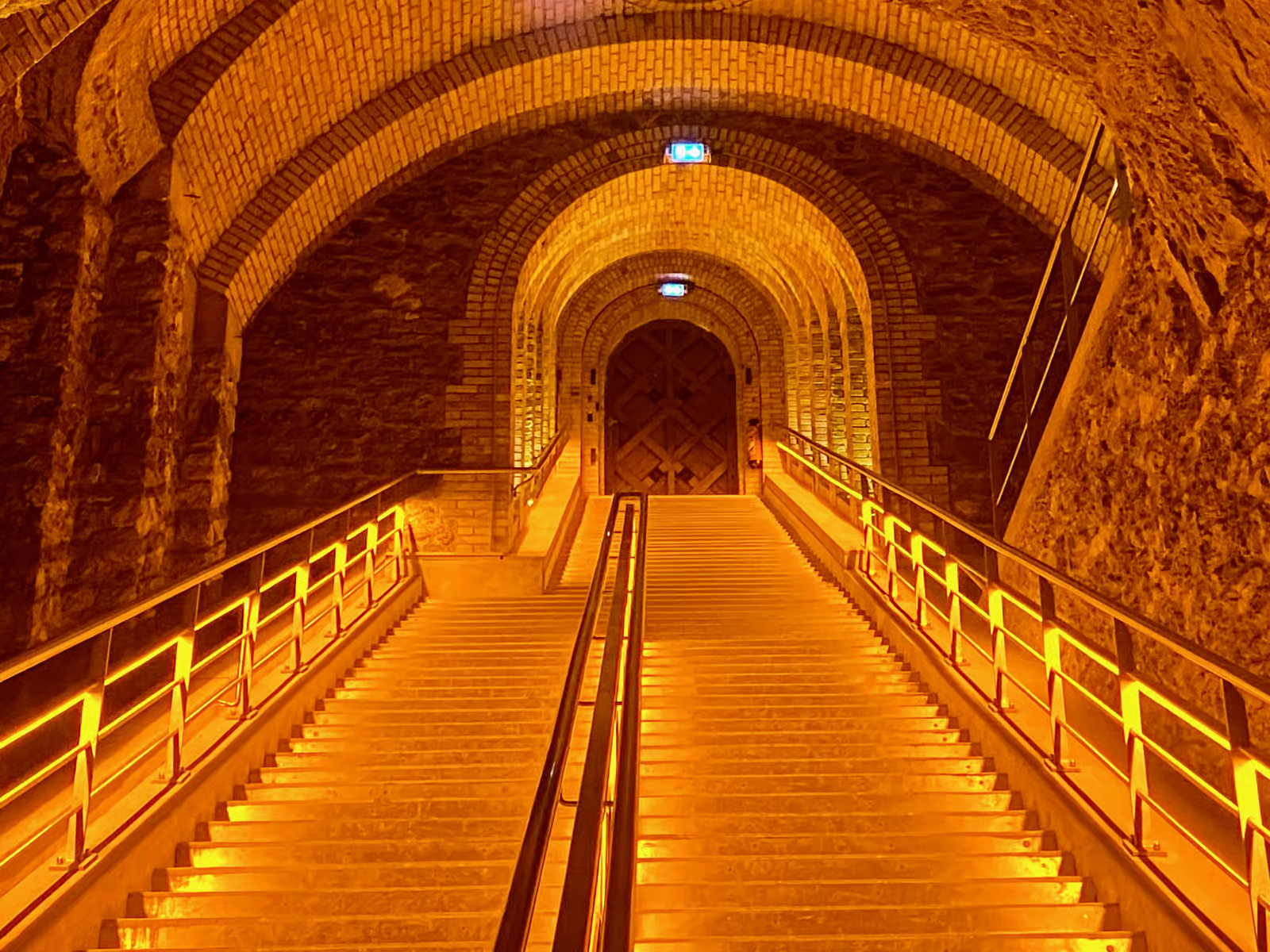
While the geology of these hills is written in stone, the wine itself is a living liquid that must be experienced in situ. To truly grasp the difference between the flinty tension of one cru and the broad shoulders of another, one must walk the very ground where these grapes are grown. The theoretical understanding of Belemnite chalk and Kimmeridgian marl remains abstract until one feels the cool humidity of a subterranean cellar and tastes the saline energy of a wine poured within sight of its original vines.
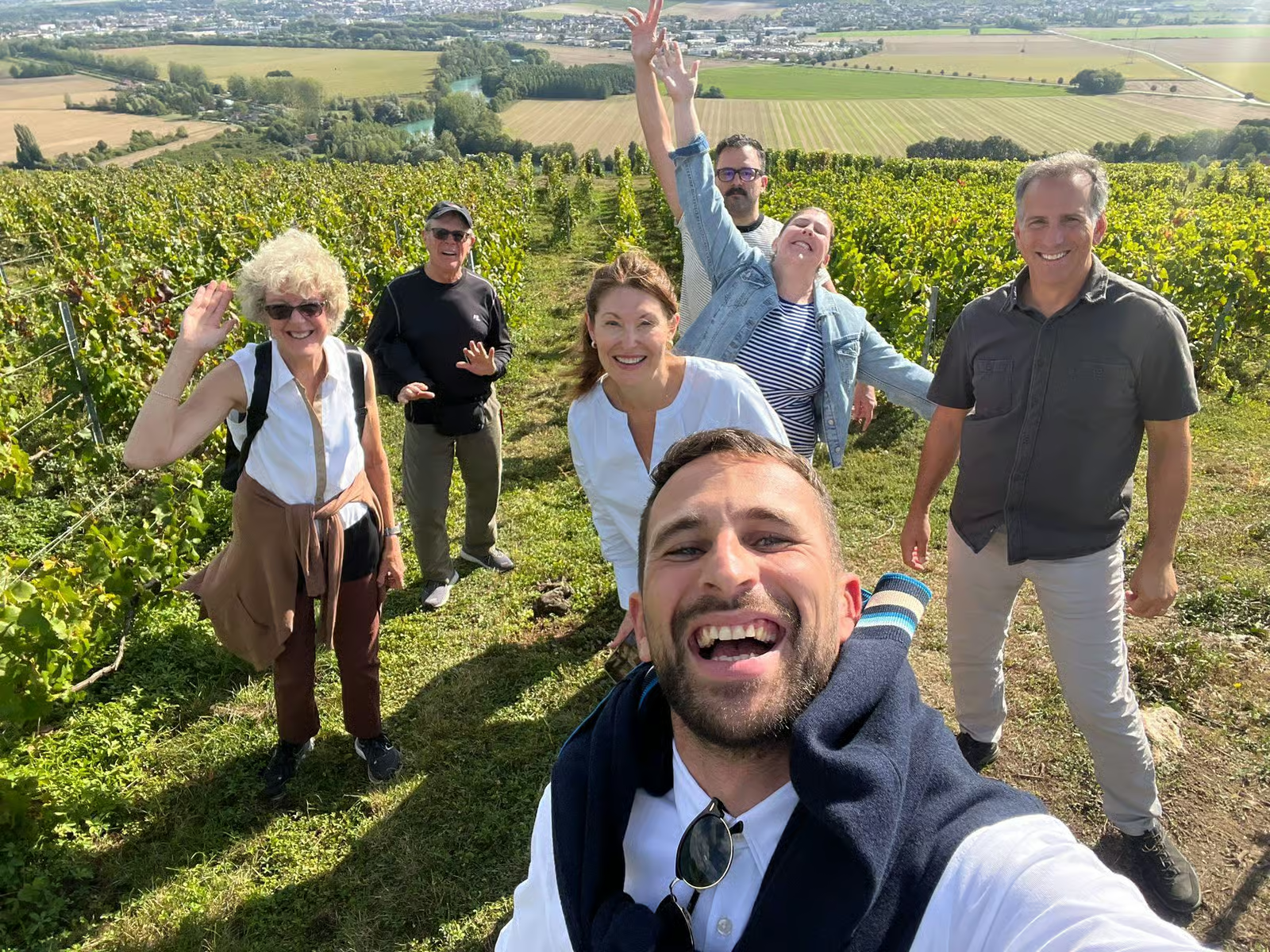
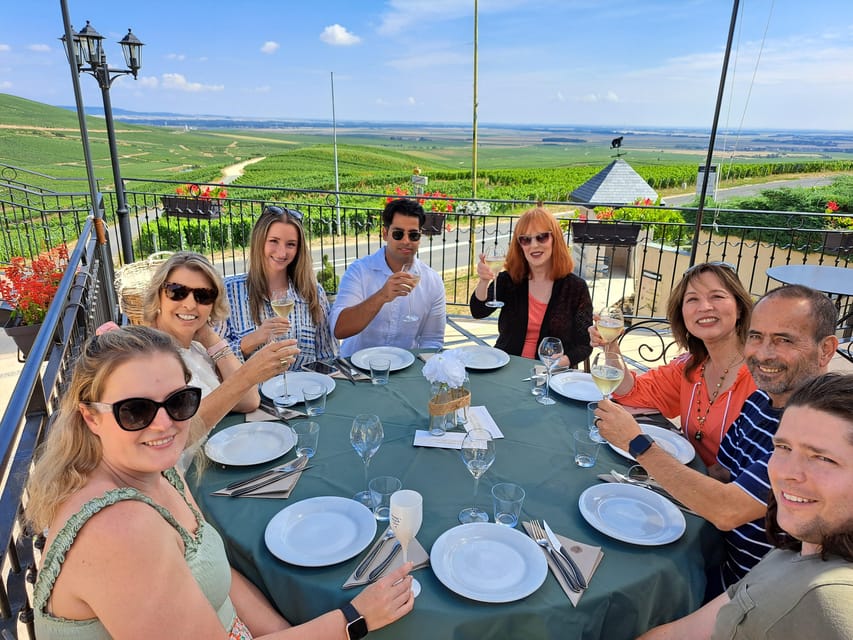
I invite you to join curated, high-end wine tours designed for the most discerning connoisseurs. This is your opportunity to walk the historic gravels, the deep limestones, and the nutrient-rich clays of the Montagne de Reims, the Côte des Blancs, and the Côte des Bar. These tours offer unparalleled access to the private estates of legendary houses and the secluded ateliers of independent growers. You will witness the mastery of the vignerons firsthand, translating the science of the soil into the sensory delight of a world-class tasting. This is more than a tour; it is a pilgrimage to the heart of viticultural excellence, an invitation to experience the living pulse of the land in its most elegant and enduring form.