Walk through a vineyard at dusk during harvest, and the idea behind moon cycles & grapevines: does lunar harvesting actually change the taste suddenly feels less like a theory and more like part of wine’s enduring theater. Pickers move through the rows under a pale sky, cellar teams speak quietly about timing, and somewhere between tradition, agriculture, and belief, the moon enters the conversation.
For travelers who care about what is in the glass and how it got there, lunar harvesting is one of those subjects that sits right on the line between romance and reality. Some estates speak about it with conviction. Others smile politely and change the subject. The truth is more interesting than a simple yes or no.
Why the moon still matters in vineyards
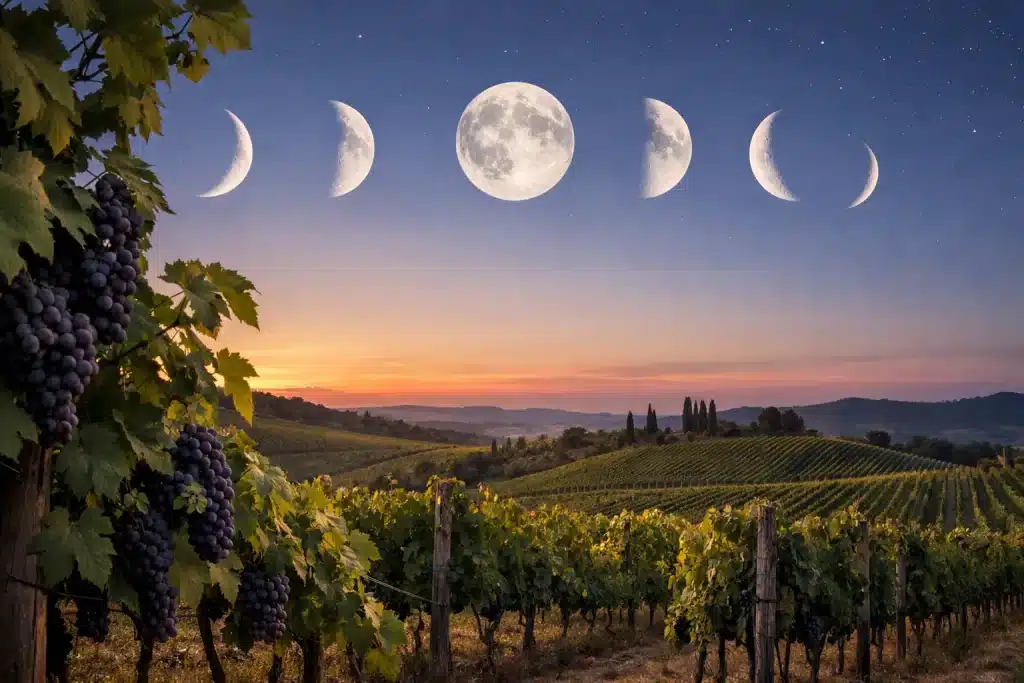
The moon has influenced farming rituals for centuries, long before winery visits became curated experiences and tasting rooms learned the language of hospitality. Across agricultural cultures, growers have used lunar calendars to decide when to plant, prune, and harvest. In wine, that tradition survives most visibly in biodynamic viticulture, where the vineyard is treated as a living organism connected to wider cosmic rhythms.
Biodynamic producers often distinguish between fruit days, root days, leaf days, and flower days, drawing on a calendar tied to lunar and planetary movements. Harvest timing may be chosen not only by sugar levels, acidity, weather pressure, and phenolic ripeness, but also by whether the day is believed to favor fruit expression or cellar stability.
For visitors, this can be captivating. A guided walk through a biodynamic estate in Burgundy, Mendoza, or Tasmania often reveals that lunar thinking is not presented as a gimmick. It is usually folded into a larger philosophy about soil life, plant balance, and attentive farming.
Moon cycles and grapevines: does lunar harvesting actually change the taste?
The honest answer is that it depends what you mean by change the taste.
If the question is whether moon phases alone can reliably produce a measurable, dramatic flavor shift in finished wine, the scientific evidence is limited. Wine chemistry is influenced by many variables that are much easier to observe directly: site, grape variety, climate, canopy management, water stress, picking date, fermentation choices, oak regime, and bottle age. Compared with those forces, the moon’s standalone effect is hard to isolate.
If the question is whether a producer working according to lunar rhythms might make a wine that tastes different because those rhythms shape decisions in the vineyard and cellar, then yes, that is entirely plausible. Not because moonlight magically sweetens berries, but because belief systems influence farming behavior. A grower who follows a lunar calendar may pick earlier, handle fruit more gently, sort more carefully, or ferment under different conditions. Those choices can affect texture, freshness, aromatic precision, and overall balance.
So the moon may not be acting as a simple flavor switch. It may be part of a broader agricultural mindset that changes outcomes over time.
What science can say, and what it cannot
There is no broad scientific consensus that wines harvested on one moon phase consistently taste better than wines harvested on another. Controlled studies are difficult because vineyards are not laboratories. Weather shifts by the hour, parcels ripen unevenly, and no two harvests are the same. Even in side-by-side comparisons, human expectation can shape perception.
That matters because wine is unusually vulnerable to suggestion. If a taster is told a bottle was harvested on a favorable fruit day under ideal lunar conditions, that story can subtly color the experience. The same is true in reverse. Skepticism has its own bias.
At the same time, dismissing lunar harvesting outright misses something essential about wine. Wine is not only chemistry. It is also craft, timing, ritual, and accumulated observation. Many experienced growers insist they notice differences in fruit vitality, fermentation behavior, or tasting profile when they work with lunar calendars. These observations may not always satisfy laboratory standards, but they are part of the lived knowledge of viticulture.
The biodynamic connection
Most conversations about lunar harvesting lead, sooner or later, to biodynamics. Yet lunar timing and biodynamics are not exactly the same thing. A winery can pay attention to moon phases without being fully biodynamic, and a biodynamic estate is also making many other choices that shape quality.
This is where confusion often starts. If a bottle from a biodynamic producer tastes more vivid or energetic, is that because the grapes were picked according to the moon? Or because the vines were farmed with intense manual care, lower yields, healthier soils, and a strong commitment to balance? Most likely, it is the full system, not one isolated factor.
For travelers visiting estates that embrace these methods, the best question is not “Does the moon make wine better?” It is “How does this philosophy change the way you farm?” That usually leads to richer conversations and more revealing tastings.
What tasters sometimes report
Among sommeliers, winemakers, and dedicated enthusiasts, one recurring idea is that wines tasted on certain lunar calendar days seem more open, expressive, or closed. This is especially common in conversations about when to open fine bottles for service. Some swear a Pinot Noir can feel more aromatic and generous on a fruit day, while a structured Syrah might seem mute on a root day.
Again, proof is elusive. But the persistence of the claim is noteworthy. In wine, repeated anecdotal patterns often become part of service culture long before science catches up, if it ever does.
As for harvesting, producers who believe in lunar timing often talk less about obvious flavor differences and more about shape and energy. They may describe fruit as more composed, acids as more integrated, or fermentations as calmer. Those are subtle distinctions, and they are difficult to separate from the influence of vineyard health and cellar skill.
What this means when you visit a winery
For a wine traveler, lunar harvesting is best understood as part of a winery’s identity rather than a guaranteed tasting note. If you visit an estate in the Loire, Stellenbosch, or Sonoma that works by the moon, you are not just hearing a technical detail. You are seeing how that producer interprets nature, risk, and timing.
Some estates embrace lunar practices because they see them as a path to greater harmony in the vineyard. Others maintain them because tradition is woven into the estate’s history. A few may mention them because guests find the idea alluring. The difference becomes clear when you ask practical questions about harvest decisions, disease pressure, soil management, and fermentation.
The most memorable visits often come from producers who can explain both the poetry and the pragmatism. They may speak about harvesting before rain, balancing ripeness against freshness, and then mention that the chosen date also aligned with their lunar calendar. That layered reasoning feels authentic because it is.
For travelers using a platform like Wine Tour Searcher to compare wine experiences across regions, this is where curation matters. A biodynamic estate tour in Alsace will offer a very different lens on lunar harvesting than a luxury tasting in Napa or a traditional cellar visit in Rioja. The pleasure lies in discovering how differently the wine world interprets the same question.
So, does lunar harvesting matter?
Yes, but not always in the way people expect.
If you are hoping for a dramatic blind-tasting revelation where moon-harvested wine tastes unmistakably lunar, you will probably be disappointed. Wine does not work that neatly. If, however, you are interested in how worldview shapes farming and how farming shapes flavor, then lunar harvesting absolutely matters. It can influence decisions, discipline, and attention at the most delicate moment of the season.
That distinction is worth holding onto. The moon may not override terroir, but it can become part of how a grower listens to terroir.
And perhaps that is why the subject endures. Wine invites us to care about details that other drinks leave behind – the slope of the vineyard, the age of the vines, the timing of the rain, the hand of the maker. Moon cycles belong to that larger fascination. Not every claim deserves reverence, but not every tradition needs to be reduced to myth or measurement either.
The next time you stand in a vineyard and hear a winemaker mention the lunar calendar, take it as an invitation rather than a verdict. Taste carefully, ask better questions, and let the place speak for itself.