
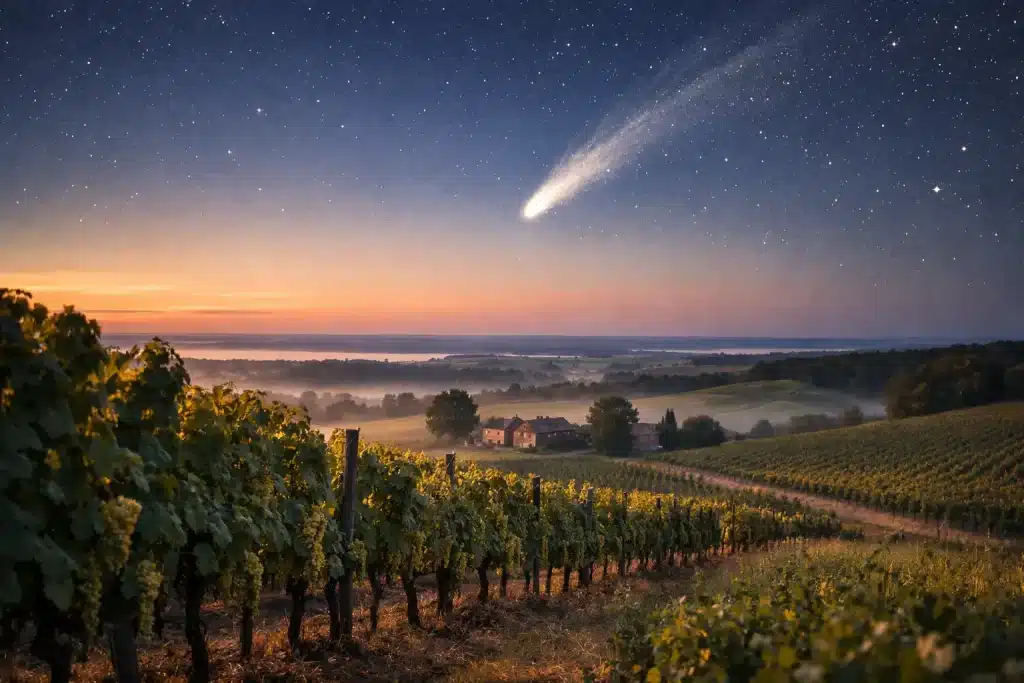
In the summer of 1811, European growers looked up and saw a brilliant comet burning across the night sky. Months later, many of them looked down at their vines and found something even more astonishing: a harvest that would pass into wine legend. The story behind comet vintages: how a cosmic phenomenon saved the 1811 harvest is part climate history, part cultural myth, and part reminder that wine has always lived at the edge of nature’s mystery.
For travelers who love wine, this is more than a charming old tale. It is a window into how growers once understood the vineyard before meteorology, satellite imaging, and modern vineyard management. It also explains why certain vintages become larger than life, carrying not just flavor but folklore, prestige, and a sense of destiny.
What is a comet vintage?
A comet vintage is a wine year associated with the appearance of a bright comet, especially when the harvest that followed was exceptional. The most famous example is 1811, when the Great Comet appeared for much of the year and was later linked to remarkable wines across parts of Europe.
The idea was simple and seductive. A comet appeared in the heavens, the weather favored the vines, and the resulting wines were unusually concentrated, age-worthy, and memorable. In the minds of many drinkers, the celestial event and the quality of the vintage became inseparable.
Scientifically, there is no evidence that a comet itself improves grapes. Comets do not ripen fruit, reduce mildew, or balance sugar and acidity. Yet the belief persisted because the year really was outstanding in several key regions. When a spectacular sky coincides with a spectacular harvest, myth finds fertile ground.
Comet vintages: how a cosmic phenomenon saved the 1811 harvest
The word saved is not entirely literal, but it captures why 1811 has such force in wine history. Europe in the early 19th century was hardly a stable backdrop for agriculture. The Napoleonic period brought economic strain, political upheaval, and uneven trade conditions. Vineyard work remained deeply vulnerable to weather, disease pressure, and labor limitations. A great growing season could feel like rescue.
In many classic regions, 1811 delivered exactly the kind of conditions growers dream about and can never command. Reports from the period point to a warm, dry summer and a favorable run-up to harvest in parts of France and central Europe. Healthy fruit, strong ripening, and relatively low disease pressure helped create wines of depth and longevity.
This matters because a great vintage is rarely about heat alone. Too much heat can flatten acidity, push alcohol too high, and produce wines that impress early but age awkwardly. Too much rain near harvest can swell berries and dilute concentration. The finest years tend to come from balance: enough warmth to ripen, enough stability to protect the crop, and enough restraint in the season to preserve freshness.
By those standards, 1811 was extraordinary. It was celebrated in Bordeaux, admired in parts of the Rhine, and spoken of with awe in Champagne circles. The vintage became famous not only because it was excellent, but because it seemed excellent everywhere that mattered to the European wine imagination.
Why the 1811 vintage became legendary
Not every strong harvest becomes a legend. The 1811 vintage did because three forces came together at once: quality, timing, and storytelling.
First, the wines themselves earned praise. Historical accounts describe reds with unusual richness and longevity, while sweet and sparkling wines from the period were also wrapped in admiration. Some bottles from 1811 were reputed to survive for decades in remarkable condition, which only strengthened the vintage’s aura.
Second, the comet gave people a symbol. Wine culture has always loved signs, whether drawn from saints’ days, lunar cycles, old farming customs, or dramatic shifts in weather. The Great Comet of 1811 was visible, memorable, and easy to romanticize. It turned an agricultural success into a cultural event.
Third, the timing was powerful. Europe was living through war and instability. Against that backdrop, a magnificent harvest felt almost providential. The idea that the heavens had marked the year made emotional sense to people who needed reasons to believe in fortune.
This is where comet vintages sit in a fascinating space between fact and feeling. The quality of 1811 did not require supernatural explanation. But the human desire to narrate good fortune gave the vintage a glow that ordinary meteorological records never could.
The real vineyard explanation behind the myth
If the comet did not save the vintage, what did?
The most convincing answer is weather pattern and vineyard response. Successful harvests in pre-industrial Europe depended heavily on a stable season. Growers had fewer tools to correct problems in the cellar and fewer interventions in the vineyard. A year with favorable flowering, healthy canopy growth, dry harvest conditions, and complete ripening could produce wines that seemed almost miraculous.
Different regions would have experienced 1811 in different ways, and that nuance matters. Bordeaux may have benefited from one sequence of seasonal conditions, while the Rhine saw another. Soil type, grape variety, exposure, and local farming practice would all have shaped the final result. So while 1811 is often treated as one great European vintage, it was really a mosaic of successful local stories.
That is part of what makes the year so compelling for modern wine travelers. It reminds us that vintage quality is never only regional reputation. It is also site, season, and the quiet decisions made in each parcel.
Why wine travelers still care about comet vintages
For anyone planning visits through Bordeaux, Champagne, the Rhine Valley, or other historic wine landscapes, comet vintages offer something richer than a curiosity. They connect the glass to the long memory of place.
Stand in an old cellar or walk a slope that has been under vine for centuries, and the 1811 story feels less like trivia and more like continuity. Growers then were watching the same skies, worrying over the same harvest windows, and hoping for the same rare alignment of ripeness and grace. The tools have changed. The emotional stakes have not.
This is one reason wine tourism resonates so deeply when it is done well. A tasting is not just about identifying blackberry, toast, or citrus. It is about entering the lived history of a region. Legendary vintages such as 1811 sharpen that experience because they reveal how a year becomes part of a destination’s identity.
That history can guide a more meaningful itinerary. A visit to an estate with deep archival roots, a cellar tour focused on historic vintages, or a regional tasting that explains how climate shaped famous years can turn a pleasant afternoon into something memorable.
Was 1811 great everywhere?
No, and that is where the story benefits from a little restraint.
Vintage legends tend to flatten complexity. Even in a celebrated year, not every producer makes profound wine, and not every vineyard benefits equally. Storage conditions, winemaking choices, and later bottling history also affect how a wine is remembered. Some of the reverence around 1811 comes from genuine excellence. Some of it comes from the natural inflation that follows any famous story.
There is also the issue of survival bias. We hear about the extraordinary bottles that lasted and impressed. We hear less about the ordinary wines from the same year that disappeared quietly. That does not diminish the greatness of 1811, but it does place it in context.
In other words, comet vintages are best understood as both real and embellished. The vintage was exceptional. The cosmic explanation was poetic. Together they created a legend strong enough to outlast two centuries.
The lasting appeal of the 1811 harvest
The 1811 vintage still captivates because it sits at the crossroads of agriculture, astronomy, and human imagination. Wine, perhaps more than any other cultural product, invites that kind of layered meaning. It begins in weather and labor, but it ends in memory, ritual, and story.
That is why the tale endures. Not because modern wine lovers think a comet can improve Cabernet or Riesling, but because the image is irresistible: a brilliant object crossing the night sky while vines below move toward one of the most celebrated harvests in history.
For anyone who loves wine regions not simply as destinations but as living cultural landscapes, 1811 offers a beautiful lesson. Great vintages are born from earthly conditions, yet they become unforgettable when people give them language, symbols, and wonder. The next time you walk through a historic vineyard at dusk, it is worth glancing upward for a moment. Wine has always asked us to pay attention to the ground beneath our feet – and sometimes to the sky above it.