
A bottle can stop you before the cork ever comes out. In some cases, that pause is admiration. In others, it is outrage, laughter, protest, or a legal threat. The most controversial and scandalous wine labels in history were never just about graphic design – they became flashpoints for politics, religion, sex, censorship, and the shifting boundaries of taste.
For wine lovers, that matters more than it may seem. A label is often the first translation of a place, a producer, and a point of view. When it misfires, or provokes on purpose, the bottle starts telling a very different story. Sometimes that story becomes bigger than the wine itself.
Why controversial wine labels matter
Wine occupies a peculiar cultural space. It is agricultural and artisanal, but also luxurious. It carries centuries of ritual, yet it competes on crowded modern shelves where attention is expensive. That tension helps explain why some producers choose provocation. A shocking label can cut through sameness in a way a restrained chateau sketch never will.
Still, scandal rarely lands in a vacuum. A sexually explicit drawing may be treated as playful in one market and offensive in another. A religious image might feel historically layered to one audience and deeply disrespectful to another. What reads as satire in a cosmopolitan city can be seen as exploitation elsewhere. Wine is global, and labels travel into cultural contexts their creators do not fully control.
That is why the most controversial wine labels in history are so revealing. They show where branding meets belief, where commercial freedom meets public standards, and where a bottle becomes a cultural object rather than just a beverage.
The most controversial and scandalous wine labels in history
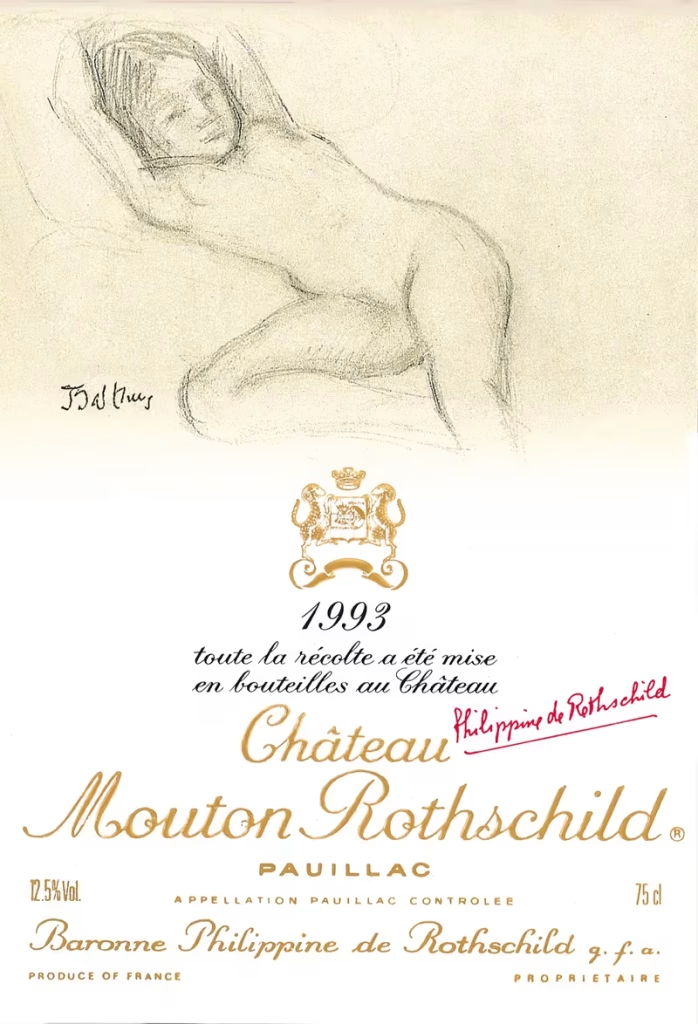
Mouton Rothschild 1993 label
Some disputed labels became famous because of nudity. Others triggered anger through political symbolism, racial insensitivity, or irreverent uses of sacred imagery. In several cases, regulators stepped in. In others, retailers refused to stock the wine, consumers organized boycotts, or courts got involved.
One of the clearest examples is Mouton Rothschild, whose artist-designed labels are legendary. In 1993, the estate released a label created by Balthus featuring a nude adolescent figure. It was accepted in many places as part of the château’s long-standing dialogue with fine art, but US authorities objected. Bottles imported into the United States had to cover the artwork with a blank space. That compromise made the label even more notorious. It also exposed a recurring wine-world friction point: the same image can be celebrated as art in Europe and treated as unacceptable commercial packaging in America.
Another frequent source of controversy is the deliberate use of sexual imagery by smaller producers looking to break from convention. Across the late twentieth and early twenty-first centuries, several wineries released bottles featuring pin-up illustrations, suggestive poses, or names designed to provoke a double take. Some sold briskly on novelty alone. Others were criticized for reducing wine to a joke, especially when the branding felt disconnected from region, craftsmanship, or the character of the estate.
That trade-off matters. Edgy branding may help a bottle stand out in a casual retail environment, but it can also cheapen perceived quality. For producers rooted in place, that can be risky. If a winery wants to build long-term prestige, a scandalous label may create awareness while quietly undermining credibility.
Religious offense has produced even sharper reactions. Labels using saints, crucifixes, nuns, popes, or sacred iconography in ironic or erotic ways have repeatedly drawn backlash. In heavily Catholic regions, these designs can cross a line quickly. Even when the producer intends humor, consumers may see mockery. In those situations, the problem is not just taste – it is whether branding treats living belief systems as aesthetic props.
The wine trade has also had its share of labels accused of racial or colonial insensitivity. Older branding from different eras sometimes leaned on caricatures, exoticized imagery, or romanticized depictions of labor and indigenous identity. What once passed without challenge now reads very differently. Some of these labels have been retired quietly, while others have sparked public criticism that forced wineries to confront the gap between inherited branding and contemporary values.
This is where scandal becomes historically useful. A label is not only a marketing decision. It is a record of what a producer thought was acceptable, aspirational, or saleable at a given moment. Looking back at those bottles can tell us as much about social history as about wine culture.
Art, censorship, and the fine line between gallery and bottle
Wine has long borrowed prestige from the art world. Commissioning an artist, referencing classical painting, or using avant-garde imagery can position a bottle as cultured and collectible. But labels are not hung in museums. They are sold in supermarkets, airport shops, and tasting rooms that serve a broad public.
That distinction explains why censorship disputes recur. Regulators may accept nudity in an art catalog while rejecting it on alcohol packaging. Retailers may fear complaints even when the image is lawful. Producers, meanwhile, often argue that wine belongs to a civilizational tradition in which art, sensuality, and ritual have always intertwined.
Both sides have a case. A winery should not have to flatten its identity for the most conservative shelf standard in the market. At the same time, commercial alcohol packaging reaches audiences who did not consent to a gallery experience. The issue is rarely absolute free expression versus absolute prudishness. More often, it is about context.
When shock sells – and when it backfires
There is no question that controversy can move bottles. A banned label, a social media uproar, or a customs dispute can generate priceless attention. For newer brands, that kind of visibility is tempting.
But shock has a short shelf life. Once the first reaction passes, the wine still has to justify itself. If the bottle feels gimmicky, consumers may buy once and never again. If the scandal appears cynical rather than organic, the brand can look desperate. In tourism-driven regions especially, visitors often want more than a punchline. They want a sense of estate character, landscape, hospitality, and story.
That is why the most enduring labels, even controversial ones, tend to be anchored in something real – a serious artistic program, a coherent house style, or a provocative idea that reflects the producer’s identity. Empty provocation fades quickly. Distinctive vision lasts longer.
What these labels reveal about wine culture
The scandals around wine labels are really arguments about who wine is for. Is it a democratic pleasure that can be playful, irreverent, and modern? Or is it a cultural inheritance that asks for restraint, symbolism, and respect? The answer, of course, is both, depending on the bottle, the region, and the audience.
That is part of what makes wine travel so compelling. Move from Napa to Tuscany, from South Africa to Australia, from Rioja to emerging Eastern European regions, and you find radically different visual languages around wine. Some estates project old-world gravitas. Others embrace contemporary design, humor, or pop culture references. Neither approach is automatically better. What matters is whether the label feels true to the experience in the glass and the place behind it.
For travelers, that makes labels worth paying attention to when visiting wineries. They are small windows into how a producer wants to be understood. A restrained, typographic label may suggest confidence and heritage. A disruptive one may signal experimentation, irreverence, or a break from local tradition. Even before a tasting starts, the bottle is already shaping expectation.
At Wine Tour Searcher, that broader relationship between place, producer identity, and visitor experience is part of the appeal of wine discovery itself. Labels are not the whole story, but they are often the first clue.
The future of controversial wine labels in history
Future scandals will probably look different from past ones. Today, the sharpest scrutiny often centers on cultural appropriation, gender politics, mental health references, environmental claims, and the ethics of using social causes as branding devices. A label no longer has to be explicit to trigger criticism. It simply has to feel careless in a more attentive marketplace.
That may not be bad for wine. The best producers are learning that originality does not require lazy provocation. A label can be bold without being crude, witty without being demeaning, and memorable without borrowing offense as a shortcut. In a crowded global market, that is a more demanding creative standard, but also a more interesting one.
The next time a bottle catches your eye for the wrong reason, pause before dismissing it. Sometimes a scandalous label is just noise. Sometimes it is a clue to changing values, contested histories, or a producer testing the limits of what wine can say before anyone even pours a glass.